agentic ai
Made with DoodleNotes · Oct 24, 2026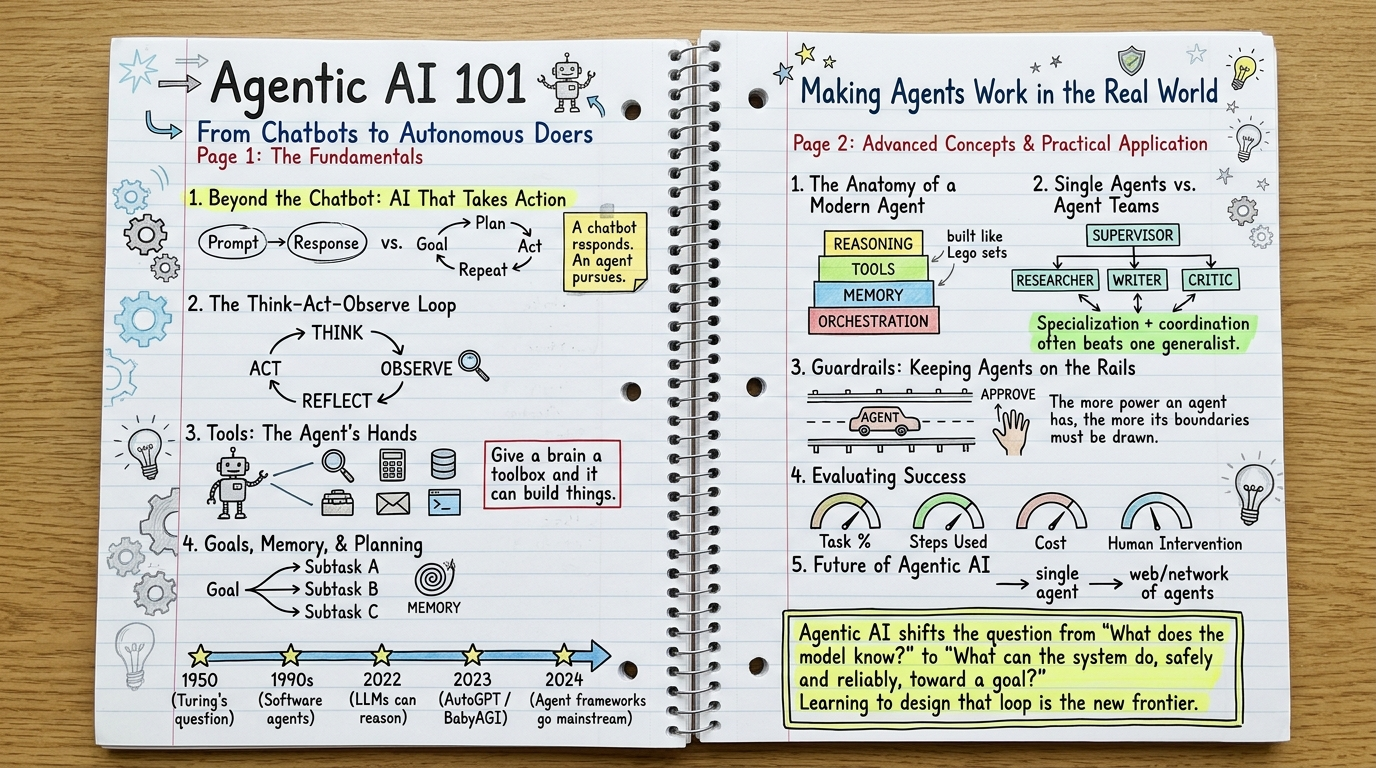
agentic ai
The same content DoodleNotes wrote before drawing it.
Agentic AI 101 → From Chatbots to Autonomous Doers
- 1
Beyond the Chatbot: AI That Takes Action
Traditional AI answers questions and waits for your next prompt. Agentic AI goes a step further: given a goal, it plans the steps needed, uses tools, checks its own progress, and keeps working until the job is done. Think of the difference between a librarian who answers your question and an assistant who goes off and finds every book you need for your research project.
Sticky note: A chatbot responds. An agent pursues.
- 2
The Think-Act-Observe Loop
At the heart of every agent is a loop. The agent reasons about what to do next, takes an action such as searching the web or running code, observes the result, and then decides whether to continue or change course. This cycle repeats until the goal is met, much like a detective who forms a theory, tests it, and revises it based on the clues.
- 3
Tools: The Agent's Hands
A language model on its own can only generate text. Agents become powerful when they are given tools: search engines, calculators, databases, email clients, or code interpreters. The model decides which tool to use, how to call it, and how to interpret the output. Tools turn words into actions in the real world.
Sticky note: Give a brain a toolbox and it can build things.
- 4
Goals, Memory, and Planning
Good agents hold a goal in mind and break it into smaller subtasks. They also remember what they have already tried, using short-term memory within a session and longer-term memory stored between sessions. This combination lets an agent avoid repeating mistakes and stay focused on a multi-step objective.
Timeline: 1950 Turing asks whether machines can think and act intelligently · 1990s Software agents and multi-agent systems emerge in research labs · 2022 Large language models become capable reasoners for the first time at scale · 2023 Projects like AutoGPT and BabyAGI show LLMs running self-directed task loops · 2024 Agent frameworks and tool-use APIs go mainstream in products and enterprises
Making Agents Work in the Real World
- 1
The Anatomy of a Modern Agent
A production agent typically combines four layers: a reasoning model that decides what to do, a set of tools it can call, a memory store that keeps context, and an orchestration layer that manages the loop and enforces limits. Each layer can be swapped or upgraded independently, which is why agent systems are often built like Lego sets rather than monoliths.
- 2
Single Agents vs. Agent Teams
Some tasks are best handled by one agent working alone, while others benefit from a team. In multi-agent systems, specialized agents take on roles such as researcher, writer, and critic, passing work between them. A supervisor agent can coordinate the group, much like a film director guiding actors, cinematographers, and editors toward one finished movie.
Sticky note: Specialization plus coordination often beats one generalist.
- 3
Guardrails: Keeping Agents on the Rails
An agent that can act can also act wrongly. Responsible designs add guardrails such as permission limits on tools, step budgets that stop runaway loops, human approval for high-stakes actions like sending payments, and logging so every decision can be audited. Good guardrails make agents trustworthy enough to use on real tasks.
Sticky note: The more power an agent has, the more carefully its boundaries must be drawn.
- 4
Evaluating an Agent's Success
Judging an agent is harder than grading a single answer because it is the whole path that matters. Teams measure task completion rate, number of steps taken, cost per task, and how often a human needs to intervene. Testing agents on realistic scenarios reveals failure modes such as getting stuck, hallucinating tool results, or misreading instructions.
- 5
Where Agentic AI Is Going
Agents are already handling customer support workflows, software debugging, research synthesis, and personal scheduling. As models get better at long-horizon reasoning and as tool ecosystems grow, agents will take on longer and more complex projects. The central challenge ahead is balancing autonomy with reliability and safety.
Bottom insight: Agentic AI shifts the question from 'What does the model know?' to 'What can the system do, safely and reliably, toward a goal?' Learning to design that loop is the new frontier.
For study only. Check anything you rely on against your textbook.
Studying something else?
Type a topic and get your own hand-drawn page like this one in about 40 seconds.
your turn