GCD C programing
Made with DoodleNotes · Oct 21, 2026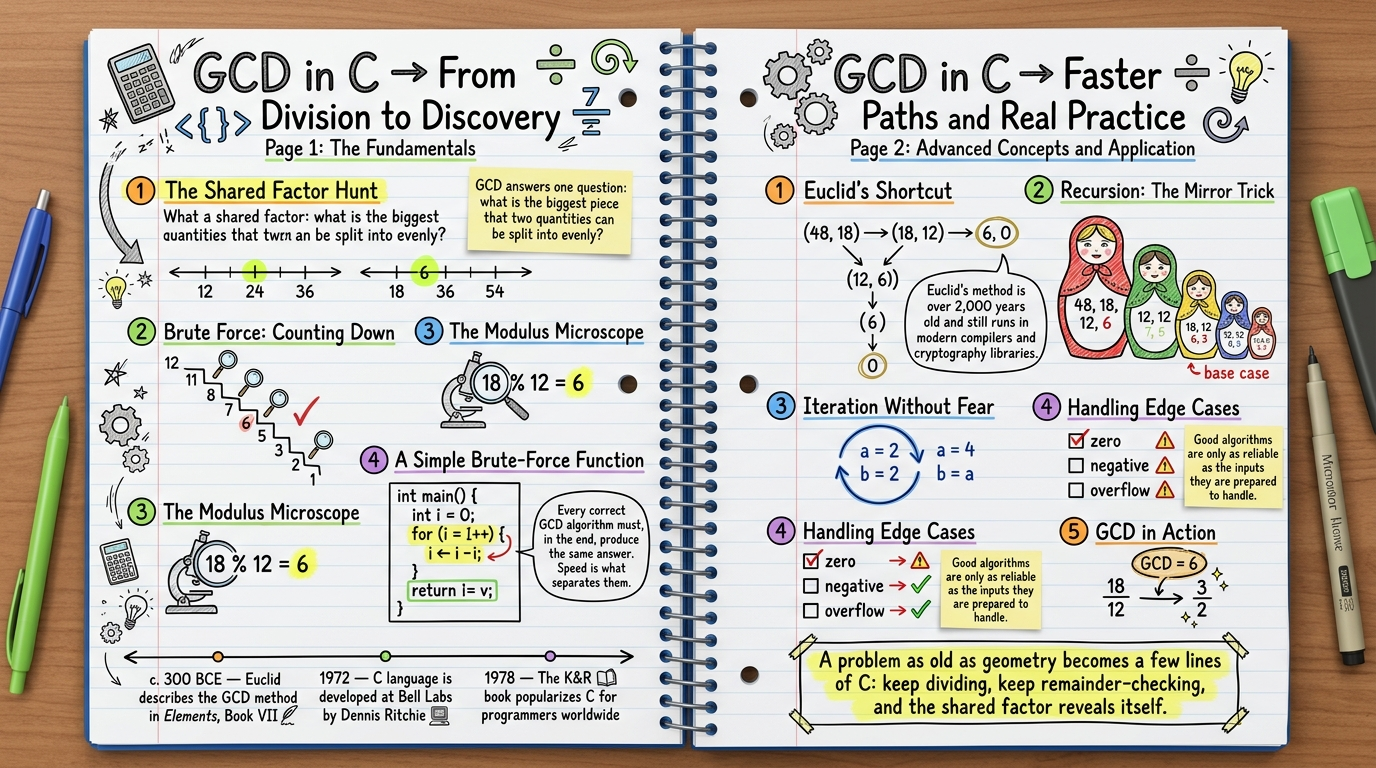
GCD C programing
The same content DoodleNotes wrote before drawing it.
GCD in C → From Division to Discovery
- 1
The Shared Factor Hunt
The Greatest Common Divisor (GCD) of two integers is the largest positive integer that divides both of them without leaving a remainder. For example, the GCD of 12 and 18 is 6, because 6 is the biggest number that fits evenly into both. Finding it is a classic first step in understanding number relationships.
Sticky note: GCD answers one question: what is the biggest piece that two quantities can be split into evenly?
- 2
Brute Force: Counting Down
The simplest C approach starts at the smaller of the two numbers and counts down, checking each candidate with the modulus operator (%). The first number that divides both evenly is the GCD. This method is easy to write and understand, but it can be slow for very large inputs.
- 3
The Modulus Microscope
The % operator returns the remainder after division, and it is the key tool for divisibility checks in C. A value of a % b equal to 0 means b divides a exactly. Understanding this single operator unlocks nearly every GCD algorithm you will write.
- 4
A Simple Brute-Force Function
A basic C function takes two int parameters, loops from the smaller value down to 1, and returns the first i where both a % i and b % i equal zero. The loop guarantees a result because 1 divides every integer. Writing this version first builds intuition before you move to faster methods.
Sticky note: Every correct GCD algorithm must, in the end, produce the same answer. Speed is what separates them.
Timeline: c. 300 BCE Euclid describes the GCD method in Elements, Book VII · 1972 C language is developed at Bell Labs by Dennis Ritchie · 1978 The K&R book popularizes C for programmers worldwide
GCD in C → Faster Paths and Real Practice
- 1
Euclid's Shortcut
Euclid's algorithm replaces the pair (a, b) with (b, a % b) repeatedly until the remainder becomes zero. The last nonzero value is the GCD. Because each step shrinks the numbers rapidly, this method is far faster than counting down, even for very large inputs.
Sticky note: Euclid's method is over 2,000 years old and still runs in modern compilers and cryptography libraries.
- 2
Recursion: The Mirror Trick
Euclid's algorithm can be written recursively in one line: if b is zero, return a; otherwise, call gcd(b, a % b). The function calls itself with smaller arguments until the base case is reached. This version is elegant and mirrors the mathematical definition closely.
- 3
Iteration Without Fear
The same logic can be written as a while loop, which avoids the risk of stack overflow on very deep recursion. A temporary variable or a direct swap-and-modulo pattern keeps the code short. Most production C code prefers this iterative form.
- 4
Handling Edge Cases
Real programs must consider zero, negative numbers, and integer overflow. The GCD of any number and zero is the number itself, and negative inputs are usually converted to their absolute values. Using unsigned types or taking absolute values prevents surprising results.
Sticky note: Good algorithms are only as reliable as the inputs they are prepared to handle.
- 5
GCD in Action
GCD powers everyday tasks such as simplifying fractions, computing least common multiples, and scheduling repeating events. Dividing numerator and denominator by their GCD produces the simplest form of a fraction. Mastering GCD in C gives you a reusable tool for many practical problems.
Bottom insight: A problem as old as geometry becomes a few lines of C: keep dividing, keep remainder-checking, and the shared factor reveals itself.
For study only. Check anything you rely on against your textbook.
Studying something else?
Type a topic and get your own hand-drawn page like this one in about 40 seconds.
your turn