Create AI notes of module1,2,3 based on reema tareja txt book of 1st year 1st sem
Made with DoodleNotes · Oct 22, 2026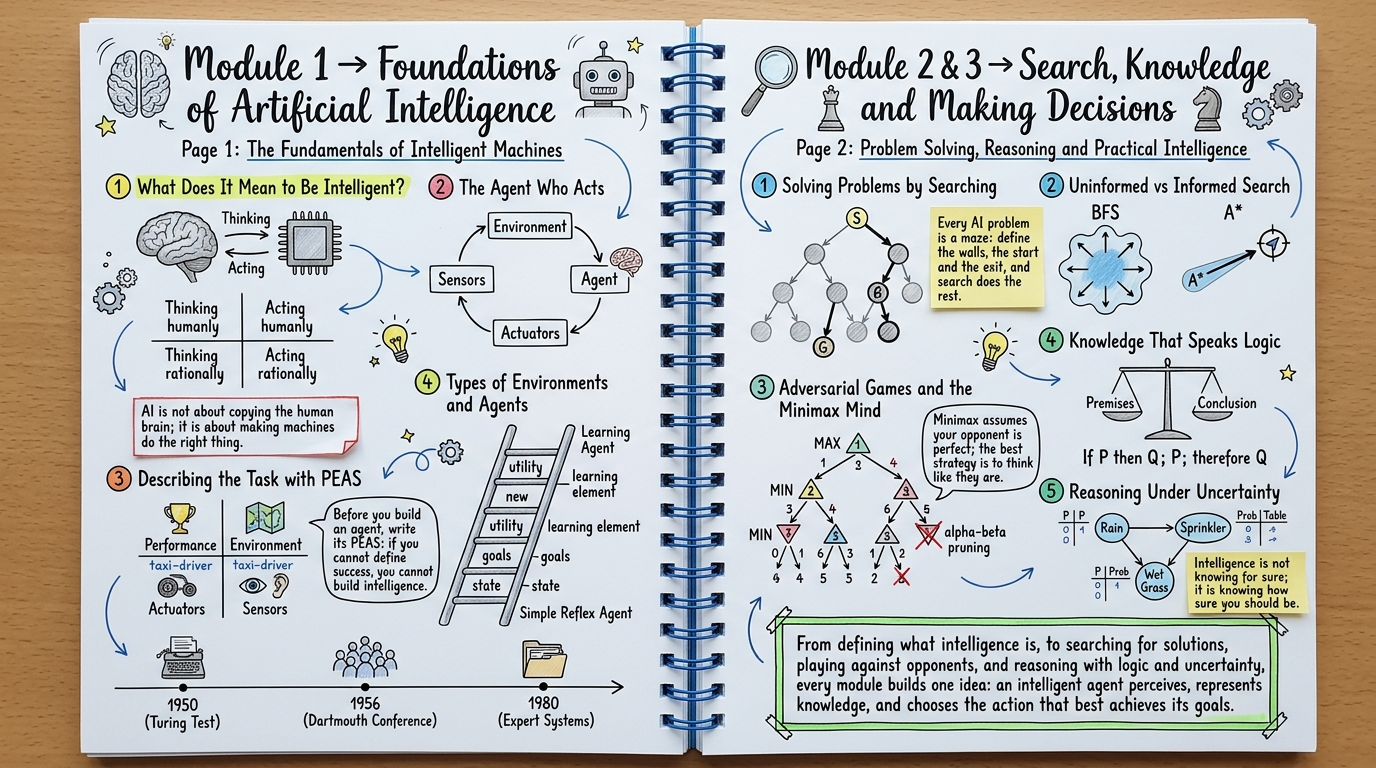
Create AI notes of module1,2,3 based on reema tareja txt book of 1st year 1st sem
The same content DoodleNotes wrote before drawing it.
Module 1 → Foundations of Artificial Intelligence
- 1
What Does It Mean to Be Intelligent?
Artificial Intelligence is the branch of computer science that builds machines capable of performing tasks that normally require human intelligence, such as reasoning, learning, perception, and language understanding. Intelligence in machines is judged by behaviour: a system is intelligent if it acts rationally to achieve its goals. Module 1 introduces the core definitions and the different ways AI has been understood over time.
Sticky note: AI is not about copying the human brain; it is about making machines do the right thing.
- 2
The Agent Who Acts
An agent is anything that perceives its environment through sensors and acts upon that environment through actuators. A rational agent chooses actions that maximise its expected performance measure given what it has perceived. Understanding agents gives us a unified way to describe robots, software bots, and recommendation systems.
- 3
Describing the Task with PEAS
PEAS stands for Performance measure, Environment, Actuators and Sensors. Writing a PEAS description forces us to specify exactly what success looks like and what the agent can see and do. It is the first step in designing any intelligent agent.
Sticky note: Before you build an agent, write its PEAS: if you cannot define success, you cannot build intelligence.
- 4
Types of Environments and Agents
Environments differ in observability, determinism, episodic or sequential structure, static or dynamic nature, and whether they are discrete or continuous. Agents range from simple reflex agents that respond to current percepts, to model-based, goal-based, utility-based and learning agents that become progressively more capable.
Timeline: 1950 Alan Turing proposes the Turing Test in 'Computing Machinery and Intelligence' · 1956 Dartmouth Conference coins the term 'Artificial Intelligence' · 1980 Expert systems become commercially popular
Module 2 & 3 → Search, Knowledge and Making Decisions
- 1
Solving Problems by Searching
Many AI problems can be framed as finding a sequence of actions that leads from an initial state to a goal state. A problem is defined by its states, actions, transition model, goal test and path cost. Search algorithms explore the state space systematically to find a solution path.
Sticky note: Every AI problem is a maze: define the walls, the start and the exit, and search does the rest.
- 2
Uninformed vs Informed Search
Uninformed search strategies such as Breadth-First Search, Depth-First Search and Uniform-Cost Search use no knowledge about how close a state is to the goal. Informed strategies like A* use a heuristic estimate to guide the search, dramatically reducing the number of nodes explored while still finding optimal solutions when the heuristic is admissible.
- 3
Adversarial Games and the Minimax Mind
In two-player games such as chess or tic-tac-toe, one player's gain is the other's loss. The Minimax algorithm assumes both players play optimally, alternating between maximising the agent's score and minimising the opponent's. Alpha-beta pruning removes branches that cannot affect the final decision, making deep game search practical.
Sticky note: Minimax assumes your opponent is perfect; the best strategy is to think like they are.
- 4
Knowledge That Speaks Logic
Knowledge-based agents store facts in a knowledge base and derive new conclusions through inference. Propositional and first-order logic provide a precise language for representing statements, and inference rules such as modus ponens let the agent reason from what it knows to what must follow.
- 5
Reasoning Under Uncertainty
The real world is rarely certain, so agents must reason with probabilities. Bayesian reasoning updates beliefs as new evidence arrives, and Bayesian networks represent dependencies among variables compactly. This is the foundation for diagnosis, spam filtering and many modern learning systems.
Sticky note: Intelligence is not knowing for sure; it is knowing how sure you should be.
Bottom insight: From defining what intelligence is, to searching for solutions, playing against opponents, and reasoning with logic and uncertainty, every module builds one idea: an intelligent agent perceives, represents knowledge, and chooses the action that best achieves its goals.
For study only. Check anything you rely on against your textbook.
Studying something else?
Type a topic and get your own hand-drawn page like this one in about 40 seconds.
your turn