Make notes on Blood typing. Include what are red blood cells, Antigens, antibodies, Rh factor, and who can donate to who
Made with DoodleNotes · Oct 27, 2026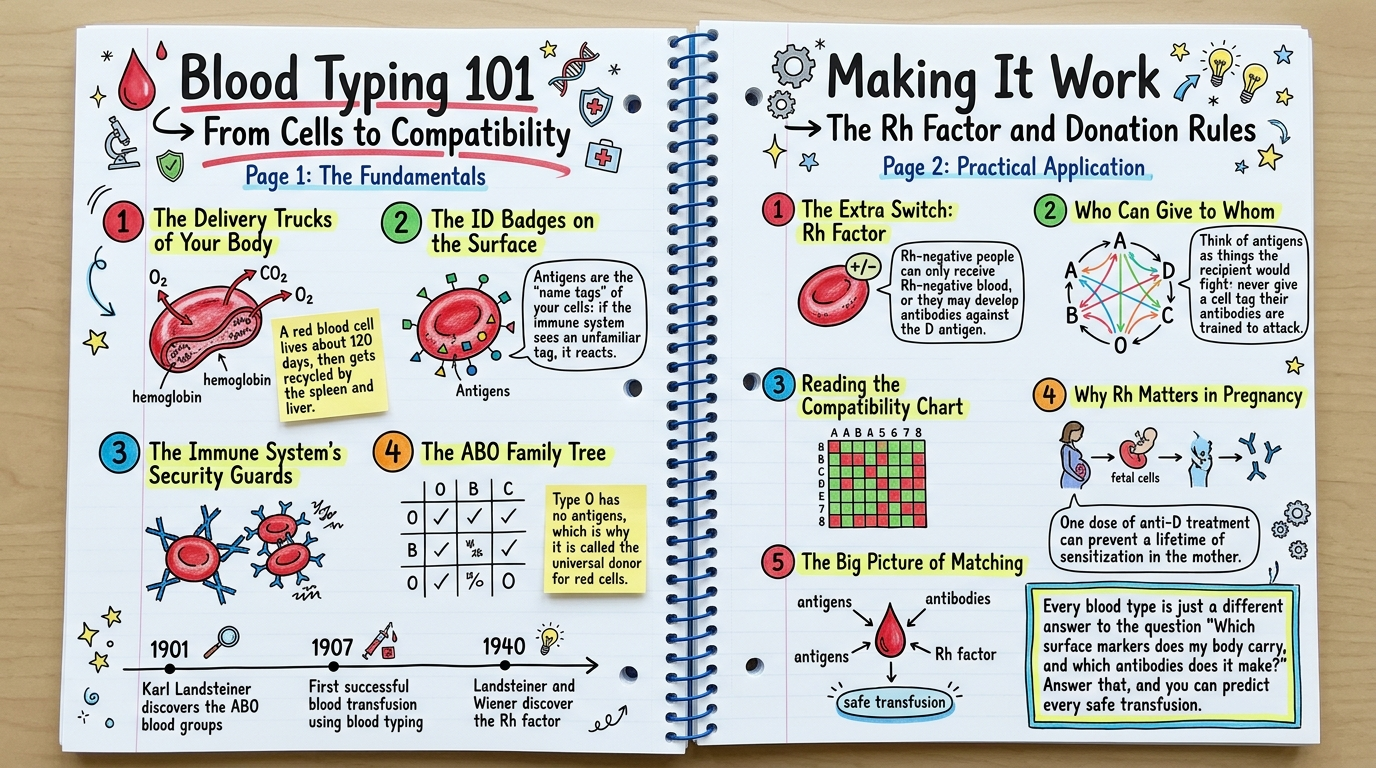
Make notes on Blood typing. Include what are red blood cells, Antigens, antibodies, Rh factor, and who can donate to who
The same content DoodleNotes wrote before drawing it.
Blood Typing 101 → From Cells to Compatibility
- 1
The Delivery Trucks of Your Body
Red blood cells are small, disc-shaped cells that carry oxygen from your lungs to every tissue and carry carbon dioxide back out. They lack a nucleus, which leaves more room for hemoglobin, the iron-rich protein that binds oxygen. Your body makes millions of them every second in the bone marrow.
Sticky note: A red blood cell lives about 120 days, then gets recycled by the spleen and liver.
- 2
The ID Badges on the Surface
Antigens are molecules, usually sugar chains attached to proteins or lipids, that sit on the outer surface of red blood cells. Your immune system uses them to recognize what belongs to your body and what does not. Different blood types are simply different versions of these surface markers.
Sticky note: Antigens are the 'name tags' of your cells: if the immune system sees an unfamiliar tag, it reacts.
- 3
The Immune System's Security Guards
Antibodies are Y-shaped proteins produced by the immune system that bind to specific antigens. If you are exposed to an antigen your body does not carry, your immune system builds antibodies against it. These antibodies then target and clump foreign red blood cells, a reaction called agglutination.
- 4
The ABO Family Tree
The ABO system groups blood by two antigens, A and B. Type A has only A antigens and anti-B antibodies, type B has only B antigens and anti-A antibodies, type AB has both antigens and no antibodies, and type O has neither antigen but both antibodies. These combinations determine which blood types can safely mix.
Sticky note: Type O has no antigens, which is why it is called the universal donor for red cells.
Timeline: 1901 Karl Landsteiner discovers the ABO blood groups · 1907 First successful blood transfusion using blood typing · 1940 Landsteiner and Wiener discover the Rh factor
Making It Work → The Rh Factor and Donation Rules
- 1
The Extra Switch: Rh Factor
The Rh factor is a separate protein on red blood cells, called the D antigen. If you have it, you are Rh-positive; if you lack it, you are Rh-negative. Your full blood type combines your ABO group with this sign, such as A+ or O-.
Sticky note: Rh-negative people can only receive Rh-negative blood, or they may develop antibodies against the D antigen.
- 2
Who Can Give to Whom
For red blood cell transfusions, donor cells must not carry antigens that the recipient's antibodies would attack. Type O-negative is the universal donor, and type AB-positive is the universal recipient. Matching ABO and Rh types keeps the transfusion safe.
Sticky note: Think of antigens as things the recipient would fight: never give a cell tag their antibodies are trained to attack.
- 3
Reading the Compatibility Chart
A quick compatibility table lists which donors work for each recipient. Type A+ can receive from A+, A-, O+, and O-. Type AB- can receive from any Rh-negative type. Checking the chart before transfusion prevents dangerous immune reactions.
- 4
Why Rh Matters in Pregnancy
If an Rh-negative mother carries an Rh-positive baby, some fetal blood may enter her circulation during delivery. Her immune system can then produce anti-D antibodies that threaten future Rh-positive pregnancies. Injections of anti-D immunoglobulin given during pregnancy prevent this.
Sticky note: One dose of anti-D treatment can prevent a lifetime of sensitization in the mother.
- 5
The Big Picture of Matching
Blood typing combines antigens, antibodies, and the Rh factor into a simple system that saves lives every day. Understanding who can donate to whom comes down to one rule: avoid giving cells that the recipient's immune system will attack. Every transfusion is an application of this logic.
Bottom insight: Every blood type is just a different answer to the question 'Which surface markers does my body carry, and which antibodies does it make?' Answer that, and you can predict every safe transfusion.
For study only. Check anything you rely on against your textbook.
Studying something else?
Type a topic and get your own hand-drawn page like this one in about 40 seconds.
your turn