«Вологий запах, запах паші», «Чари ночі», «О слово рідне! Орле скутий!», «Коли б ми плакати могли…», «На камені», «Бояриня», «Так ніхто не кохав…», «Васильки», «Тигролови» короткий зміст і пояснення
Made with DoodleNotes · Oct 27, 2026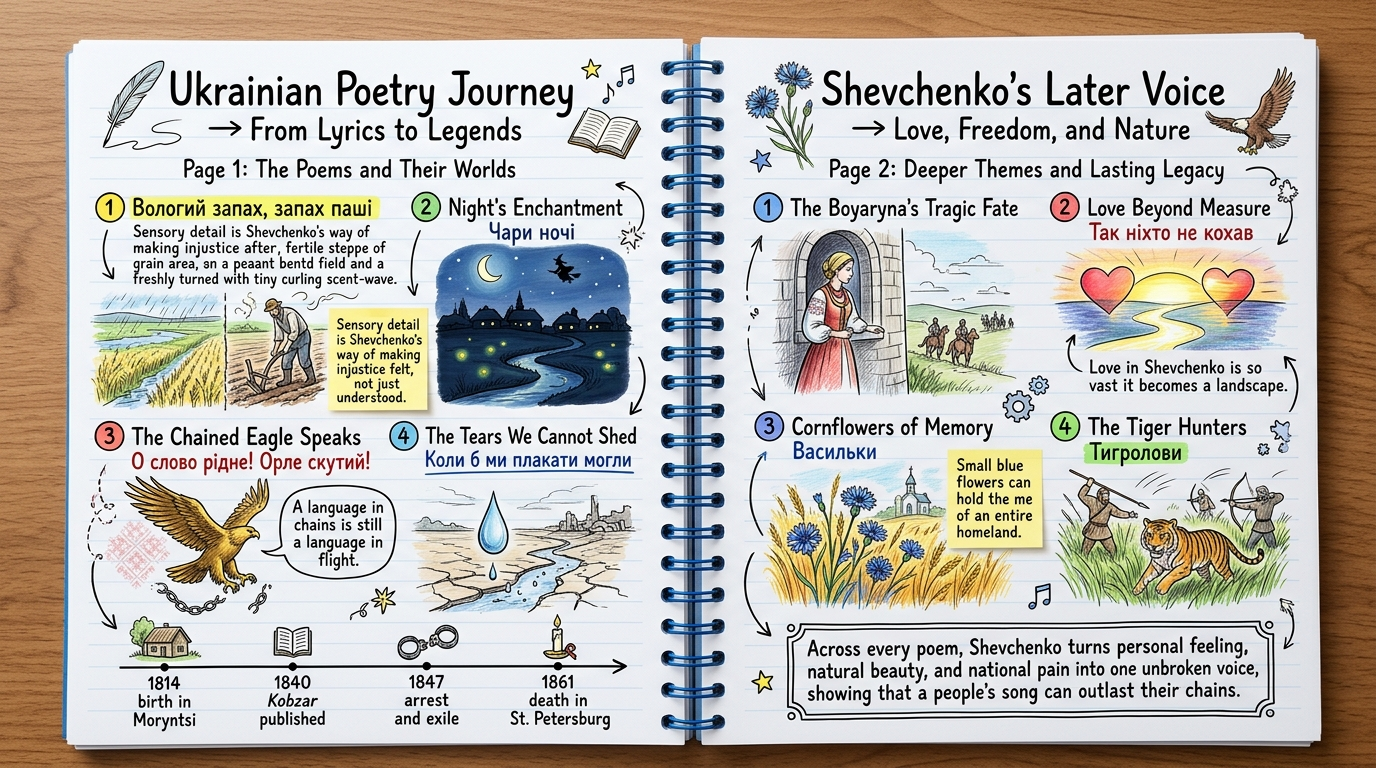
«Вологий запах, запах паші», «Чари ночі», «О слово рідне! Орле скутий!», «Коли б ми плакати могли…», «На камені», «Бояриня», «Так ніхто не кохав…», «Васильки», «Тигролови» короткий зміст і пояснення
The same content DoodleNotes wrote before drawing it.
Ukrainian Poetry Journey → From Lyrics to Legends
- 1
Вологий запах, запах паші
This poem by Taras Shevchenko paints the sensory world of the Ukrainian steppe and its people, evoking the moist, earthy smell of fields and the labor that shapes them. Shevchenko contrasts the natural beauty of the land with the burden of serfdom and hard toil. The poem invites readers to feel the connection between people and their soil.
Sticky note: Sensory detail is Shevchenko's way of making injustice felt, not just understood.
- 2
Night's Enchantment
Чари ночі evokes the magical, mysterious atmosphere of a Ukrainian night, full of folklore, shadows, and spirits. Shevchenko uses the night as a canvas for longing and romantic imagination. The poem blends natural imagery with the supernatural, reflecting the folk traditions he loved.
- 3
The Chained Eagle Speaks
О слово рідне! Орле скутий! is one of Shevchenko's most powerful declarations: the native word is a bird in chains, yet still capable of flight. The poem celebrates the Ukrainian language as a force that cannot be fully silenced, even under imperial suppression. It is both a lament and a call to resistance.
Sticky note: A language in chains is still a language in flight.
- 4
The Tears We Cannot Shed
Коли б ми плакати могли expresses the bitter helplessness of a people who have lost their freedom and cannot even fully mourn it. Shevchenko describes tears that would be too small to wash away the suffering of the nation. The poem turns grief into a moral indictment against those who caused it.
Timeline: 1814 Taras Shevchenko is born in Moryntsi, Ukraine, into a serf family · 1840 Kobzar, his first major collection of poems, is published · 1847 Arrested for his involvement in the Cyril and Methodius Brotherhood and exiled · 1861 Shevchenko dies in St. Petersburg, just before the serfdom reform
Shevchenko's Later Voice → Love, Freedom, and Nature
- 1
The Boyaryna's Tragic Fate
Бояриня tells the story of a noblewoman who waits in vain for her beloved, a Cossack who never returns. Shevchenko uses the ballad form to explore loyalty, longing, and the cruelty of war and fate. The poem carries the emotional weight of Ukrainian folk song into literary art.
- 2
Love Beyond Measure
Так ніхто не кохав speaks of a love so intense that it surpasses anything anyone has ever felt. Shevchenko compares devotion to natural forces, making personal emotion feel cosmic. The poem reveals his tender, almost worshipful side.
Sticky note: Love in Shevchenko is so vast it becomes a landscape.
- 3
Cornflowers of Memory
Васильки is a gentle lyric in which cornflowers stand for innocence, homeland, and youthful memory. Shevchenko recalls the simple joys of the countryside and the people who once filled it. The flowers become a symbol of what has been lost and what must be remembered.
Sticky note: Small blue flowers can hold the memory of an entire homeland.
- 4
The Tiger Hunters
Тигролови is a dramatic narrative poem about hunters who pursue a tiger, using the chase as a metaphor for bravery, pride, and the human struggle against overwhelming forces. Shevchenko's vivid action scenes show his range beyond lyrical and historical themes. The poem rewards readers who enjoy adventure and symbolic depth.
Bottom insight: Across every poem, Shevchenko turns personal feeling, natural beauty, and national pain into one unbroken voice, showing that a people's song can outlast their chains.
For study only. Check anything you rely on against your textbook.
Studying something else?
Type a topic and get your own hand-drawn page like this one in about 40 seconds.
your turnMore from the gallery
See all notes