persuasive speaking
Made with DoodleNotes · Oct 27, 2026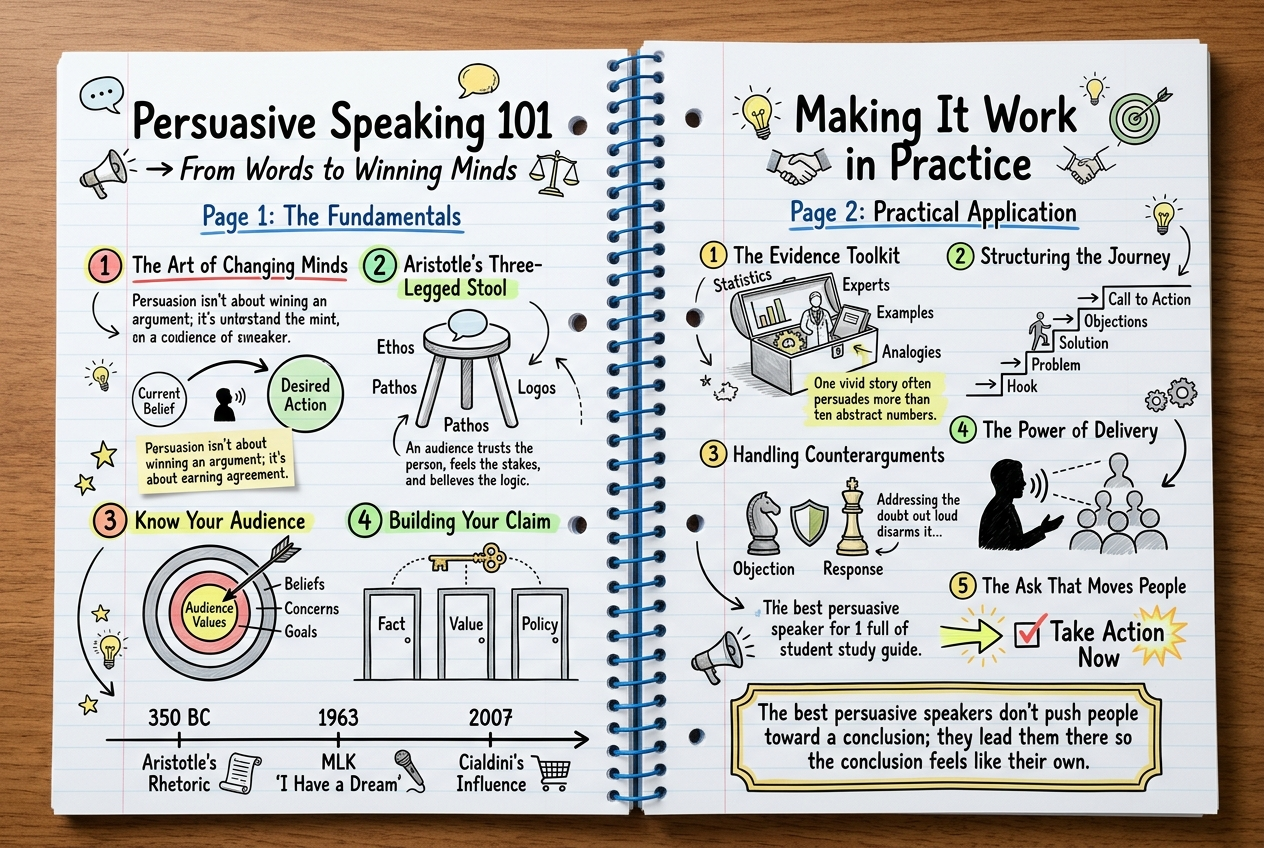
persuasive speaking
The same content DoodleNotes wrote before drawing it.
Persuasive Speaking 101 → From Words to Winning Minds
- 1
The Art of Changing Minds
Persuasive speaking is the craft of guiding an audience toward a belief, decision, or action. Unlike informing, which shares facts, persuasion asks listeners to move from where they are to where you want them to be. Success depends on understanding both your message and the people hearing it.
Sticky note: Persuasion isn't about winning an argument; it's about earning agreement.
- 2
Aristotle's Three-Legged Stool
Over two thousand years ago, Aristotle identified three pillars of persuasion: ethos (your credibility), pathos (emotional connection), and logos (logical reasoning). Strong speakers balance all three rather than leaning on just one. Think of them as legs on a stool: remove one, and the whole thing wobbles.
Sticky note: An audience trusts the person, feels the stakes, and believes the logic.
- 3
Know Your Audience
Every persuasive message must be built for a specific listener. Consider what your audience already values, what they fear, and what they hope for. A message that inspires college students may fall flat with corporate executives. Audience analysis is the quiet work that makes a speech land.
- 4
Building Your Claim
A persuasive speech begins with a clear claim, a single statement you want the audience to accept. Claims come in three types: fact (is it true?), value (is it good or bad?), and policy (what should we do?). Naming your claim type helps you choose the right evidence.
Timeline: 350 Aristotle's Rhetoric defines ethos, pathos, and logos · 1963 Martin Luther King Jr. delivers 'I Have a Dream' blending all three appeals · 2007 Persuasion research by Cialdini expands principles of influence in modern marketing
Making It Work in Practice
- 1
The Evidence Toolkit
Strong persuasion rests on evidence: statistics, expert testimony, real examples, and analogies. Choose sources your audience respects and explain why each piece matters. Vague claims invite doubt, while specific, verifiable details build confidence.
Sticky note: One vivid story often persuades more than ten abstract numbers.
- 2
Structuring the Journey
Persuasive speeches typically follow a path: capture attention, establish the problem, present your solution, address objections, and close with a call to action. This sequence mirrors how people naturally decide. Each stage prepares the audience for the next.
- 3
Handling Counterarguments
Skilled speakers anticipate opposition rather than ignoring it. Name the strongest objection, acknowledge its merit, and then explain why your position still holds. This technique, sometimes called refutation, signals honesty and makes your case harder to dismiss.
Sticky note: Addressing the doubt out loud disarms it before the audience can.
- 4
The Power of Delivery
Your voice, posture, eye contact, and pacing communicate confidence before a single argument lands. Pause after key points so ideas can sink in. Vary your tone to match emotion, and let your body show conviction rather than nervousness.
- 5
The Ask That Moves People
A persuasive speech should end with a specific, achievable call to action. Vague requests like 'think about it' rarely produce change, while clear steps like 'sign this petition today' give listeners a path forward. Make the next step obvious and easy.
Bottom insight: The best persuasive speakers don't push people toward a conclusion; they lead them there so the conclusion feels like their own.
For study only. Check anything you rely on against your textbook.
Studying something else?
Type a topic and get your own hand-drawn page like this one in about 40 seconds.
your turnMore from the gallery
See all notes