Students will need 4 places to take notes on Grimms brothers fairy tales: Rapunzel, Jack Beanstalk, Little Red CAP, and Cinderella. Note characters, setting, conflicts, archetypes, and lessons
Made with DoodleNotes · Oct 26, 2026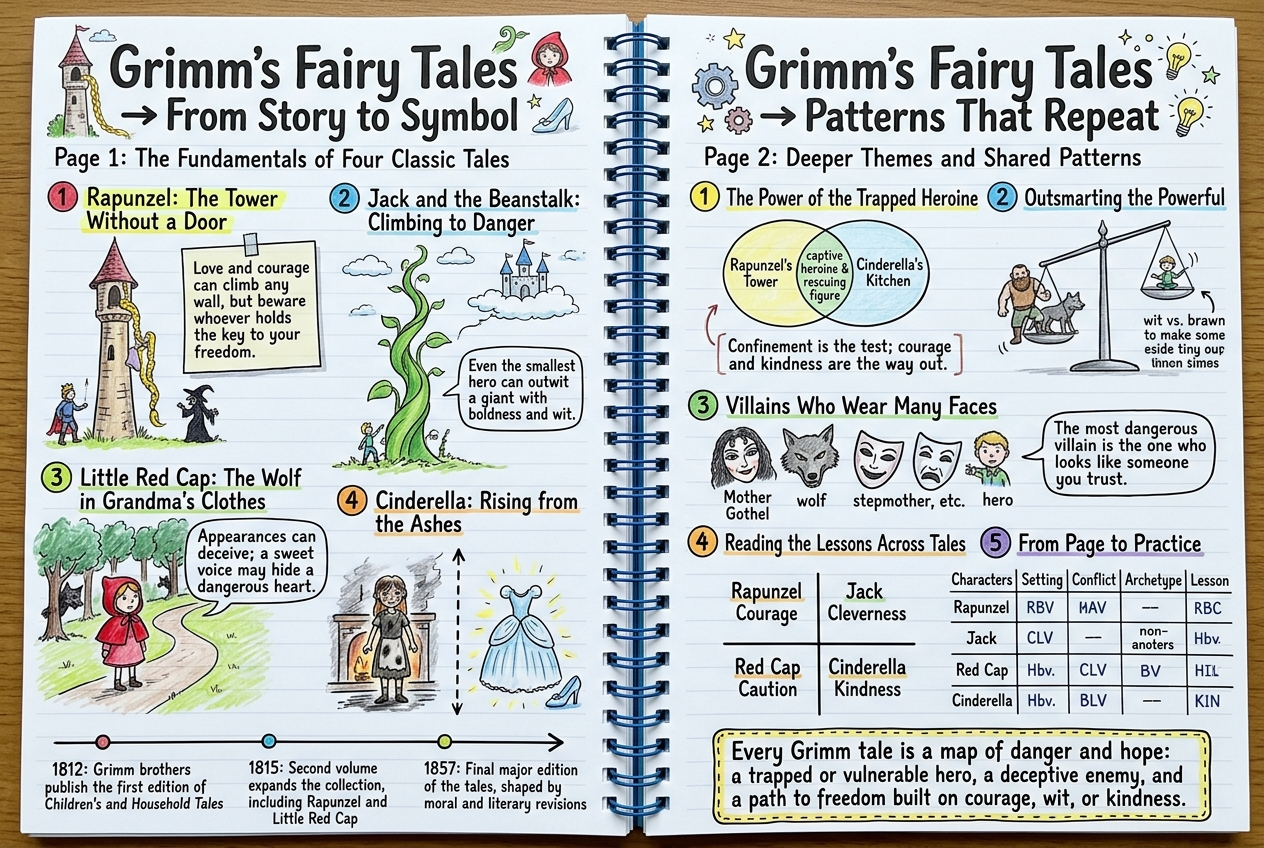
Students will need 4 places to take notes on Grimms brothers fairy tales: Rapunzel, Jack Beanstalk, Little Red CAP, and Cinderella. Note characters, setting, conflicts, archetypes, and lessons
The same content DoodleNotes wrote before drawing it.
Grimm's Fairy Tales → From Story to Symbol
- 1
Rapunzel: The Tower Without a Door
Rapunzel is a young girl with extraordinarily long hair, locked by the sorceress Mother Gothel in a tower with no door or stairs. Characters include Rapunzel, Mother Gothel, and the Prince, who climbs her hair to reach her. The setting is an isolated tower in a dark forest, and the central conflict is Rapunzel's confinement and the struggle to escape a manipulative guardian. Rapunzel's archetype is the Innocent Captive, and the lesson is that trust can be betrayed and that love and courage can break even the strongest walls.
Sticky note: Lesson: Love and courage can climb any wall, but beware whoever holds the key to your freedom.
- 2
Jack and the Beanstalk: Climbing to Danger
Jack trades his family's cow for a handful of magic beans, which grow into a giant beanstalk reaching into the clouds. Characters include Jack, his widowed mother, and the Giant who lives in the sky castle. The setting shifts from a poor village to the sky kingdom, and the conflict is Jack's struggle against the Giant who threatens him. Jack is the Clever Underdog archetype, and the lesson is that bold courage and quick wit can overcome size and strength.
Sticky note: Lesson: Even the smallest hero can outwit a giant with boldness and wit.
- 3
Little Red Cap: The Wolf in Grandma's Clothes
A girl in a red hood travels through the woods to visit her sick grandmother, but meets a cunning wolf who tricks her into revealing her path. Characters include Little Red Cap, her grandmother, and the Wolf. The setting is a dangerous forest between the village and Grandmother's cottage, and the conflict is the girl's vulnerability to deception. Little Red Cap is the Naive Traveler archetype, and the lesson is to stay cautious, listen to warnings, and never trust strangers who seem too friendly.
Sticky note: Lesson: Appearances can deceive; a sweet voice may hide a dangerous heart.
- 4
Cinderella: Rising from the Ashes
Cinderella is mistreated by her stepmother and stepsisters, forced to do all the household chores, until a magical fairy godmother helps her attend a royal ball. Characters include Cinderella, her stepmother and stepsisters, the Fairy Godmother, and the Prince. The setting moves between the cinder-covered kitchen and the glittering palace, and the conflict is oppression by her family and her longing for a better life. Cinderella is the Persecuted Heroine archetype, and the lesson is that kindness and patience are rewarded, and that goodness eventually triumphs over cruelty.
Timeline: 1812 Grimm brothers publish the first edition of Children's and Household Tales · 1815 Second volume expands the collection, including Rapunzel and Little Red Cap · 1857 Final major edition of the tales, shaped by moral and literary revisions
Grimm's Fairy Tales → Patterns That Repeat
- 1
The Power of the Trapped Heroine
Both Rapunzel and Cinderella feature young women confined by others, one physically in a tower and one emotionally by a cruel household. Their stories show how confinement tests character and how external help, whether a prince or a fairy godmother, often arrives to set them free. Comparing these two tales reveals how the same archetype can be expressed in very different settings.
Sticky note: Confinement is the test; courage and kindness are the way out.
- 2
Outsmarting the Powerful
Jack defeats a giant and Little Red Cap must outwit a wolf, showing that weaker characters often triumph through cleverness rather than force. These tales teach that wit can matter more than size. Yet Little Red Cap's story is a warning, showing that cleverness must be paired with caution.
- 3
Villains Who Wear Many Faces
Mother Gothel, the wolf, and the stepmother each use disguise or manipulation to gain power over the heroes. Their deceptions reveal a recurring theme: the most dangerous enemies often appear trustworthy, familiar, or even loving.
Sticky note: The most dangerous villain is the one who looks like someone you trust.
- 4
Reading the Lessons Across Tales
Each tale carries a moral about courage, caution, kindness, or cleverness, and these lessons reflect the values of the societies that told them. Grimm tales often emphasize obedience, justice, and consequences for wrongdoing. Recognizing these lessons helps readers see how stories teach as much as they entertain.
- 5
From Page to Practice
When you take notes on these four tales, track characters, settings, conflicts, archetypes, and lessons side by side. Patterns will emerge that help you compare stories and understand how fairy tales shape cultural memory.
Bottom insight: Every Grimm tale is a map of danger and hope: a trapped or vulnerable hero, a deceptive enemy, and a path to freedom built on courage, wit, or kindness.
For study only. Check anything you rely on against your textbook.
Studying something else?
Type a topic and get your own hand-drawn page like this one in about 40 seconds.
your turnMore from the gallery
See all notes