understanding plot
Made with DoodleNotes · Oct 26, 2026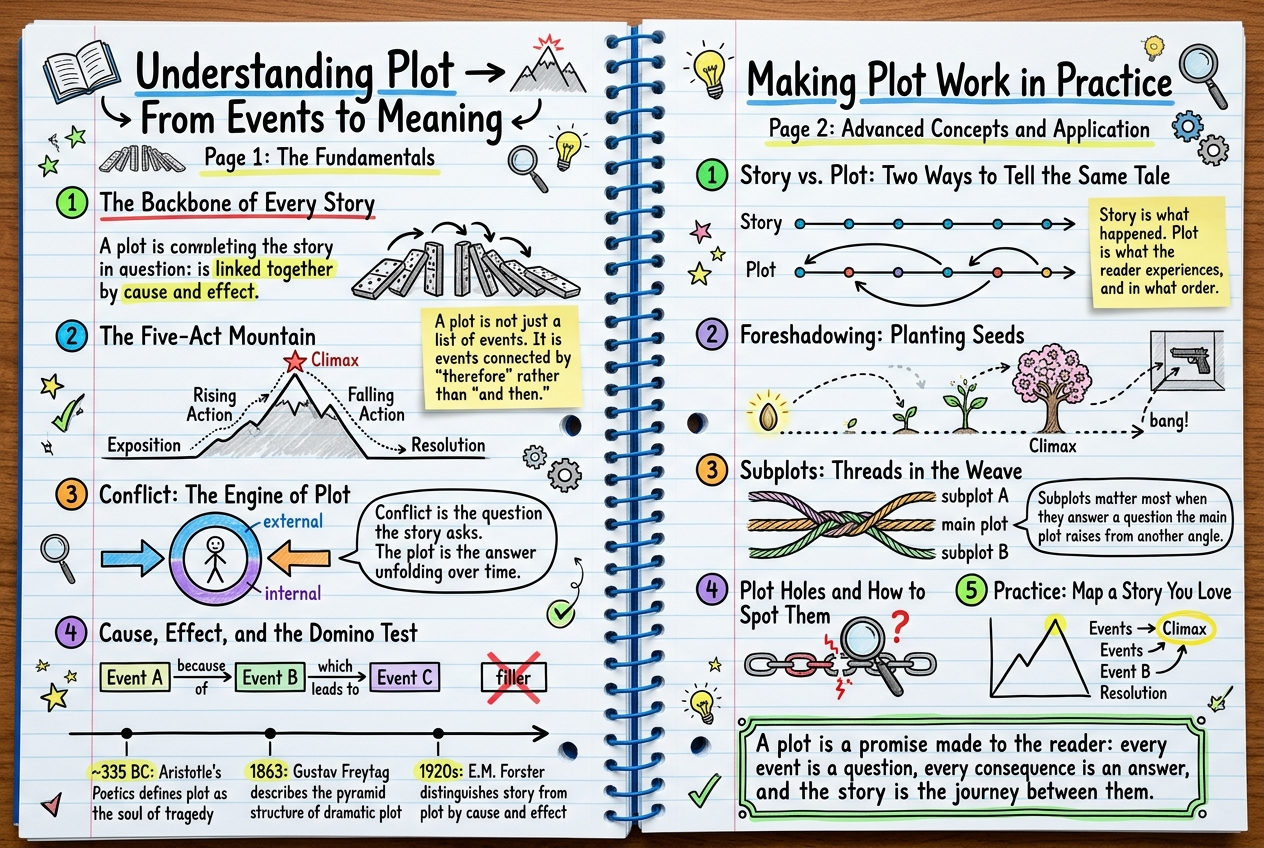
understanding plot
The same content DoodleNotes wrote before drawing it.
Understanding Plot → From Events to Meaning
- 1
The Backbone of Every Story
A plot is the sequence of events that make up a story, linked together by cause and effect. It answers the question 'what happens?' but, more importantly, 'why does it happen?' Each event should lead to the next, so the story feels like a chain rather than a random list.
Sticky note: A plot is not just a list of events. It is events connected by 'therefore' rather than 'and then.'
- 2
The Five-Act Mountain
Most plots follow a basic shape: exposition, rising action, climax, falling action, and resolution. The exposition introduces characters and setting, the rising action builds tension, and the climax is the turning point. The falling action and resolution show the consequences and bring the story to a close.
- 3
Conflict: The Engine of Plot
Without conflict, there is no plot, only description. Conflict is the problem or opposition a character faces, and it creates the question readers want answered: will the character succeed? Conflict can be external, such as a character against a storm or another person, or internal, such as a character battling fear or doubt.
Sticky note: Conflict is the question the story asks. The plot is the answer unfolding over time.
- 4
Cause, Effect, and the Domino Test
A strong plot passes the 'because' test: every major event should happen because of something that came before it. If you can remove an event and the story still works the same way, that event is probably filler. Tight cause-and-effect makes a plot feel inevitable and satisfying.
Timeline: ~335 BC Aristotle's Poetics defines plot as the soul of tragedy · 1863 Gustav Freytag describes the pyramid structure of dramatic plot · 1920s E.M. Forster distinguishes story from plot by cause and effect
Making Plot Work in Practice
- 1
Story vs. Plot: Two Ways to Tell the Same Tale
The story is everything that happened in chronological order, while the plot is how the author chooses to reveal those events. A mystery might begin with the detective arriving at a crime scene, then flash back to reveal earlier events. The same material can produce very different reading experiences depending on its arrangement.
Sticky note: Story is what happened. Plot is what the reader experiences, and in what order.
- 2
Foreshadowing: Planting Seeds
Foreshadowing hints at events to come, creating anticipation and making later developments feel earned rather than arbitrary. A gun hung on the wall in act one should fire by act three. Subtle foreshadowing rewards careful readers and makes a second reading richer.
- 3
Subplots: Threads in the Weave
Subplots are secondary storylines that run alongside the main plot, often mirroring or contrasting it. They deepen themes, develop supporting characters, and give pacing variety. A strong subplot should eventually connect to the main plot rather than floating separately.
Sticky note: Subplots matter most when they answer a question the main plot raises from another angle.
- 4
Plot Holes and How to Spot Them
A plot hole occurs when the story breaks its own logic, such as a character knowing something they should not, or an unexplained event that contradicts earlier rules. Readers forgive a lot, but they notice when cause and effect break down. Checking each major event against the question 'what made this happen?' helps catch these gaps.
- 5
Practice: Map a Story You Love
The best way to understand plot is to take apart a story you already enjoy. Identify the conflict, list the major events, mark the climax, and ask why each event happens. Then try sketching the same story as a chain of causes, and notice where it feels tight and where it wanders.
Bottom insight: A plot is a promise made to the reader: every event is a question, every consequence is an answer, and the story is the journey between them.
For study only. Check anything you rely on against your textbook.
Studying something else?
Type a topic and get your own hand-drawn page like this one in about 40 seconds.
your turnMore from the gallery
See all notes