us open abierto de australia
Made with DoodleNotes · Oct 25, 2026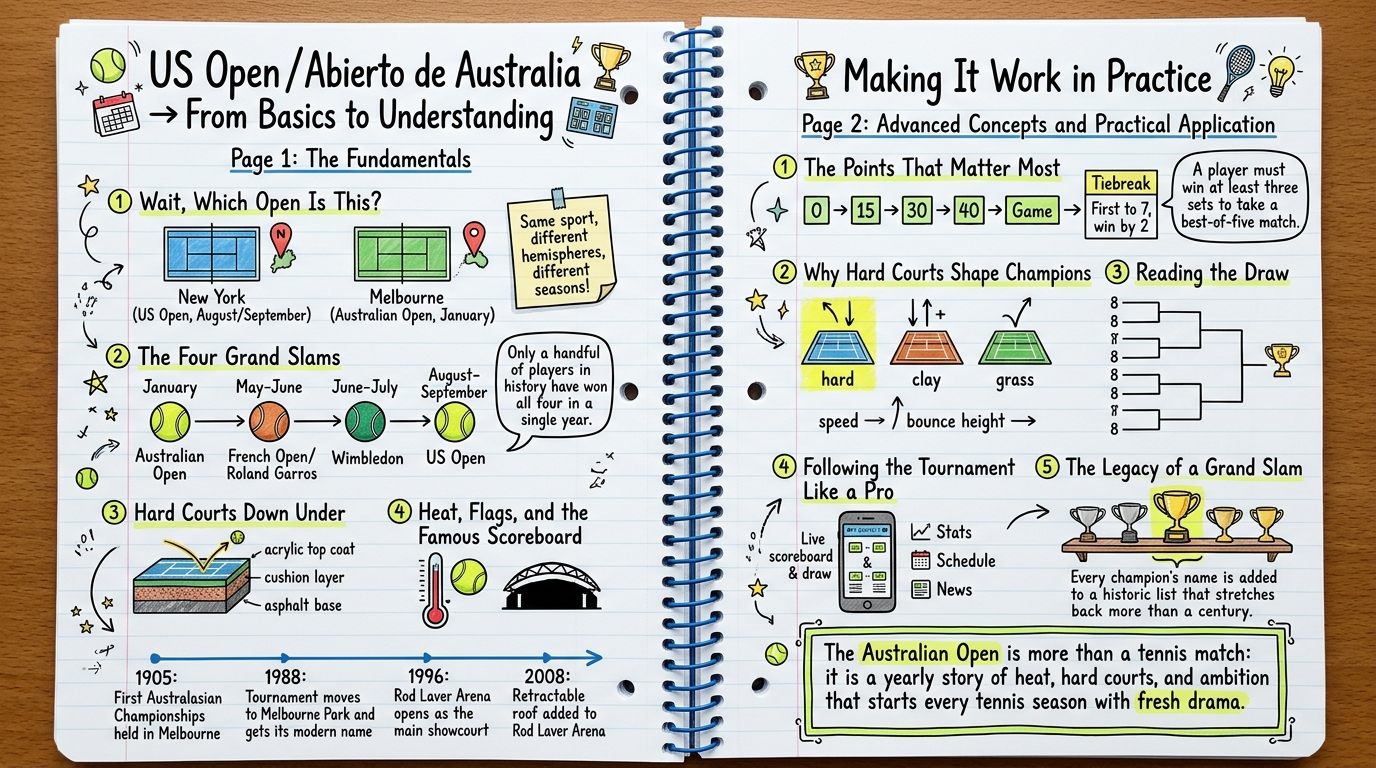
us open abierto de australia
The same content DoodleNotes wrote before drawing it.
US Open Abierto de Australia → From Basics to Understanding
- 1
Wait, Which Open Is This?
The phrase 'US Open Abierto de Australia' mixes two names: 'US Open' is the Grand Slam tennis tournament held in New York, while 'Abierto de Australia' is Spanish for 'Australian Open,' the Grand Slam held in Melbourne. Both are among the four Grand Slam events in tennis. Students often confuse them, so it helps to know which one the phrase refers to before going further.
Sticky note: Same sport, different hemispheres, different seasons!
- 2
The Four Grand Slams
The Grand Slams are the four most prestigious tennis tournaments in the world, played in a fixed yearly order. The Australian Open opens the calendar in January, followed by the French Open (Roland Garros) in May and June, Wimbledon in June and July, and the US Open to close the season in late August and September. Winning all four in one calendar year is called the 'Calendar Grand Slam,' an achievement that is extremely rare.
Sticky note: Only a handful of players in history have won all four in a single year.
- 3
Hard Courts Down Under
The Australian Open is played on hard courts, which use a blue or green acrylic surface that produces a fairly quick, consistent bounce. Unlike grass or clay, hard courts reward powerful serves and fast groundstrokes. Matches are held at Melbourne Park, which has been the site of the tournament since 1988.
- 4
Heat, Flags, and the Famous Scoreboard
Melbourne summers can be extremely hot, so the tournament has a 'Extreme Heat Policy' that can pause play or move matches under a roof. The event is also known for its colorful atmosphere and for the massive Rod Laver Arena, named after the Australian tennis legend who won the Grand Slam in 1962 and 1969.
Timeline: 1905 First Australasian Championships held in Melbourne · 1988 Tournament moves to Melbourne Park and gets its modern name · 1996 Rod Laver Arena opens as the main showcourt · 2008 Retractable roof added to Rod Laver Arena
Making It Work in Practice
- 1
The Points That Matter Most
Grand Slam matches are best-of-five sets for men and best-of-three for women, a format that rewards stamina and consistency. Scoring follows the standard tennis system of 15, 30, 40, and game, with deuce and advantage used when the score is tied at 40-40. Tiebreaks are used in most sets, but the final set in Melbourne has historically had special rules.
Sticky note: A player must win at least three sets to take a best-of-five match.
- 2
Why Hard Courts Shape Champions
Because hard courts play fast and true, they favor players with big serves and aggressive baseline games. Many champions in Melbourne have built their styles around quick footwork and power. Understanding the surface helps explain why certain players dominate here more than at Roland Garros or Wimbledon.
- 3
Reading the Draw
The tournament uses a single-elimination bracket of 128 players in the singles draw, with seeding designed to keep top players apart until later rounds. Each round halves the field until only two players remain for the final. Following a bracket is one of the best ways to track a tournament's story.
- 4
Following the Tournament Like a Pro
To follow the Australian Open effectively, watch the seeding list, track the progress of top players, and note upsets. Official tournament apps and websites provide live scores, draws, and statistics. Learning to read these tools turns a casual viewer into an informed fan.
- 5
The Legacy of a Grand Slam
Winning a Grand Slam is considered one of the highest achievements in tennis, and each title adds to a player's place in history. Records like the most Australian Open titles are tracked closely by fans and analysts. The tournament continues to grow as a showcase of athletic excellence and national pride.
Sticky note: Every champion's name is added to a historic list that stretches back more than a century.
Bottom insight: The Australian Open is more than a tennis match: it is a yearly story of heat, hard courts, and ambition that starts every tennis season with fresh drama.
For study only. Check anything you rely on against your textbook.
Studying something else?
Type a topic and get your own hand-drawn page like this one in about 40 seconds.
your turn