what is doodle notes and what are its benefits
Made with DoodleNotes · Oct 21, 2026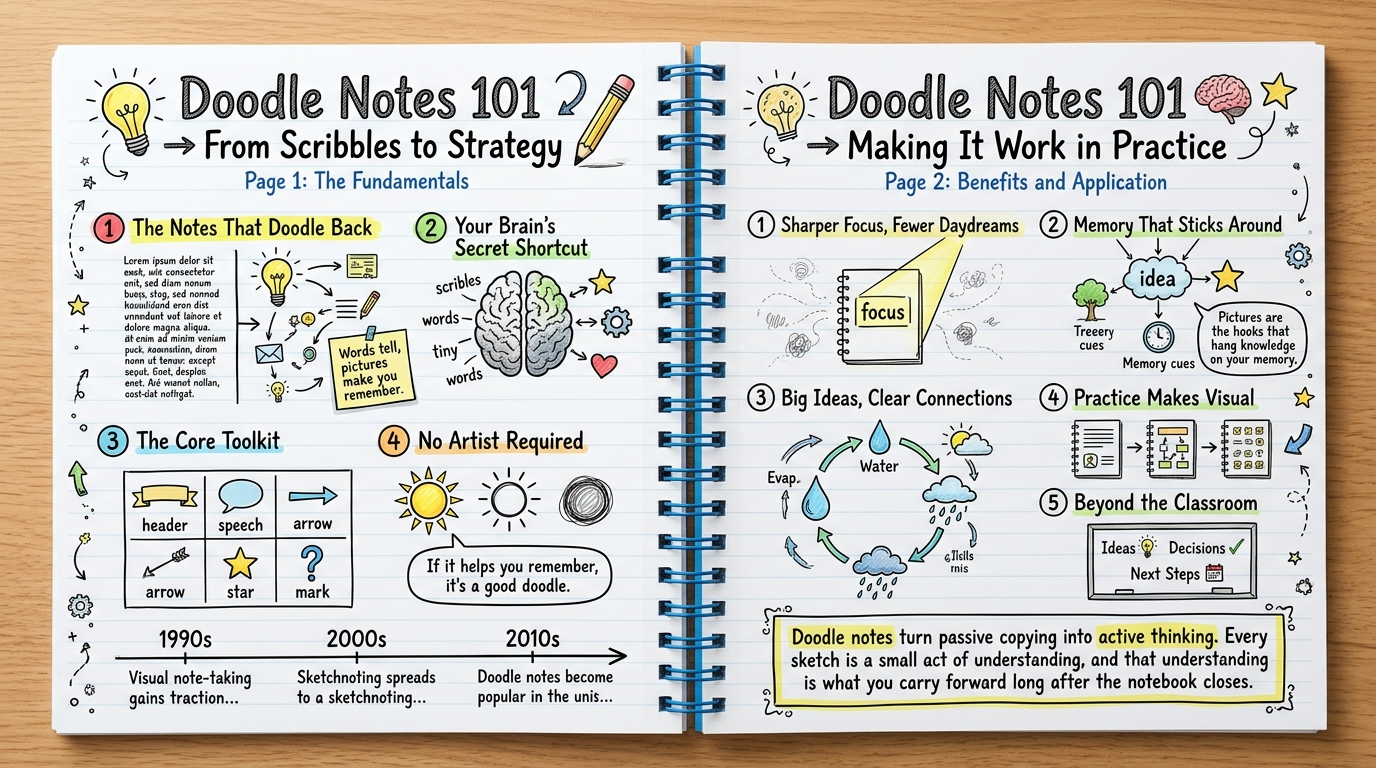
what is doodle notes and what are its benefits
The same content DoodleNotes wrote before drawing it.
Doodle Notes 101 → From Scribbles to Strategy
- 1
The Notes That Doodle Back
Doodle notes are a note-taking method that blends written words with simple drawings, icons, arrows, and shapes. Instead of recording lectures as plain text, you capture ideas visually so your brain processes and stores information in multiple formats at once. The result is notes that feel more like a sketchbook than a transcript.
Sticky note: Words tell, pictures make you remember.
- 2
Your Brain's Secret Shortcut
Doodling while listening keeps your attention engaged rather than drifting. Visual notes also create memorable anchors: when you later glance at a sketch, your brain reconstructs the surrounding ideas far faster than it would from a block of text. This dual coding of words and images is what makes the method so effective.
- 3
The Core Toolkit
Every doodle note relies on a small set of building blocks: headers in bold lettering, boxes or bubbles to group ideas, arrows to show cause and effect, and simple icons such as stars, question marks, and exclamation points. You do not need artistic talent; stick figures and basic shapes are enough. Consistency matters more than detail.
- 4
No Artist Required
Many people hesitate because they believe they cannot draw. Doodle notes are designed for imperfect lines and quick sketches. The goal is to represent meaning, not to create art. A circle with a face or a simple cloud is perfectly valid if it helps you remember the concept.
Sticky note: If it helps you remember, it's a good doodle.
Timeline: 1990s Visual note-taking gains traction in education and design circles · 2000s Sketchnoting spreads through conferences and creative professionals · 2010s Doodle notes become a popular study and productivity technique
Doodle Notes 101 → Making It Work in Practice
- 1
Sharper Focus, Fewer Daydreams
Because doodle notes require you to decide what matters enough to draw, you stay mentally active during a lecture or meeting. This active filtering reduces passive listening and mind-wandering. Students often report that they follow the material more closely when their hands are busy translating ideas into visuals.
- 2
Memory That Sticks Around
Visual notes give your memory more hooks to grab. A concept tied to an image, a color, and a position on the page is easier to recall than an abstract sentence. Reviewing doodle notes before an exam is quick, because the pictures jog your memory of the explanations around them.
Sticky note: Pictures are the hooks that hang knowledge on your memory.
- 3
Big Ideas, Clear Connections
Doodle notes make relationships visible. Arrows, boxes, and spatial layout reveal how concepts connect, which is difficult to see in linear text. This makes them especially useful for processes, systems, and comparisons where understanding the structure matters as much as the facts.
- 4
Practice Makes Visual
Start small by doodling only headings and key terms, then gradually add icons and connections as you get comfortable. Use a consistent set of symbols across subjects so your notes become easy to scan. Over time, building your personal visual vocabulary becomes second nature.
- 5
Beyond the Classroom
Doodle notes are not limited to school. Professionals use them in meetings, workshops, and brainstorming sessions to capture ideas quickly and share them visually. Anyone who needs to learn, remember, or communicate complex information can benefit from this approach.
Bottom insight: Doodle notes turn passive copying into active thinking. Every sketch is a small act of understanding, and that understanding is what you carry forward long after the notebook closes.
For study only. Check anything you rely on against your textbook.
Studying something else?
Type a topic and get your own hand-drawn page like this one in about 40 seconds.
your turn