Advantages and disadvantages of organisation
Made with DoodleNotes · Oct 29, 2026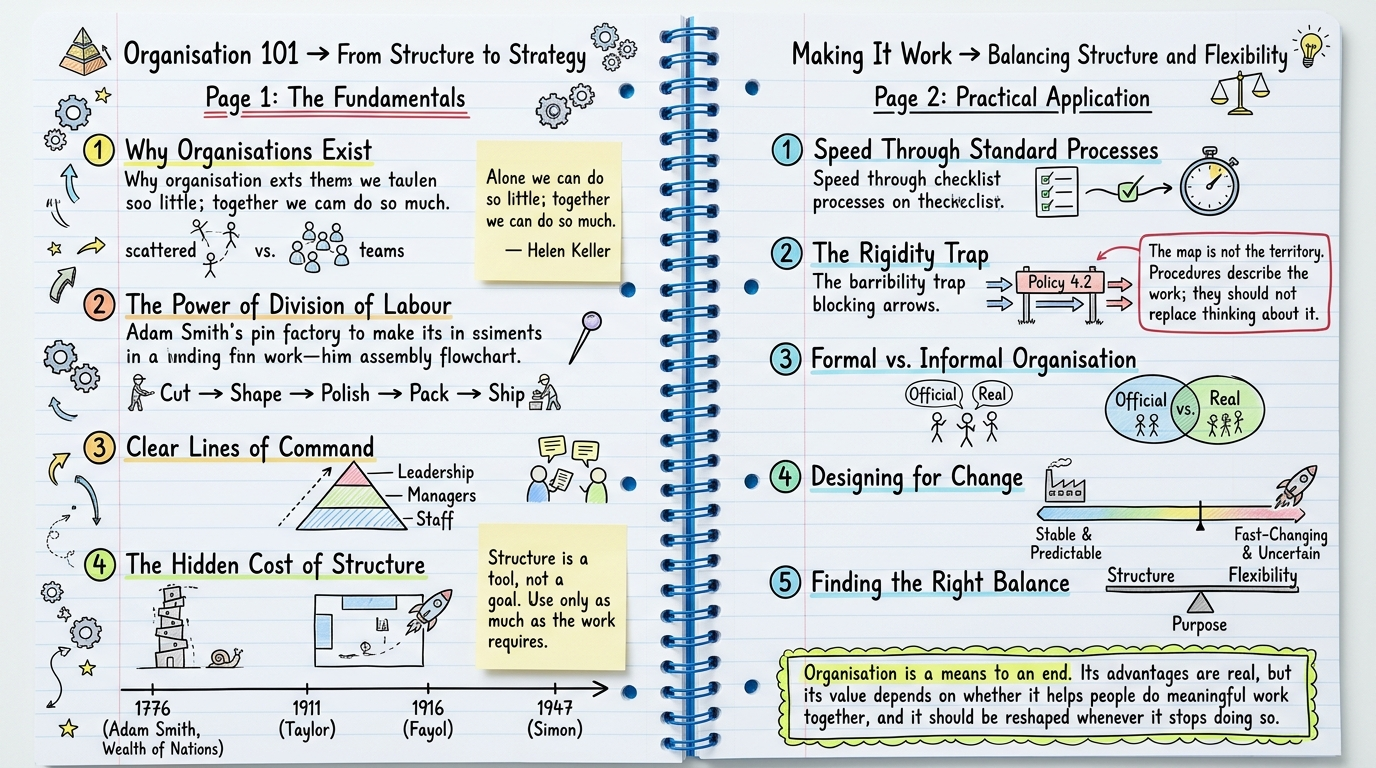
Advantages and disadvantages of organisation
The same content DoodleNotes wrote before drawing it.
Organisation 101 → From Structure to Strategy
- 1
Why Organisations Exist
An organisation is a group of people working together toward shared goals that none of them could easily achieve alone. Organising these people into roles, teams and rules turns scattered effort into coordinated action. Think of it as the difference between a crowd and a well-rehearsed orchestra.
Sticky note: Alone we can do so little; together we can do so much. - Helen Keller
- 2
The Power of Division of Labour
When work is split into specialised tasks, each person can become highly skilled at their part. Adam Smith illustrated this with a pin factory, where ten workers producing pins individually made only a few each day, but divided into specialised steps they produced tens of thousands. Specialisation is one of the core advantages organisation creates.
- 3
Clear Lines of Command
A well-structured organisation shows who reports to whom, so everyone knows where to take a question and who makes the final decision. This reduces confusion, speeds up decisions, and keeps accountability visible. Without it, two people may be told to do opposite things on the same day.
- 4
The Hidden Cost of Structure
Every layer of hierarchy, every rule and every approval step adds time and cost. Organisations that grow without care can become slow, bureaucratic and full of paperwork that no longer serves its purpose. Recognising this early is the first step toward healthier structures.
Sticky note: Structure is a tool, not a goal. Use only as much as the work requires.
Timeline: 1776 Adam Smith publishes The Wealth of Nations, popularising division of labour · 1911 Frederick Taylor's Principles of Scientific Management shapes factory organisation · 1916 Henri Fayol defines the core functions of management and organisational structure · 1947 Herbert Simon introduces ideas on bounded rationality within organisations
Making It Work → Balancing Structure and Flexibility
- 1
Speed Through Standard Processes
Standard procedures let people repeat good practice without reinventing it every time. New staff can learn faster, quality becomes more consistent, and routine decisions take minutes instead of meetings. Standardisation is a major advantage of a well-organised system.
- 2
The Rigidity Trap
The same structure that brings order can resist change. When rules are followed blindly, people may ignore a better idea because 'that's not how we do it here.' Organisations facing new markets or technologies can find their own systems holding them back.
Sticky note: The map is not the territory. Procedures describe the work; they should not replace thinking about it.
- 3
Formal vs. Informal Organisation
Every organisation has two structures: the official chart on paper and the informal networks where people really get things done. Friendships, shared lunches and quick chats often solve problems faster than any formal channel. Good leaders notice both and support the useful parts of each.
- 4
Designing for Change
Modern organisations increasingly use flatter structures, cross-functional teams and project-based work to stay responsive. These designs trade some stability for speed and adaptability. The best choice depends on how predictable the environment is and how much coordination the work requires.
- 5
Finding the Right Balance
The goal is not maximum structure or minimum structure, but the right amount for the task. Enough organisation to coordinate, specialise and stay accountable; enough freedom to adapt, experiment and learn. Striking this balance is an ongoing skill, not a one-time decision.
Bottom insight: Organisation is a means to an end. Its advantages are real, but its value depends on whether it helps people do meaningful work together, and it should be reshaped whenever it stops doing so.
For study only. Check anything you rely on against your textbook.
Studying something else?
Type a topic and get your own hand-drawn page like this one in about 40 seconds.
your turn