Disadvantages of organisation
Made with DoodleNotes · Oct 29, 2026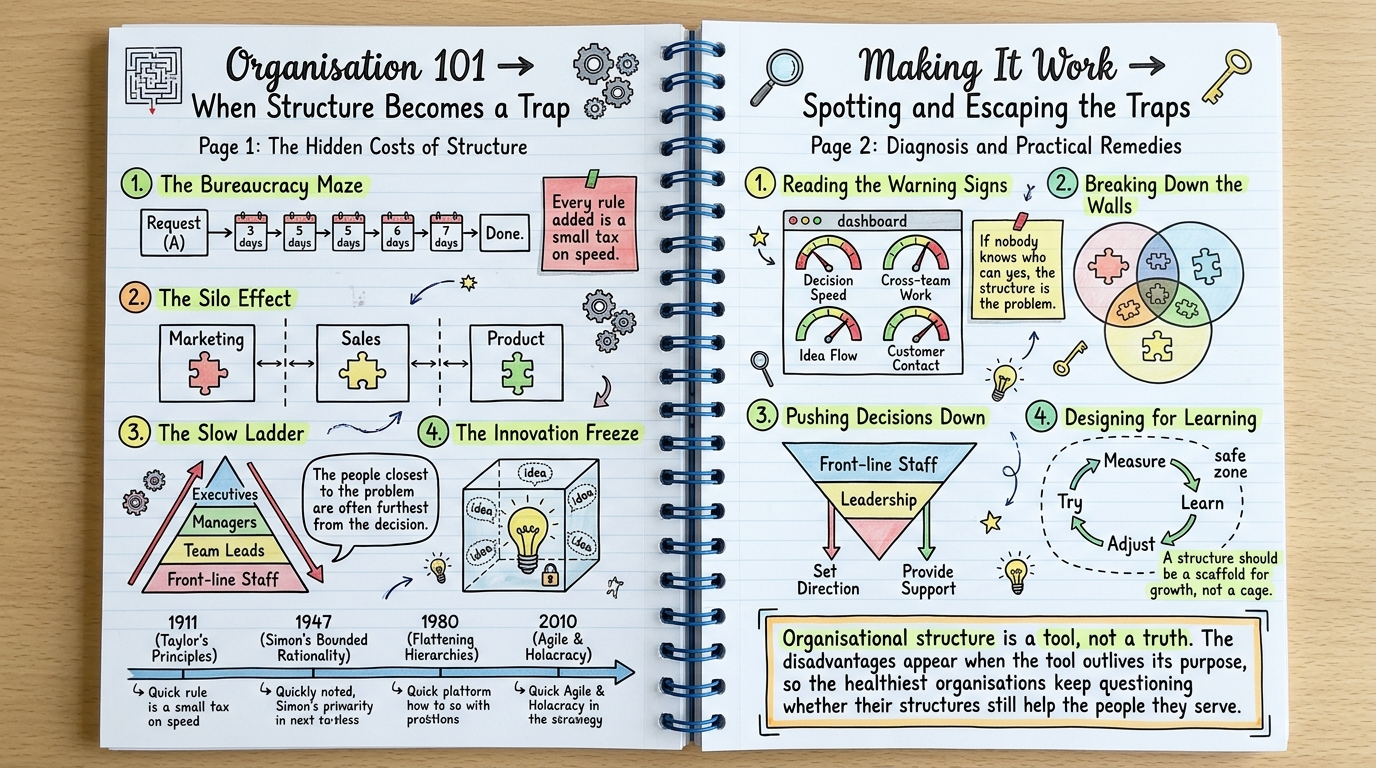
Disadvantages of organisation
The same content DoodleNotes wrote before drawing it.
Organisation 101 → When Structure Becomes a Trap
- 1
The Bureaucracy Maze
As organisations grow, they add layers of rules, approvals, and paperwork. What began as a way to keep things consistent can turn into a maze where simple decisions take weeks. Employees spend more time navigating procedures than doing the actual work.
Sticky note: Every rule added is a small tax on speed.
- 2
The Silo Effect
Departments often build their own walls, sharing information only when forced to. Marketing, sales, and product teams may each hold a piece of the customer story but never see the whole picture. This fragmentation leads to duplicated work and conflicting goals.
- 3
The Slow Ladder
Traditional hierarchies concentrate decisions at the top. Information must travel up the chain, and instructions must travel back down, which slows everything. Front-line staff who know the customer best often have the least power to act.
Sticky note: The people closest to the problem are often furthest from the decision.
- 4
The Innovation Freeze
When success is measured by following procedure, people learn that taking risks is dangerous. New ideas get filtered out before they reach anyone who could test them. Over time, the organisation becomes excellent at repeating yesterday's methods and poor at imagining tomorrow's.
Timeline: 1911 Frederick Taylor publishes Principles of Scientific Management, promoting rigid process control · 1947 Herbert Simon describes bounded rationality, showing how complex structures limit decisions · 1980 Western firms begin widespread restructuring to flatten hierarchies after competition from leaner rivals · 2010 Agile and holacracy movements challenge traditional command-and-control structures
Making It Work → Spotting and Escaping the Traps
- 1
Reading the Warning Signs
Organisations rarely announce their problems. Look for signs such as meetings that exist only to approve other meetings, projects stalled for months awaiting sign-off, or staff who say 'that's not my department' when a customer problem arises. These symptoms reveal structural friction before it shows up in the financial results.
Sticky note: If nobody knows who can say yes, the structure is the problem.
- 2
Breaking Down the Walls
Cross-functional teams bring people from different departments together around a shared goal. Regular mixing of roles, shared objectives, and open information systems help silos dissolve. The aim is to make collaboration the default rather than the exception.
- 3
Pushing Decisions Down
Empowering front-line teams with clear boundaries lets them act without waiting for permission. Leaders shift from approving decisions to setting direction and guardrails. This works best when people understand the purpose behind the rules, not just the rules themselves.
- 4
Designing for Learning
Organisations can protect experimentation with small safe-to-fail pilots, blameless post-mortems, and time budgeted for trying new things. Rewarding learning from failure makes it possible to discover what works. Structure then serves the work instead of controlling it.
Sticky note: A structure should be a scaffold for growth, not a cage.
Bottom insight: Organisational structure is a tool, not a truth. The disadvantages appear when the tool outlives its purpose, so the healthiest organisations keep questioning whether their structures still help the people they serve.
For study only. Check anything you rely on against your textbook.
Studying something else?
Type a topic and get your own hand-drawn page like this one in about 40 seconds.
your turn