Advantages of organisation
Made with DoodleNotes · Oct 29, 2026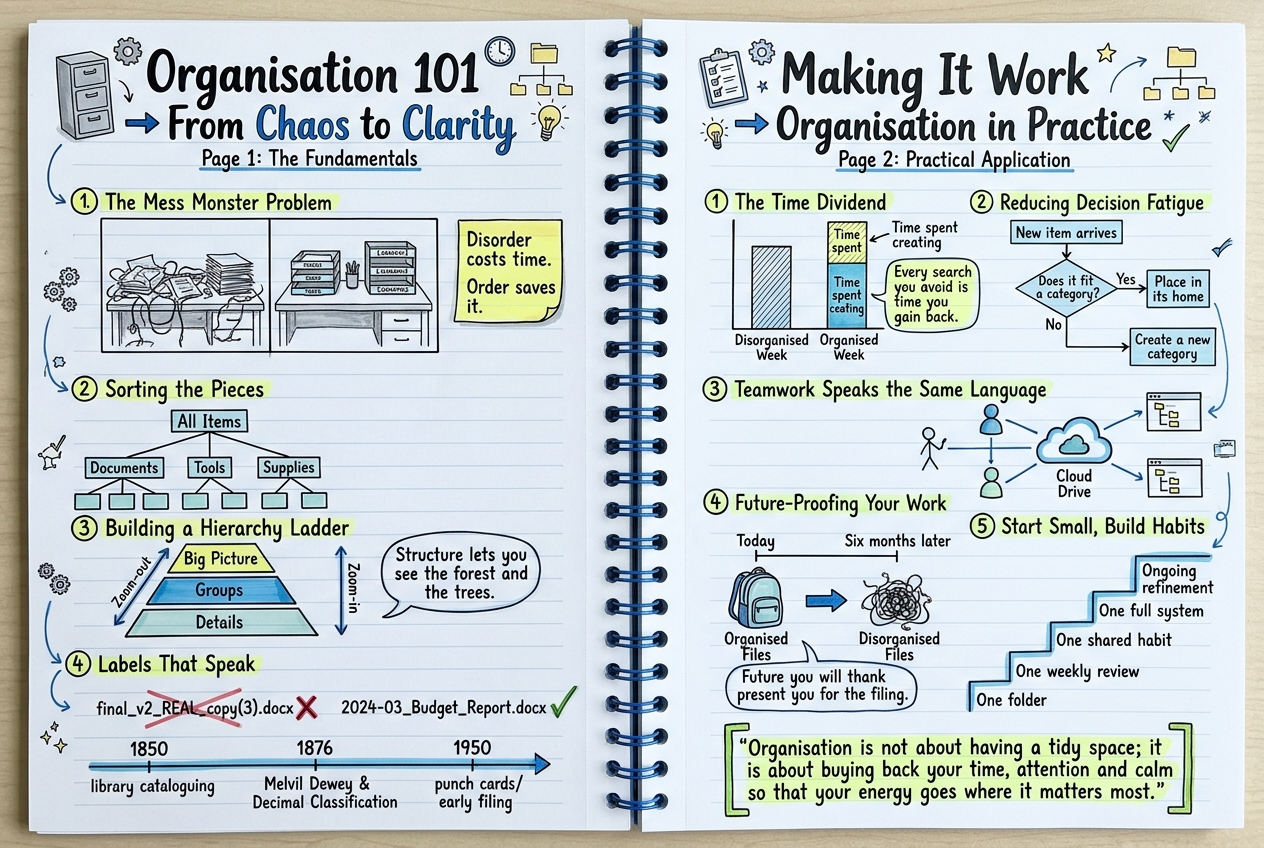
Advantages of organisation
The same content DoodleNotes wrote before drawing it.
Organisation 101 → From Chaos to Clarity
- 1
The Mess Monster Problem
Without organisation, information, time and resources pile up into a tangled mess that wastes energy and hides what matters. Organising means deliberately arranging things so that each item has a clear place, purpose and relationship to the others. The result is a system that works for you instead of against you.
Sticky note: Disorder costs time. Order saves it.
- 2
Sorting the Pieces
Good organisation starts with categorising: grouping similar things together based on a shared feature such as type, date, priority or function. Clear categories make it easy to find what you need and to notice what is missing. Choosing the right categories is often the hardest and most important step.
- 3
Building a Hierarchy Ladder
Organisation works best when information is arranged in levels, from broad groups at the top to specific details at the bottom. This structure lets you zoom out for the big picture or zoom in for detail without getting lost. Think of it like a filing cabinet: drawers, folders, then individual pages.
Sticky note: Structure lets you see the forest and the trees.
- 4
Labels That Speak
A label is a promise: it tells you exactly what lies inside without you having to open it. Clear, consistent naming conventions, such as dates written in the same format or files named by topic first, make retrieval fast and reliable. Vague labels like 'misc' or 'stuff' defeat the whole purpose.
Timeline: 1850 Dewey-style library cataloguing ideas begin to emerge as collections outgrow memory · 1876 Melvil Dewey publishes the Decimal Classification system · 1950 Punch cards and early filing systems bring structured data into offices
Making It Work → Organisation in Practice
- 1
The Time Dividend
When things are organised, you spend less time searching and more time doing. Studies of workplace productivity consistently find that people lose significant portions of their week hunting for information they already have. Each minute saved on retrieval compounds into hours over a term or a year.
Sticky note: Every search you avoid is time you gain back.
- 2
Reducing Decision Fatigue
A well-organised system makes choices automatic. When your study notes, tasks and materials have predetermined homes, you stop spending mental energy deciding where things go or what to do next. This frees your attention for thinking, learning and creative work.
- 3
Teamwork Speaks the Same Language
Shared organisation lets groups collaborate without confusion. When everyone uses the same folder structure, naming pattern and tagging method, handovers become smooth and nobody has to ask 'where is that?' Consistency is what turns individual habits into team strength.
- 4
Future-Proofing Your Work
Organised information is easier to review, update, back up and pass on. Good structure makes it possible to revisit old projects, spot patterns across records and recover quickly after a lost device or missed deadline. Organisation today is a gift to your future self.
Sticky note: Future you will thank present you for the filing.
- 5
Start Small, Build Habits
You do not need a perfect system on day one. Begin by organising one area, such as your inbox or your notes for a single subject, then review it weekly and refine as you go. Small, regular tidy-ups keep chaos from returning and turn organisation into a natural habit.
Bottom insight: Organisation is not about having a tidy space; it is about buying back your time, attention and calm so that your energy goes where it matters most.
For study only. Check anything you rely on against your textbook.
Studying something else?
Type a topic and get your own hand-drawn page like this one in about 40 seconds.
your turn