Economic Security in India
Made with DoodleNotes · Oct 28, 2026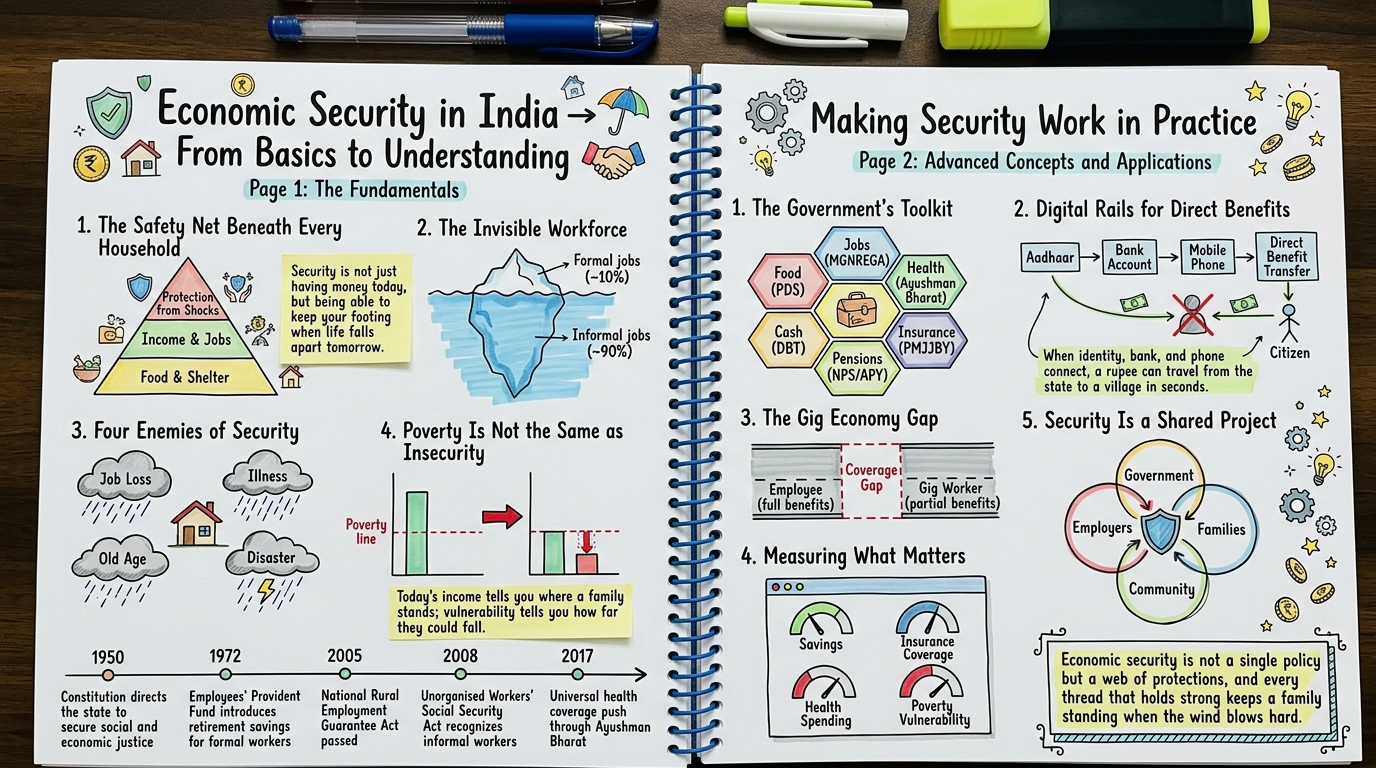
Economic Security in India
The same content DoodleNotes wrote before drawing it.
Economic Security in India → From Basics to Understanding
- 1
The Safety Net Beneath Every Household
Economic security means having a stable income, access to basic necessities, and protection against sudden shocks like illness, job loss, or crop failure. In India, where a large share of the population works in informal jobs, this security is often fragile. Understanding it is the first step to seeing why governments design welfare programs the way they do.
Sticky note: Security is not just having money today, but being able to keep your footing when life falls apart tomorrow.
- 2
The Invisible Workforce
Roughly 90 percent of India's workers are in the informal economy, meaning they lack contracts, paid leave, pensions, or social insurance. Daily-wage laborers, street vendors, and farm workers face income that changes from week to week. This makes budgeting and saving extremely difficult for millions of families.
- 3
Four Enemies of Security
Economic insecurity usually arrives through four channels: job loss, illness, old age without savings, and natural disasters such as floods or droughts. Each can push a family from stability into poverty within a single season. Recognizing these risks helps explain why insurance, pensions, and public support matter so much.
- 4
Poverty Is Not the Same as Insecurity
A family can be above the poverty line and still be economically insecure if one bad event could drag them below it. Security measures how vulnerable a household is to future shocks, not only how much it earns today. This distinction shapes how economists measure well-being in India.
Sticky note: Today's income tells you where a family stands; vulnerability tells you how far they could fall.
Timeline: 1950 Constitution directs the state to secure social and economic justice · 1972 Employees' Provident Fund introduces retirement savings for formal workers · 2005 National Rural Employment Guarantee Act passed · 2008 Unorganised Workers' Social Security Act recognizes informal workers · 2017 Universal health coverage push through Ayushman Bharat
Making Security Work in Practice
- 1
The Government's Toolkit
India uses a mix of tools to protect citizens: direct cash transfers, subsidized food through the Public Distribution System, rural employment guarantees, and health insurance schemes. Each tool targets a different kind of risk, and together they form a layered defense. No single program can protect everyone on its own.
- 2
Digital Rails for Direct Benefits
The India Stack, built on Aadhaar identity, bank accounts, and mobile phones, lets benefits reach people directly without many middlemen. This reduces leakage and speeds up payments during crises. Digital identity has become a foundation for almost every modern welfare delivery system.
Sticky note: When identity, bank, and phone connect, a rupee can travel from the state to a village in seconds.
- 3
The Gig Economy Gap
Platform workers such as delivery riders and ride-hailing drivers are changing how Indians earn, yet they often fall between existing laws. They may be classified as independent contractors, leaving them without standard social security coverage. Policymakers are now debating how to extend protections without stifling flexible work.
- 4
Measuring What Matters
Economists track security using indicators such as household savings rates, share of workers with social insurance, out-of-pocket health spending, and vulnerability to poverty over time. These measures show whether programs actually reduce risk, not just whether they spend money. Better data leads to better targeting of help.
- 5
Security Is a Shared Project
Economic security depends on governments, employers, families, and communities working together. Public programs set the floor, private employers can add benefits, and families build buffers through savings and mutual support. Strengthening any one layer makes the whole system more resilient.
Bottom insight: Economic security is not a single policy but a web of protections, and every thread that holds strong keeps a family standing when the wind blows hard.
For study only. Check anything you rely on against your textbook.
Studying something else?
Type a topic and get your own hand-drawn page like this one in about 40 seconds.
your turn