algebra 1 functions, vertical line test
Made with DoodleNotes · Oct 28, 2026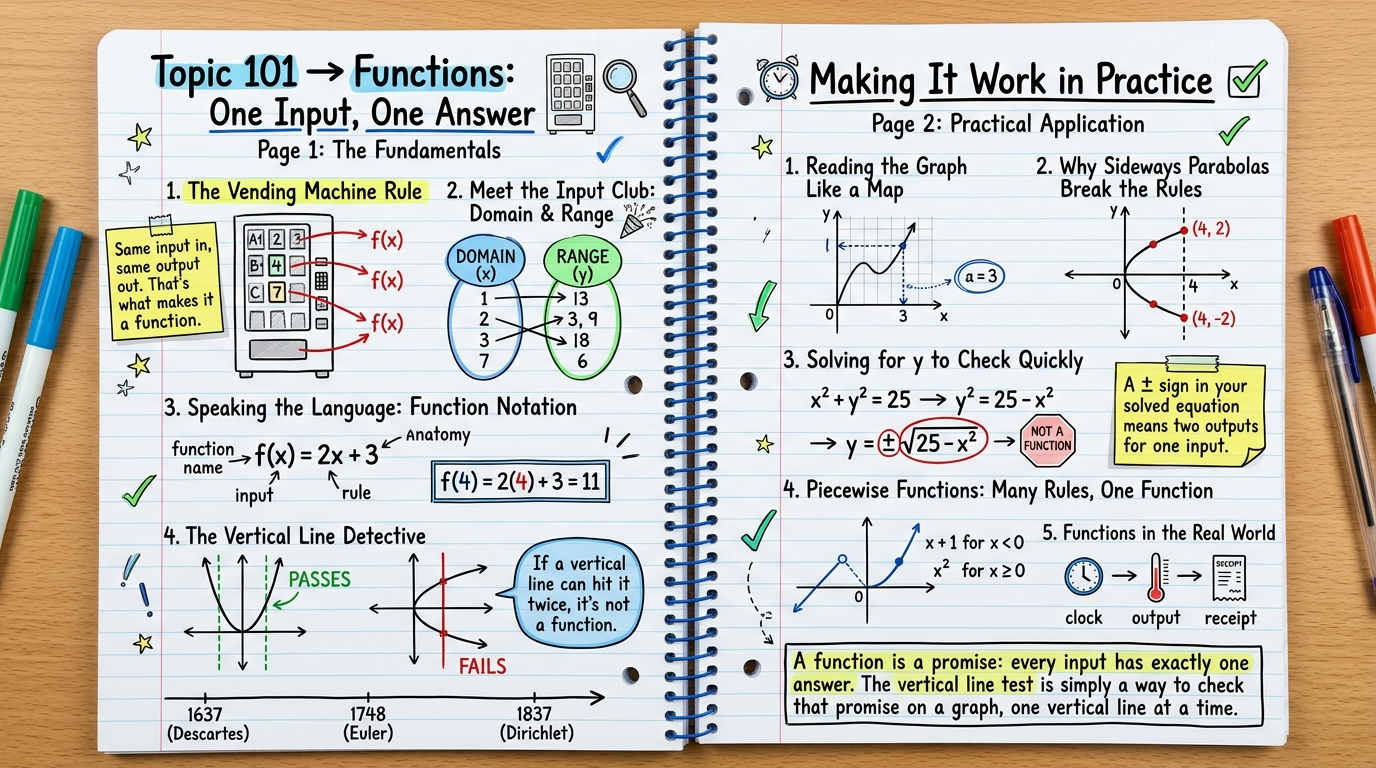
algebra 1 functions, vertical line test
The same content DoodleNotes wrote before drawing it.
Topic 101 → Functions: One Input, One Answer
- 1
The Vending Machine Rule
A function is a rule that takes an input and produces exactly one output. Press the button for B4 and you get one specific snack, never two different ones at once. In algebra, we write f(x) to show that the output depends on the input x. This one-to-one-output idea is the heart of everything in functions.
Sticky note: Same input in, same output out. That's what makes it a function.
- 2
Meet the Input Club: Domain and Range
The domain is the full set of x-values you are allowed to plug into a function, while the range is the set of all outputs you can actually get back. Think of the domain as the guest list at a party and the range as the set of drinks being served. Some functions restrict the domain, such as square roots that can't take negative numbers.
- 3
Speaking the Language: Function Notation
Instead of writing y = 2x + 3 every time, mathematicians write f(x) = 2x + 3. The letter f is just a name for the function, and the parentheses hold the input. So f(4) means replace every x with 4, giving 2(4) + 3 = 11. Reading f(4) as 'f of 4' helps you see that you are evaluating, not multiplying.
- 4
The Vertical Line Detective
Before you can trust a graph to be a function, you need to check it. The vertical line test asks whether any vertical line drawn anywhere on the graph crosses it more than once. If a vertical line hits the graph in two or more places, one input has two outputs, so it is not a function. A circle fails the test; a parabola passes.
Sticky note: If a vertical line can hit it twice, it's not a function.
Timeline: 1637 Descartes links algebra and geometry, making graphs of equations possible · 1748 Euler formalizes the modern idea of a function as a rule relating variables · 1837 Dirichlet gives the definition close to what we use today: each input maps to exactly one output
Making It Work in Practice
- 1
Reading the Graph Like a Map
A graph is a picture of every input-output pair a function produces. To find f(3) on a graph, start at x = 3 on the horizontal axis, move straight up to the curve, then read the y-value. The vertical line test is really asking whether that trip upward hits the curve only once.
- 2
Why Sideways Parabolas Break the Rules
The parabola x = y² opens to the right, so for most x-values there are two y-values, one positive and one negative. Try x = 4: y could be 2 or -2. That double answer is exactly what the vertical line test catches. Flipping the roles of x and y often turns a function into a non-function.
- 3
Solving for y to Check Quickly
When an equation is hard to picture, solve it for y. If solving gives you a single expression like y = 2x + 1, it's a function. If you need a ± sign, as in y = ±√x, you get two outputs and it fails. The ± symbol is the algebraic warning sign of a vertical line test failure.
Sticky note: A ± sign in your solved equation means two outputs for one input.
- 4
Piecewise Functions: Many Rules, One Function
A piecewise function uses different rules for different parts of the domain, such as f(x) = x + 1 when x < 0 and f(x) = x² when x ≥ 0. It is still a function as long as each x-value gets exactly one rule applied. Overlapping pieces that give two answers at the same x would break the rule.
- 5
Functions in the Real World
Every time your phone's clock shows a time, that is a function: each moment maps to one display. Temperature over a day, the price of an item at checkout, and the distance traveled over time all behave as functions. Recognizing this is the first step to modeling real problems with algebra.
Bottom insight: A function is a promise: every input has exactly one answer. The vertical line test is simply a way to check that promise on a graph, one vertical line at a time.
For study only. Check anything you rely on against your textbook.
Studying something else?
Type a topic and get your own hand-drawn page like this one in about 40 seconds.
your turnMore from the gallery
See all notes