basic maths class 11
Made with DoodleNotes · Oct 29, 2026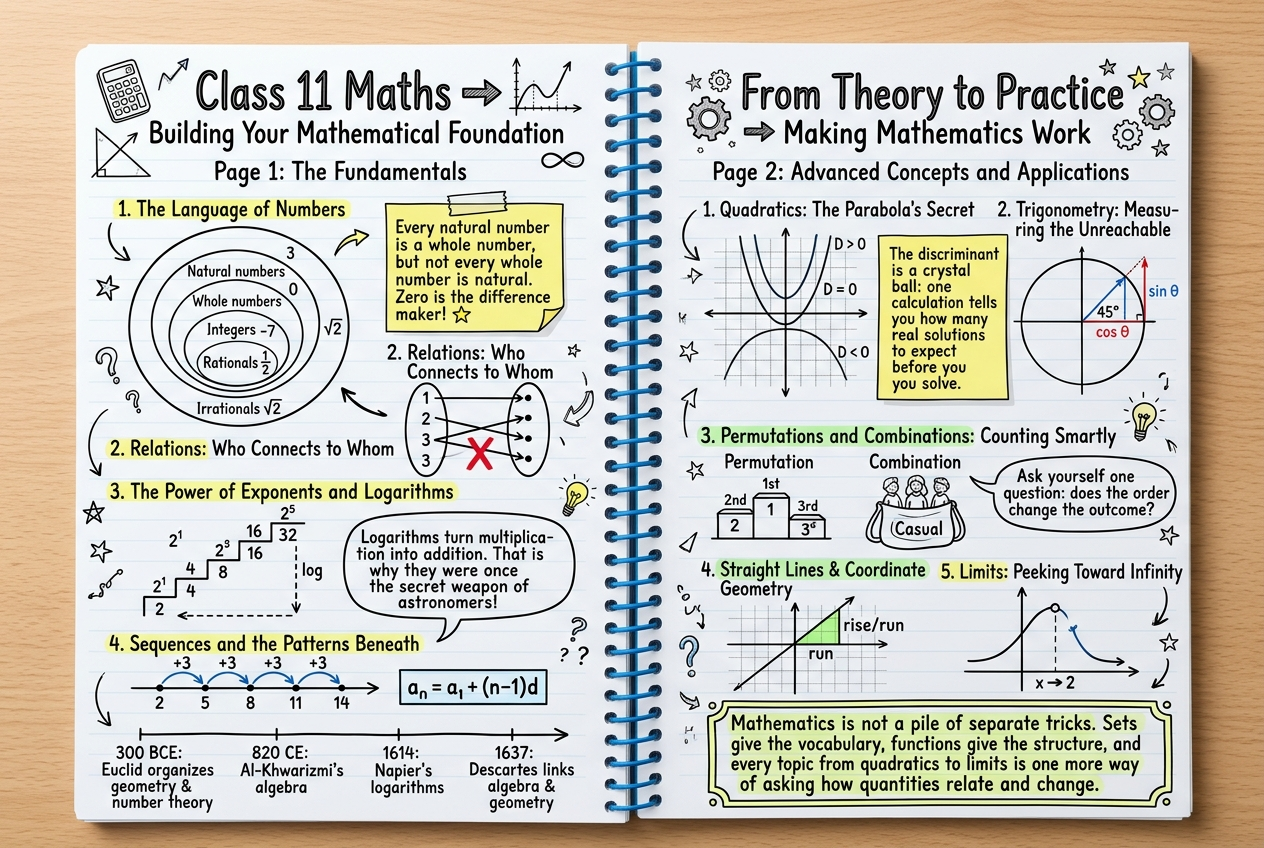
basic maths class 11
The same content DoodleNotes wrote before drawing it.
Class 11 Maths → Building Your Mathematical Foundation
- 1
The Language of Numbers
Mathematics begins with sets, the collections of objects that share a common property. Numbers are grouped into natural numbers, whole numbers, integers, rationals, and irrationals, each extending the one before it. Understanding this family tree helps you know which tool fits which problem.
Sticky note: Every natural number is a whole number, but not every whole number is natural. Zero is the difference maker!
- 2
Relations: Who Connects to Whom
A relation pairs elements from one set with elements from another, like matching students to their seats. A function is a special relation where every input has exactly one output, which is why it is so reliable in describing real processes. Domain and range tell you what goes in and what comes out.
- 3
The Power of Exponents and Logarithms
Exponents compress repeated multiplication into a compact form, so 2 multiplied by itself five times becomes 2⁵. Logarithms are the reverse question: what power do I need to raise a base to in order to get a number? Together they unlock growth, decay, and measurement scales.
Sticky note: Logarithms turn multiplication into addition. That is why they were once the secret weapon of astronomers!
- 4
Sequences and the Patterns Beneath
A sequence is an ordered list of numbers following a rule, such as the arithmetic sequence that adds a fixed difference each step. Recognizing the rule lets you predict any future term without counting all the way there. This pattern-spotting skill is the seed of all higher mathematics.
Timeline: 300 BCE Euclid organizes geometry and number theory in the Elements · 820 CE Al-Khwarizmi's work introduces systematic algebra · 1614 John Napier publishes logarithm tables · 1637 Descartes links algebra and geometry with coordinates
From Theory to Practice → Making Mathematics Work
- 1
Quadratics: The Parabola's Secret
A quadratic equation takes the form ax² + bx + c = 0 and its graph is a U-shaped parabola. The discriminant b² − 4ac reveals in advance whether the curve crosses the x-axis twice, once, or never. Factoring, completing the square, and the quadratic formula are three routes to the same answers.
Sticky note: The discriminant is a crystal ball: one calculation tells you how many real solutions to expect before you solve.
- 2
Trigonometry: Measuring the Unreachable
Sine, cosine, and tangent relate the angles of a right triangle to the ratios of its sides. With these ratios you can measure heights of towers and distances across rivers without ever getting there. The unit circle extends these ideas to every angle, positive or negative.
- 3
Permutations and Combinations: Counting Smartly
Permutations count arrangements where order matters, like seating people in chairs, while combinations count selections where order does not matter, like choosing a committee. The factorial n! sits at the heart of both. Asking 'does order matter?' is the single most useful question in counting problems.
Sticky note: Ask yourself one question before every counting problem: does the order change the outcome?
- 4
Straight Lines and Coordinate Geometry
Every straight line can be described by its slope, which measures steepness, and its intercept, where it crosses the y-axis. Two lines are parallel when slopes match and perpendicular when slopes multiply to −1. Coordinate geometry turns shapes into algebra you can calculate.
- 5
Limits: Peeking Toward Infinity
A limit describes the value a function approaches as its input gets closer and closer to some point, even if it never quite arrives. Limits are the doorway to calculus, which studies change itself. Practicing limits trains your intuition for what happens at the edge of a process.
Bottom insight: Mathematics is not a pile of separate tricks. Sets give the vocabulary, functions give the structure, and every topic from quadratics to limits is one more way of asking how quantities relate and change.
For study only. Check anything you rely on against your textbook.
Studying something else?
Type a topic and get your own hand-drawn page like this one in about 40 seconds.
your turnMore from the gallery
See all notes