Summary of Catalyzing Change in School Mathematics: Creating the Opportunities Our Students Deserve By DeAnn Huinker, Sarah B. Bush, and Karen J. Graham (2020) [pubs.nctm.org] This article synthesizes
Made with DoodleNotes · Oct 23, 2026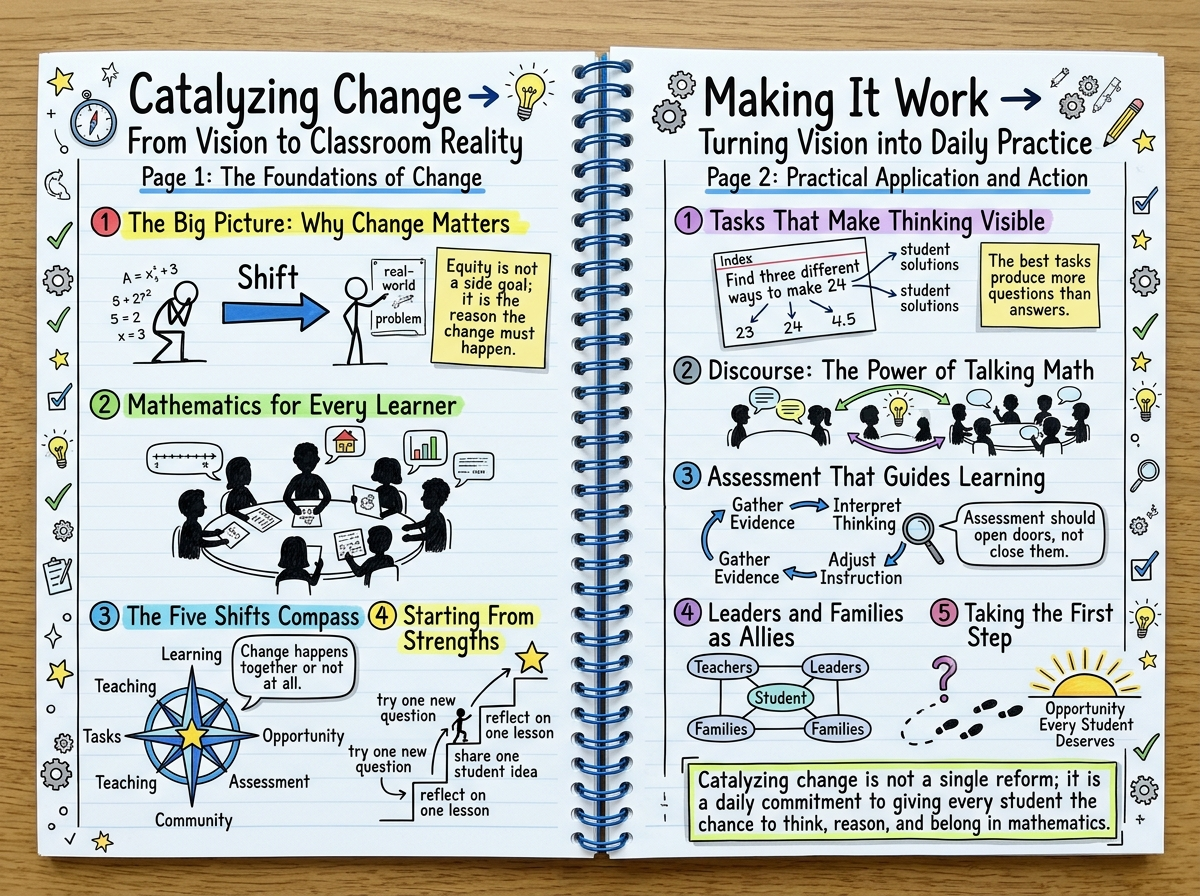
Summary of Catalyzing Change in School Mathematics: Creating the Opportunities Our Students Deserve By DeAnn Huinker, Sarah B. Bush, and Karen J. Graham (2020) [pubs.nctm.org] This article synthesizes
The same content DoodleNotes wrote before drawing it.
Catalyzing Change → From Vision to Classroom Reality
- 1
The Big Picture: Why Change Matters
Huinker, Bush, and Graham argue that school mathematics must shift from procedures and memorization toward reasoning, sense-making, and problem solving. Every student deserves access to rich mathematical experiences, not just those who already seem 'good at math.' The article synthesizes research and practice to show how this vision can become real in classrooms.
Sticky note: Equity is not a side goal; it is the reason the change must happen.
- 2
Mathematics for Every Learner
The authors emphasize that opportunity, not ability, has too often determined who gets to think deeply about mathematics. Changing this means designing lessons that welcome varied strengths, languages, and cultural backgrounds. When students see their own ideas valued, engagement and identity as mathematical thinkers grow.
- 3
The Five Shifts Compass
Change is organized around interconnected shifts in what, how, and why we teach: focusing on conceptual understanding, reasoning, and connections across ideas. Teachers, leaders, and families each play a role in moving the system together. No single shift works alone; they reinforce one another.
Sticky note: Change happens together or not at all.
- 4
Starting From Strengths
The article encourages educators to build on what already works in their classrooms rather than abandoning everything at once. Small, deliberate steps grounded in evidence can grow into lasting transformation. Reflection and collaboration help teachers notice where their practice is moving toward the vision.
Making It Work → Turning Vision into Daily Practice
- 1
Tasks That Make Thinking Visible
High-quality tasks invite multiple solution paths and require students to explain their reasoning. Rather than asking only for answers, teachers pose questions that open discussion and reveal how students think. These tasks become the engine of learning in the classroom.
Sticky note: The best tasks produce more questions than answers.
- 2
Discourse: The Power of Talking Math
Productive mathematical discussion helps students build, challenge, and refine ideas together. Teachers orchestrate talk by selecting student work, sequencing contributions, and pressing for justification. Over time, students learn to listen to and build on one another's reasoning.
- 3
Assessment That Guides Learning
Assessment is reframed as a window into student thinking rather than only a score at the end. Teachers gather evidence during lessons and use it to adjust instruction the next day. This feedback loop keeps every learner's growth in view.
Sticky note: Assessment should open doors, not close them.
- 4
Leaders and Families as Allies
Sustaining change requires school leaders who protect time for collaboration and families who understand the new goals. Professional learning communities help teachers test ideas together and learn from successes and setbacks. When everyone shares a language about mathematics, students benefit.
- 5
Taking the First Step
Readers are invited to choose one practice to strengthen next week and reflect on its impact. Progress comes from many small, intentional choices sustained over time. Each classroom contributes to the larger movement toward equitable mathematics.
Bottom insight: Catalyzing change is not a single reform; it is a daily commitment to giving every student the chance to think, reason, and belong in mathematics.
For study only. Check anything you rely on against your textbook.
Studying something else?
Type a topic and get your own hand-drawn page like this one in about 40 seconds.
your turn