nested quantifiers
Made with DoodleNotes · Oct 27, 2026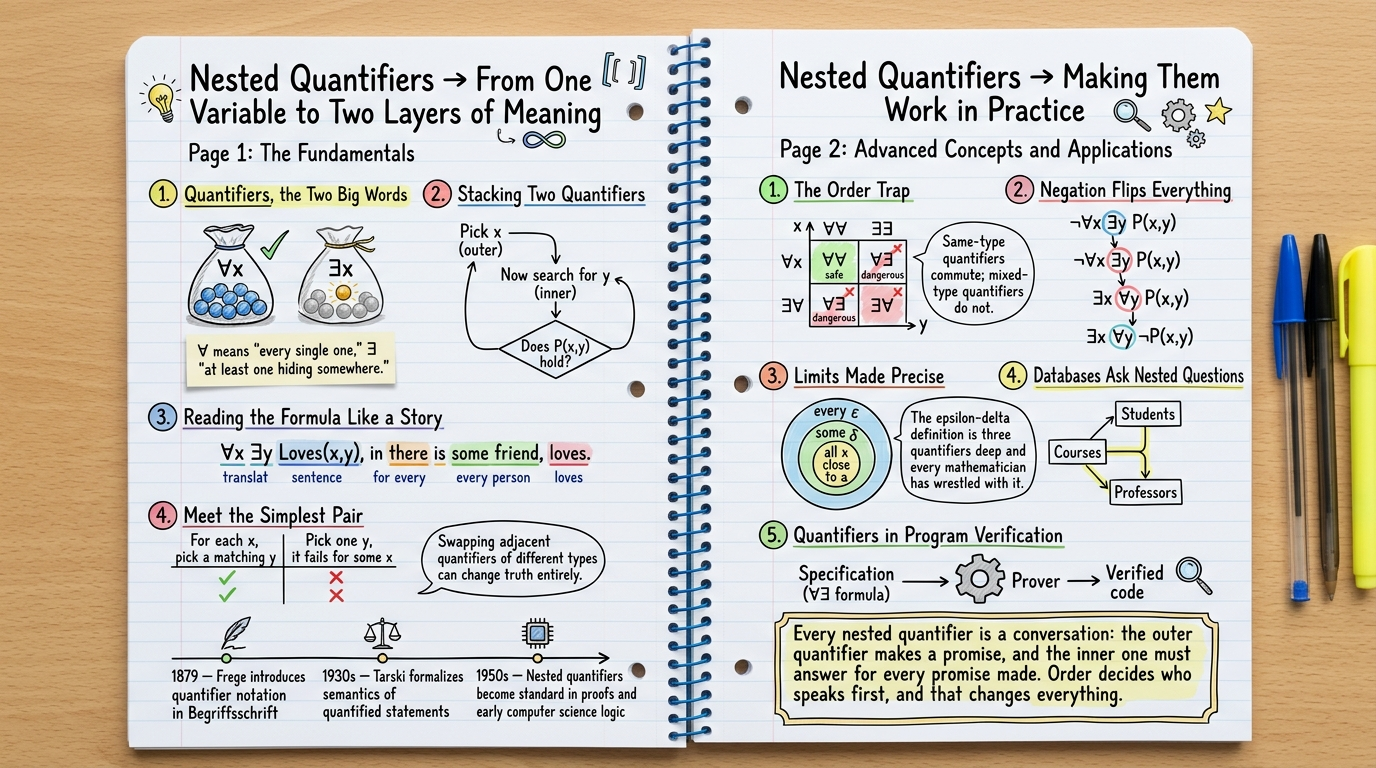
nested quantifiers
The same content DoodleNotes wrote before drawing it.
Nested Quantifiers → From One Variable to Two Layers of Meaning
- 1
Quantifiers, the Two Big Words
A quantifier tells us how many elements in a domain satisfy a statement. The universal quantifier (∀, read 'for all') claims something holds for every element, while the existential quantifier (∃, read 'there exists') claims at least one element works. Together they turn open predicates like P(x) into true or false statements.
Sticky note: ∀ means 'every single one,' ∃ means 'at least one hiding somewhere.'
- 2
Stacking Two Quantifiers
A nested quantifier places one quantifier inside the scope of another, as in ∀x ∃y P(x,y). Read left to right, each quantifier takes its turn: the outer one chooses a value first, and the inner one responds to that choice. The order of the symbols is the order of the reasoning.
- 3
Reading the Formula Like a Story
To translate a nested quantified statement into English, start with the outermost quantifier and move inward one step at a time. Each quantifier becomes a phrase such as 'for every person' or 'there is some friend,' and the predicate becomes the relationship being described. Practicing this translation builds intuition faster than memorizing rules.
- 4
Meet the Simplest Pair
Consider ∀x ∃y (x + y = 0) over the integers. For every integer x, we can find a y (namely −x) making the sum zero, so the statement is true. Swapping the order to ∃y ∀x (x + y = 0) produces a false claim, because no single y can cancel every x at once.
Sticky note: Swapping adjacent quantifiers of different types can change truth entirely.
Timeline: 1879 Frege introduces quantifier notation in Begriffsschrift, laying the groundwork for modern logic · 1930s Tarski formalizes the semantics of quantified statements, defining truth in terms of domains · 1950s Nested quantifiers become standard in mathematical proofs and early computer science logic
Nested Quantifiers → Making Them Work in Practice
- 1
The Order Trap
Quantifier order matters most when different quantifiers are adjacent. Two universals or two existentials can be swapped freely, since ∀x ∀y P(x,y) means the same as ∀y ∀x P(x,y). But ∀x ∃y and ∃y ∀x are genuinely different statements, and confusing them is the most common mistake in this topic.
Sticky note: Same-type quantifiers commute; mixed-type quantifiers do not.
- 2
Negation Flips Everything
To negate a nested quantifier, push the negation inward while flipping each quantifier: ¬∀x ∃y P(x,y) becomes ∃x ∀y ¬P(x,y). Each ∀ becomes ∃, each ∃ becomes ∀, and the innermost predicate receives the negation. This mechanical process is reliable and is the backbone of many proofs by contradiction.
- 3
Limits Made Precise
The formal definition of a limit is a nested quantifier statement: for every ε > 0 there exists δ > 0 such that for all x, if |x − a| < δ then |f(x) − L| < ε. Each layer corresponds to a step in the epsilon-delta argument. Mathematicians who understand the quantifier structure can read and write such definitions with confidence.
Sticky note: The epsilon-delta definition is three quantifiers deep and every mathematician has wrestled with it.
- 4
Databases Ask Nested Questions
A query like 'find every student who takes some course taught by every professor in the department' is a nested quantified statement. Relational algebra and SQL express these as nested subqueries or division operations. Recognizing the quantifier structure helps programmers write correct queries and spot logical bugs.
- 5
Quantifiers in Program Verification
Formal verification tools specify program behavior with nested quantifiers, such as 'for every input array there exists an output sorted array that is a permutation of it.' Writing these specifications precisely lets automated provers check that code meets its intended behavior. The same logical skills you practice here scale directly to software correctness.
Bottom insight: Every nested quantifier is a conversation: the outer quantifier makes a promise, and the inner one must answer for every promise made. Order decides who speaks first, and that changes everything.
For study only. Check anything you rely on against your textbook.
Studying something else?
Type a topic and get your own hand-drawn page like this one in about 40 seconds.
your turnMore from the gallery
See all notes