ancient civilizations: Egypt 6th grade
Made with DoodleNotes · Oct 25, 2026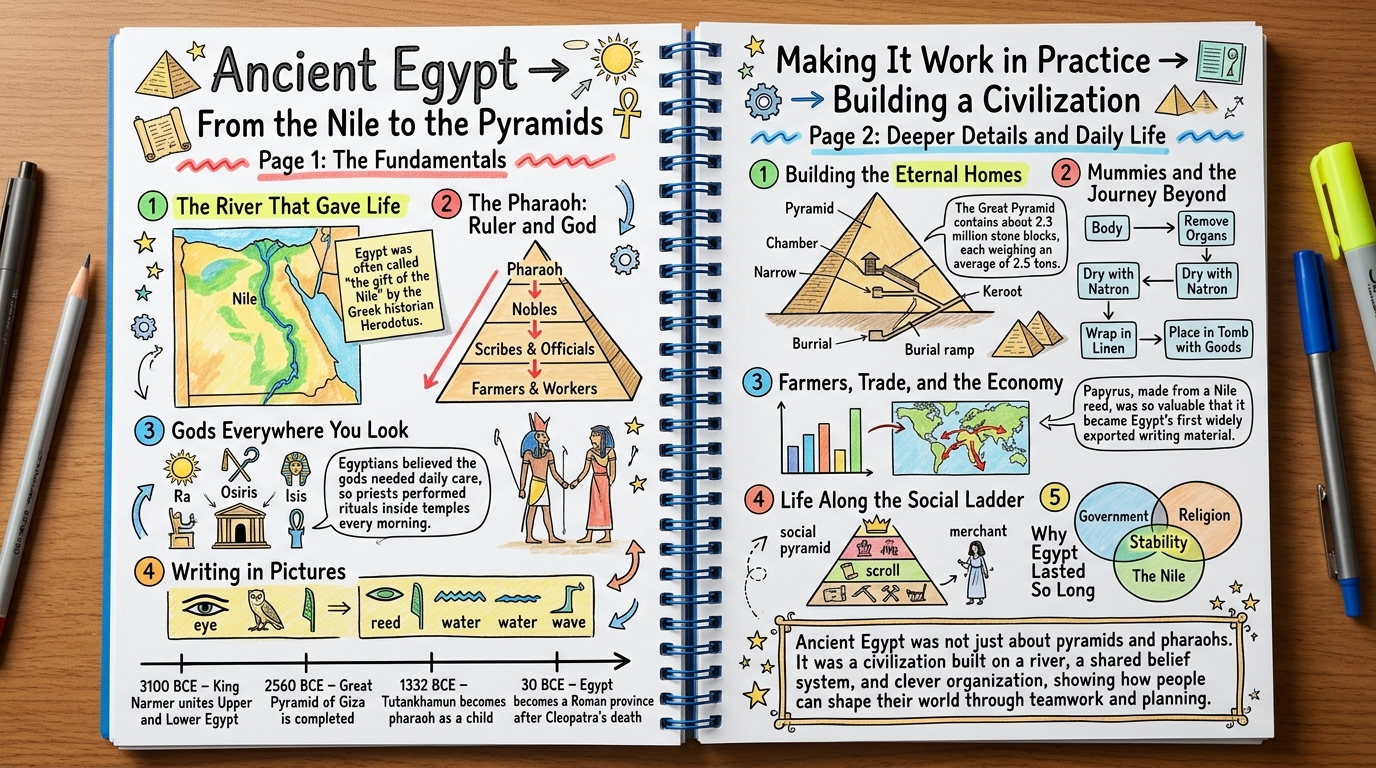
ancient civilizations: Egypt 6th grade
The same content DoodleNotes wrote before drawing it.
Ancient Egypt → From the Nile to the Pyramids
- 1
The River That Gave Life
Ancient Egypt grew along the Nile River, which flooded every year and left behind rich black soil. This soil made farming possible in the middle of a mostly desert land. Because of this reliable food supply, Egyptian civilization could grow for thousands of years.
Sticky note: Egypt was often called 'the gift of the Nile' by the Greek historian Herodotus.
- 2
The Pharaoh: Ruler and God
Egypt was ruled by a pharaoh, who was seen as both a king and a link between people and the gods. The pharaoh was believed to keep Ma'at, the balance of order and justice, in the world. Egyptians followed his commands because they believed his power came from the divine.
- 3
Gods Everywhere You Look
Egyptians worshipped many gods who controlled nature and daily life, such as Ra the sun god, Osiris the god of the afterlife, and Isis the goddess of magic and motherhood. Temples were built to honor these gods and were cared for by priests. Religion shaped almost every part of life, from farming to burial.
Sticky note: Egyptians believed the gods needed daily care, so priests performed rituals inside temples every morning.
- 4
Writing in Pictures
The ancient Egyptians developed hieroglyphs, a writing system made of pictures that stood for sounds, ideas, and objects. Scribes trained for years to learn these symbols and kept records for the government and temples. Writing helped Egypt manage taxes, trade, and history.
Timeline: 3100 BCE King Narmer unites Upper and Lower Egypt · 2560 BCE Great Pyramid of Giza is completed · 1332 BCE Tutankhamun becomes pharaoh as a child · 30 BCE Egypt becomes a Roman province after Cleopatra's death
Making It Work in Practice → Building a Civilization
- 1
Building the Eternal Homes
Pyramids were built as tombs for pharaohs, designed to help them reach the afterlife. Thousands of workers, including skilled laborers and farmers during the flood season, moved and stacked massive limestone blocks. Engineers used ramps, levers, and careful planning to complete these enormous structures.
Sticky note: The Great Pyramid contains about 2.3 million stone blocks, each weighing an average of 2.5 tons.
- 2
Mummies and the Journey Beyond
Egyptians believed the soul needed a preserved body to live on after death. Embalmers removed organs, dried the body with natron salt, and wrapped it in linen. Food, jewelry, and furniture were placed in tombs to support the dead in the next life.
- 3
Farmers, Trade, and the Economy
Most Egyptians were farmers who grew wheat, barley, flax, and vegetables along the Nile. Surplus crops were stored in granaries and used to pay workers building royal projects. Trade routes carried gold, copper, and papyrus to neighboring lands.
Sticky note: Papyrus, made from a Nile reed, was so valuable that it became Egypt's first widely exported writing material.
- 4
Life Along the Social Ladder
Egyptian society had clear levels, with the pharaoh at the top and nobles, priests, scribes, merchants, and farmers below. Women could own property, run businesses, and sign contracts, which was rare in many ancient societies. Social rank mattered, but opportunity could come through education and service.
- 5
Why Egypt Lasted So Long
Egypt remained a powerful civilization for over 3,000 years because of its strong government, religious traditions, and dependable Nile farming. Its leaders kept order through record keeping and organized labor. These foundations allowed its culture to influence the world for centuries.
Bottom insight: Ancient Egypt was not just about pyramids and pharaohs. It was a civilization built on a river, a shared belief system, and clever organization, showing how people can shape their world through teamwork and planning.
For study only. Check anything you rely on against your textbook.
Studying something else?
Type a topic and get your own hand-drawn page like this one in about 40 seconds.
your turn