Roaring 20s
Made with DoodleNotes · Oct 26, 2026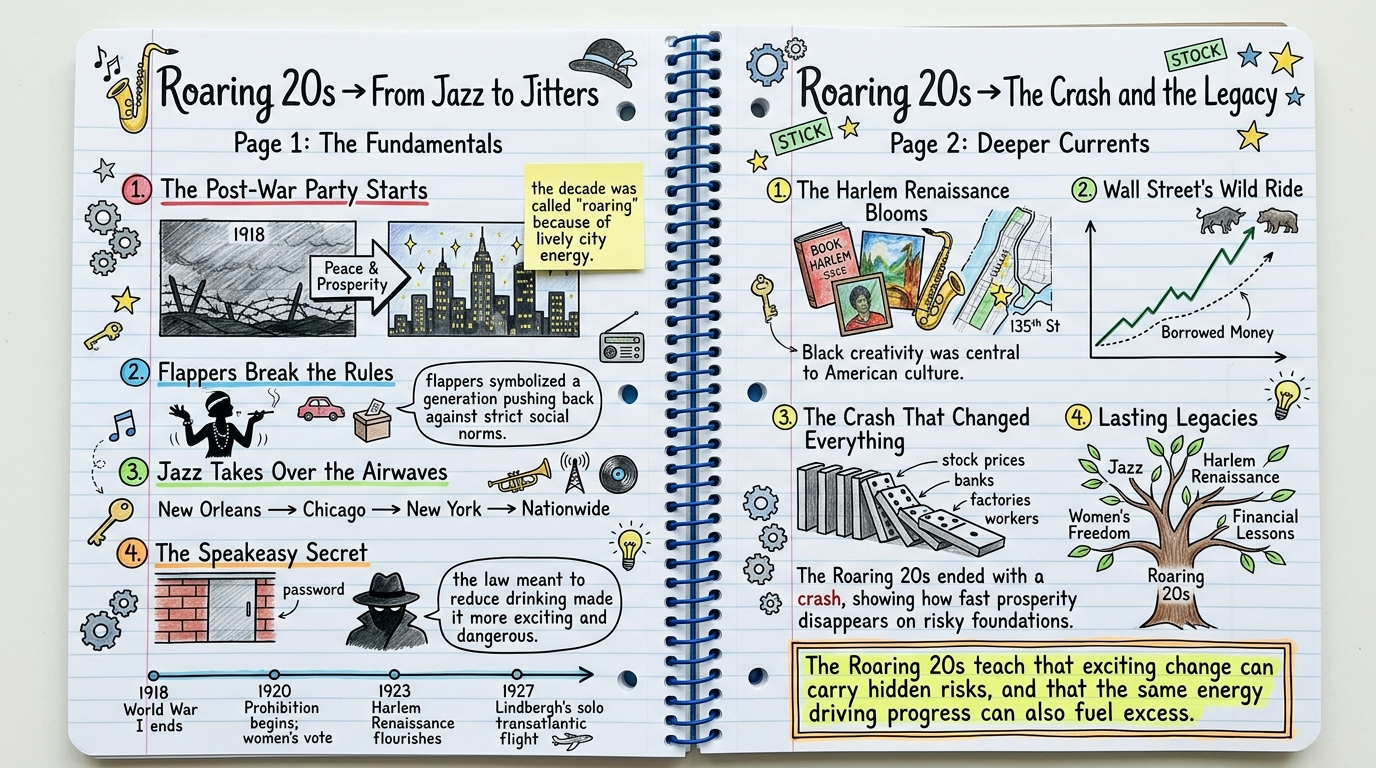
Roaring 20s
The same content DoodleNotes wrote before drawing it.
Roaring 20s → From Jazz to Jitters
- 1
The Post-War Party Starts
After World War I ended in 1918, many Americans wanted to forget the hardship and loss of the war years. The decade that followed brought rapid economic growth, booming industries, and a new sense of optimism. Cities grew quickly as people moved from farms to factories seeking jobs and excitement.
Sticky note: The decade was called 'roaring' because of the lively energy in cities, where music, dancing, and nightlife exploded in popularity.
- 2
Flappers Break the Rules
Young women known as flappers challenged traditional expectations by cutting their hair into short bobs, wearing knee-length dresses, and dancing to jazz. They smoked, drove cars, and spoke openly about independence. Their bold style signaled that women were demanding more personal freedom.
Sticky note: Flappers symbolized a generation pushing back against the strict social norms of their parents' era.
- 3
Jazz Takes Over the Airwaves
Jazz music, born in African American communities in New Orleans and other Southern cities, spread across the country during this decade. Radio broadcasts, phonograph records, and dance halls made jazz the soundtrack of the era. Musicians like Louis Armstrong and Duke Ellington became national stars.
- 4
The Speakeasy Secret
The Eighteenth Amendment banned the sale of alcohol in 1920, beginning Prohibition. Instead of stopping drinking, it moved it underground into hidden bars called speakeasies. Many people ignored the law, and organized crime grew rich by smuggling and selling illegal liquor.
Sticky note: Prohibition created a paradox: the law was meant to reduce drinking but instead made it more exciting and more dangerous.
Timeline: 1918 World War I ends · 1920 Prohibition begins; women gain the right to vote · 1923 Harlem Renaissance flourishes in New York · 1927 Charles Lindbergh completes first solo transatlantic flight
Roaring 20s → The Crash and the Legacy
- 1
The Harlem Renaissance Blooms
Harlem in New York became the center of an explosion of Black artistic and intellectual achievement. Writers like Langston Hughes and Zora Neale Hurston, along with painters and musicians, explored Black identity and culture in new ways. Their work reshaped American literature and art.
Sticky note: The Harlem Renaissance proved that Black creativity was central to American culture, not a side note to it.
- 2
Wall Street's Wild Ride
Stock prices soared throughout the decade as more Americans bought shares, often borrowing money to do so. Many believed prices would rise forever, and speculation spread rapidly. This rush of easy money built a fragile economy resting on optimism rather than solid foundations.
- 3
The Crash That Changed Everything
In October 1929, the stock market collapsed, wiping out fortunes in a matter of days. Banks failed, businesses closed, and unemployment surged across the country. The crash signaled the start of the Great Depression, a decade-long economic crisis that reached around the world.
Sticky note: The Roaring 20s ended with a crash, showing how fast prosperity can disappear when it rests on risky foundations.
- 4
Lasting Legacies
Although the decade ended in hardship, its cultural changes endured. Women gained greater social visibility and political voice, jazz became a permanent American art form, and new ideas about personal freedom continued to shape society. The era left behind a complicated mix of progress and warning.
Bottom insight: The Roaring 20s teach us that a period of exciting change can carry hidden risks, and that the same energy that drives progress can also fuel excess.
For study only. Check anything you rely on against your textbook.
Studying something else?
Type a topic and get your own hand-drawn page like this one in about 40 seconds.
your turn