First Continental Congress, Paul Revere's Ride, Patrick Henry's Fiery Speech, and Battles of Lexington and Concord
Made with DoodleNotes · Oct 25, 2026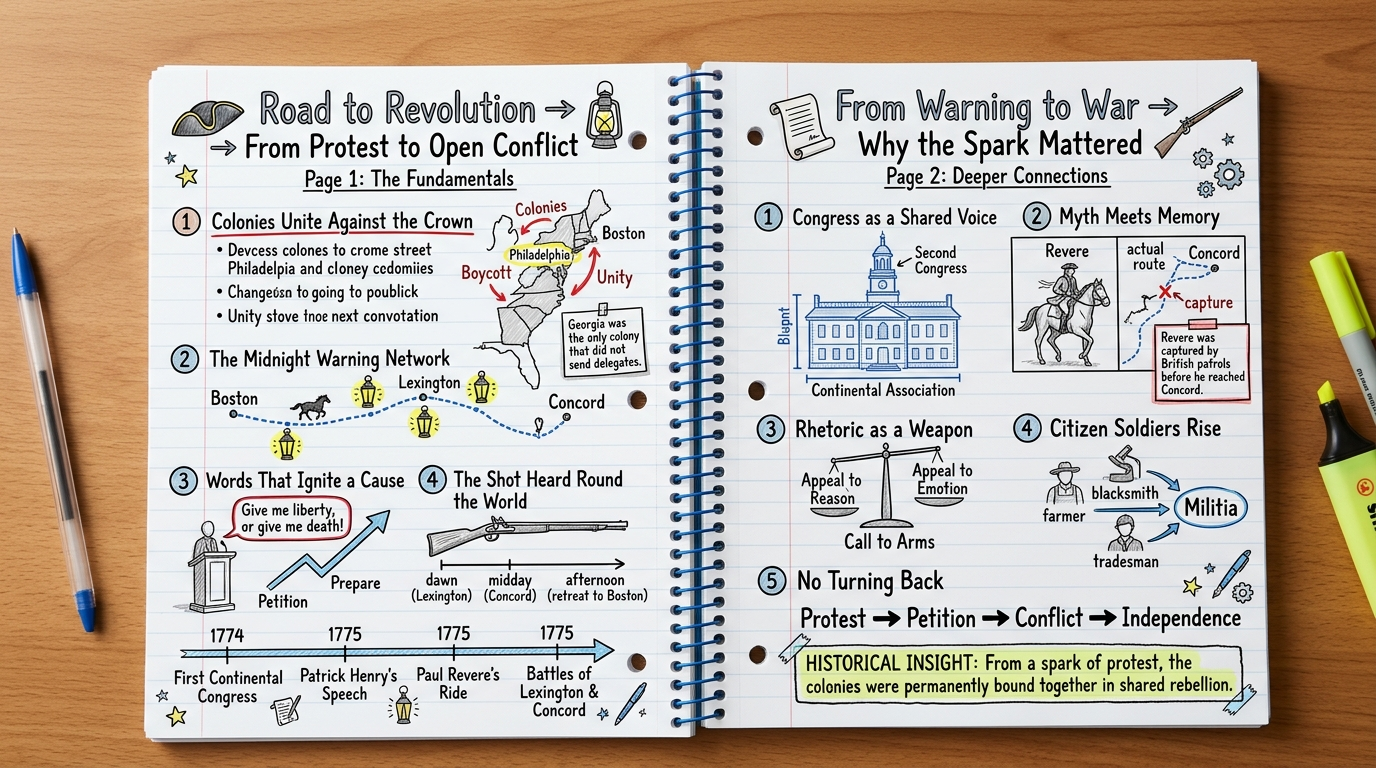
First Continental Congress, Paul Revere's Ride, Patrick Henry's Fiery Speech, and Battles of Lexington and Concord
The same content DoodleNotes wrote before drawing it.
Road to Revolution → From Protest to Open Conflict
- 1
Colonies Unite Against the Crown
After the Intolerable Acts closed Boston's port and curtailed colonial self-government in 1774, colonial leaders realized that separate protests were not enough. Delegates from twelve colonies gathered in Philadelphia in September 1774 for the First Continental Congress. They agreed to boycott British goods and organized a unified response to London's policies.
Sticky note: Georgia was the only colony that did not send delegates to the First Continental Congress.
- 2
The Midnight Warning Network
Patriot leaders in Boston feared British troops would seize colonial military supplies stored in Concord. Paul Revere and William Dawes were sent to ride out and warn the countryside that British regulars were marching. Their signals and messages spread a network of alarm that allowed militia members to prepare.
- 3
Words That Ignite a Cause
At the Virginia Convention in March 1775, Patrick Henry urged colonists to prepare for armed resistance rather than wait for peaceful reconciliation. His speech argued that negotiation had failed and that liberty was worth any sacrifice. His words helped shift many moderate delegates toward militia preparation.
Sticky note: "Give me liberty, or give me death!"
- 4
The Shot Heard Round the World
On April 19, 1775, British troops clashed with colonial militia at Lexington Green, where the first shots were fired. British forces then marched on to Concord, where they encountered stronger resistance at the North Bridge. The fighting pushed the British back toward Boston under heavy colonial fire, marking the start of the American Revolutionary War.
Timeline: 1774 First Continental Congress meets in Philadelphia · 1775 Patrick Henry delivers his liberty speech in Virginia · 1775 Paul Revere's midnight ride warns of British march · 1775 Battles of Lexington and Concord begin the war
From Warning to War → Why the Spark Mattered
- 1
Congress as a Shared Voice
The First Continental Congress did not declare independence, but it created a precedent for colonies acting together. Delegates drafted a Declaration and Resolves and agreed to a Continental Association to enforce the boycott. This cooperation laid groundwork for the Second Continental Congress, which later led the war effort.
- 2
Myth Meets Memory
Revere's ride is celebrated in Longfellow's 1861 poem, which popularized the story of lanterns and warnings. In reality, Revere was captured before reaching Concord, and Dawes and another rider, Prescott, carried the alarm further. The legend highlights how communication and local networks shaped the outcome.
Sticky note: Revere was captured by British patrols before he reached Concord.
- 3
Rhetoric as a Weapon
Patrick Henry's speech shows how persuasion can move a government. He framed the conflict as a choice between freedom and submission, appealing to emotion as well as reason. Speeches like his helped convince colonists that resistance was necessary and honorable.
- 4
Citizen Soldiers Rise
The militia at Lexington and Concord were ordinary farmers and tradesmen who had trained on village greens. Their ability to gather quickly and fight from cover, rather than in formal lines, challenged British military habits. Their success convinced many colonists that a full war could be fought and won.
- 5
No Turning Back
Once blood was shed at Lexington and Concord, reconciliation became far more difficult. Colonial leaders moved toward independence, which culminated in the Declaration of Independence in 1776. The events of April 1775 transformed a political dispute into a revolutionary war.
Bottom insight: Revolutions often begin with coordination, words, and a single warning. The chain from Philadelphia to Concord shows how ideas, communication, and courage combined to turn colonial grievances into a nation's birth.
For study only. Check anything you rely on against your textbook.
Studying something else?
Type a topic and get your own hand-drawn page like this one in about 40 seconds.
your turn