river valley civilizations
Made with DoodleNotes · Oct 26, 2026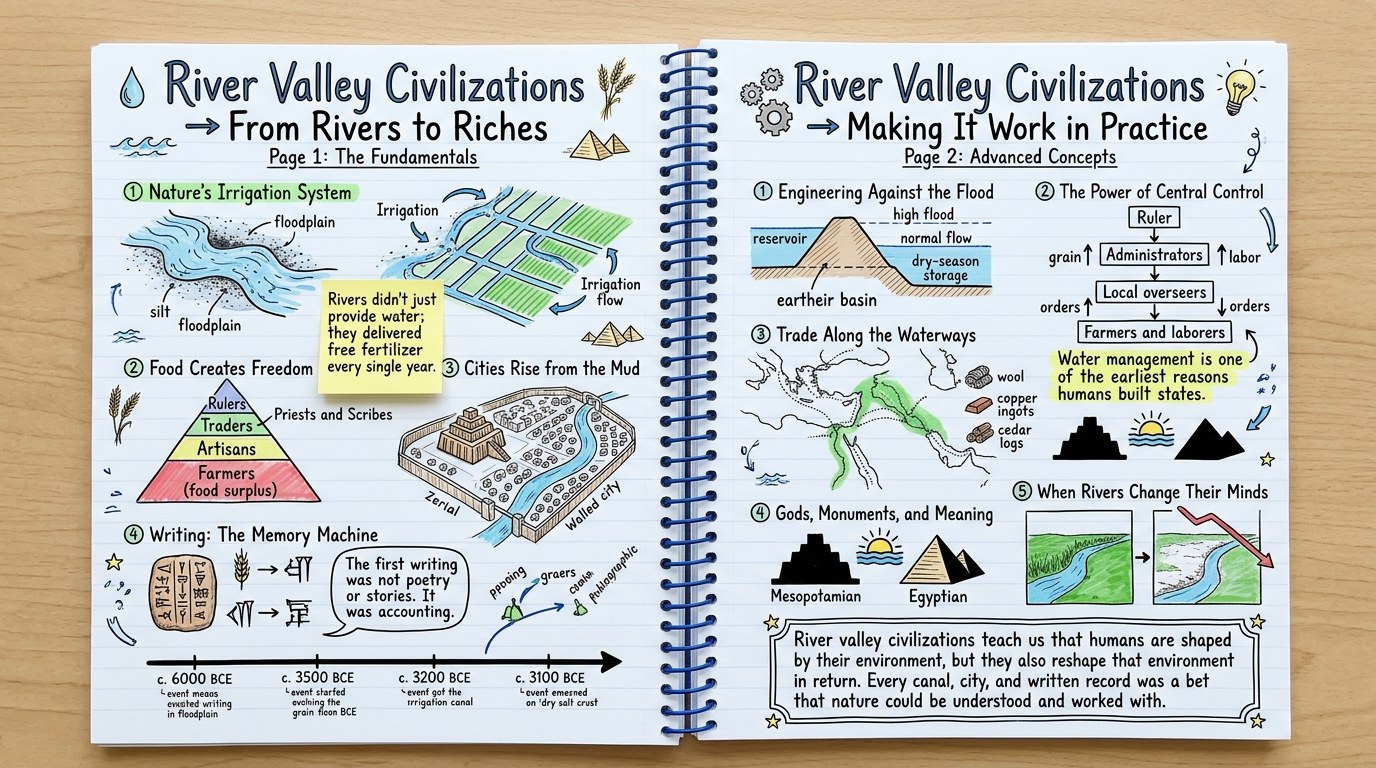
river valley civilizations
The same content DoodleNotes wrote before drawing it.
River Valley Civilizations → From Rivers to Riches
- 1
Nature's Irrigation System
Rivers flooded their banks each year, leaving behind rich, dark silt that made the surrounding soil extraordinarily fertile. Early farmers learned that these predictable floods could be harnessed, turning wild water into a reliable source of food. This discovery made it possible to grow more food than a family needed in a single season.
Sticky note: Rivers didn't just provide water; they delivered free fertilizer every single year.
- 2
Food Creates Freedom
When farmers produced more food than they consumed, not everyone had to farm anymore. Some people became potters, weavers, builders, and priests, which created the first specialized jobs. This division of labor is the foundation of every modern economy.
- 3
Cities Rise from the Mud
As surplus food and specialized workers gathered in one place, the first true cities emerged along river banks. Mud-brick walls, temples, and marketplaces appeared, and populations grew into the thousands. Living close together also meant new problems to solve, such as who makes the rules and who keeps the peace.
- 4
Writing: The Memory Machine
Keeping track of grain stores, taxes, and trade deals became too complicated to remember. Scribes developed writing systems such as cuneiform in Mesopotamia and hieroglyphs in Egypt to record these details. Writing allowed knowledge, laws, and history to survive long after the people who created them were gone.
Sticky note: The first writing was not poetry or stories. It was accounting.
Timeline: c. 6000 BCE Farming communities settle along the Nile and Tigris-Euphrates · c. 3500 BCE Sumerian cities such as Uruk and Ur flourish · c. 3200 BCE Cuneiform and early Egyptian hieroglyphs appear · c. 3100 BCE Egypt unifies under the first pharaohs
River Valley Civilizations → Making It Work in Practice
- 1
Engineering Against the Flood
Floods were generous but unpredictable, so civilizations built dikes, levees, reservoirs, and canals to control the water. Mesopotamians dug long canal networks, while Egyptians used basins to store floodwater for the dry season. Managing water required coordinated labor, which pushed societies toward stronger central organization.
- 2
The Power of Central Control
Large irrigation projects needed someone to organize thousands of workers, collect grain, and settle disputes. Kings and priest-kings emerged as the coordinators of this system, often claiming divine authority to justify their power. Taxes in grain and labor became the engine that funded monuments and armies.
Sticky note: Water management is one of the earliest reasons humans built states.
- 3
Trade Along the Waterways
Rivers served as highways that carried goods far beyond the valley. Mesopotamian merchants traded wool, grain, and crafted goods for metals, timber, and stone from distant regions. Trade spread ideas, technologies, and writing styles along the same routes.
- 4
Gods, Monuments, and Meaning
Religion tied people to their rulers and to the natural cycles that governed their survival. Temples and pyramids were both spiritual centers and displays of organized labor and wealth. Egyptian beliefs about the Nile's annual rebirth linked the flood to the eternal cycle of life and death.
- 5
When Rivers Change Their Minds
Civilizations depended so heavily on their rivers that changes in flow, soil salinity, or silting could cause collapse. Overirrigation in Mesopotamia gradually concentrated salt in the soil, reducing harvests over centuries. Shifting channels and drought also contributed to the decline of many river cities.
Bottom insight: River valley civilizations teach us that humans are shaped by their environment, but they also reshape that environment in return. Every canal, city, and written record was a bet that nature could be understood and worked with.
For study only. Check anything you rely on against your textbook.
Studying something else?
Type a topic and get your own hand-drawn page like this one in about 40 seconds.
your turn