кирило мефодіівське братство
Made with DoodleNotes · Oct 27, 2026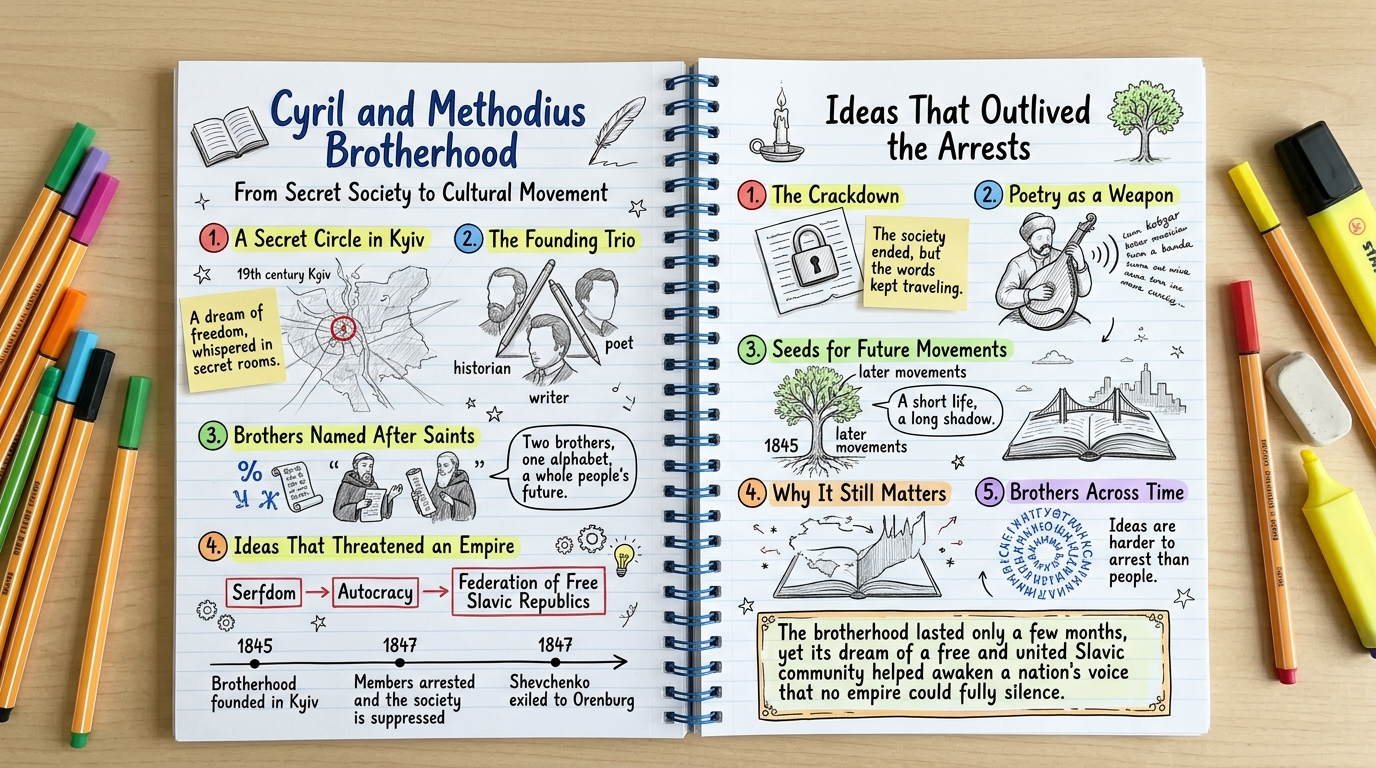
кирило мефодіівське братство
The same content DoodleNotes wrote before drawing it.
Cyril and Methodius Brotherhood → From Secret Society to Cultural Movement
- 1
A Secret Circle in Kyiv
The Cyril and Methodius Brotherhood was a secret Ukrainian political and cultural society founded in Kyiv in December 1845. Its members were young intellectuals, writers, and students who dreamed of a free, democratic, and federated Slavic community. They met quietly, because the Russian Empire viewed any hint of Ukrainian national thinking as dangerous.
Sticky note: A dream of freedom, whispered in secret rooms
- 2
The Founding Trio
Mykola Kostomarov, Panteleimon Kulish, and Taras Shevchenko were the brotherhood's most famous members. Kostomarov was a historian, Kulish a writer and translator, and Shevchenko a poet whose verses would become the voice of Ukrainian identity. Together they combined scholarship, literature, and political vision.
- 3
Brothers Named After Saints
The society took its name from Saints Cyril and Methodius, the 9th-century Byzantine brothers who created the Glagolitic alphabet and brought Christianity and literacy to the Slavs. Choosing their names signaled a shared Slavic heritage and a mission of enlightenment. Members believed that education and faith could unite Slavic peoples.
Sticky note: Two brothers, one alphabet, a whole people's future
- 4
Ideas That Threatened an Empire
The brotherhood's program called for the abolition of serfdom, the end of autocracy, and equal rights for all Slavic nations. It imagined a federation of free Slavic republics modeled on democratic principles. Such ideas were radical in an empire ruled by the tsar, so the members' ideals placed them at serious personal risk.
Timeline: 1845 Brotherhood founded in Kyiv · 1847 Members arrested and the society is suppressed · 1847 Shevchenko exiled to Orenburg
Cyril and Methodius Brotherhood → Ideas That Outlived the Arrests
- 1
The Crackdown
In 1847 the Russian authorities discovered the brotherhood and arrested its members. Shevchenko was sentenced to military service and exile, and he was forbidden to write or paint during his years in the ranks. The organization was dissolved, but its leaders were not forgotten.
Sticky note: The society ended, but the words kept traveling
- 2
Poetry as a Weapon
Shevchenko's poetry, including the Kobzar collection, became a foundation of modern Ukrainian literature and national consciousness. His works celebrated Ukrainian history, language, and freedom, carrying the brotherhood's ideals far beyond its small circle. Many later readers saw him as the nation's conscience.
- 3
Seeds for Future Movements
The brotherhood's combination of cultural revival and political demands influenced later Ukrainian thinkers and movements. Its vision of national dignity helped shape the national awakening of the later 19th century. Even though it was short-lived, it planted ideas that grew for decades.
Sticky note: A short life, a long shadow
- 4
Why It Still Matters
Today the brotherhood is remembered as an early expression of Ukrainian national identity. Its members showed that language, culture, and history could be tools for political thought. Studying them helps students understand how ideas can survive repression.
- 5
Brothers Across Time
The name of Cyril and Methodius continues to connect Slavic peoples through the alphabet and shared heritage. The brotherhood reminds us that small groups of committed thinkers can influence entire nations. Their legacy lives in books, memory, and the ongoing story of Ukrainian culture.
Sticky note: Ideas are harder to arrest than people
Bottom insight: The brotherhood lasted only a few months, yet its dream of a free and united Slavic community helped awaken a nation's voice that no empire could fully silence.
For study only. Check anything you rely on against your textbook.
Studying something else?
Type a topic and get your own hand-drawn page like this one in about 40 seconds.
your turn