baisc maths class 11 physics
Made with DoodleNotes · Oct 29, 2026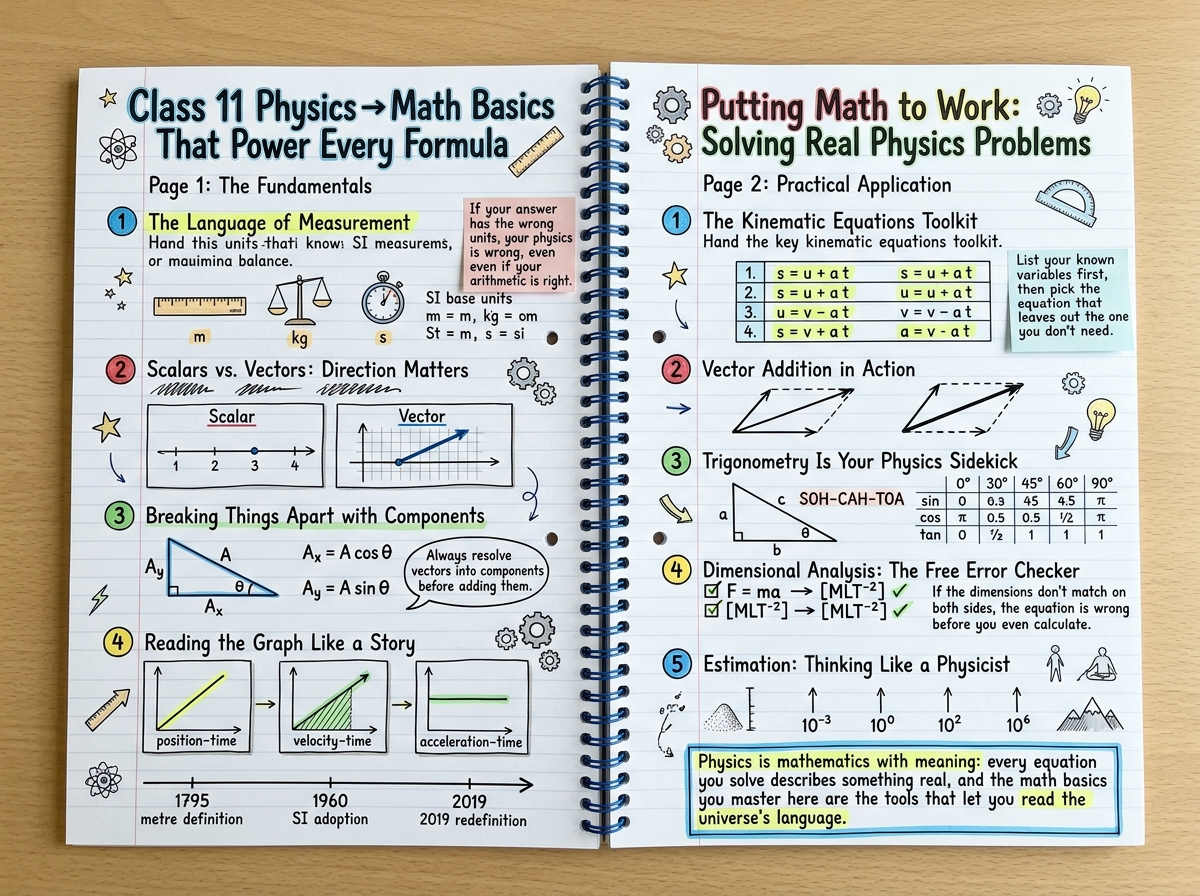
baisc maths class 11 physics
The same content DoodleNotes wrote before drawing it.
Class 11 Physics → Math Basics That Power Every Formula
- 1
The Language of Measurement
Physics describes the universe using numbers with units, and every quantity has a magnitude and a unit. Standard SI units such as metre, kilogram, and second form the common language scientists use worldwide. Getting comfortable with unit systems is the first step to avoiding costly mistakes.
Sticky note: If your answer has the wrong units, your physics is wrong, even if your arithmetic is right.
- 2
Scalars vs. Vectors: Direction Matters
A scalar has only magnitude, such as mass, temperature, or speed. A vector has both magnitude and direction, such as velocity, force, or displacement. Vectors are drawn as arrows, and their length shows size while their tip shows direction.
- 3
Breaking Things Apart with Components
Any vector can be split into horizontal and vertical components using trigonometry. For a vector of magnitude A at angle θ, the components are Ax = A cos θ and Ay = A sin θ. This trick turns a messy two-dimensional problem into two simpler one-dimensional ones.
Sticky note: Always resolve vectors into components before adding them.
- 4
Reading the Graph Like a Story
Graphs translate physical motion into shapes that can be read at a glance. The slope of a position-time graph gives velocity, and the slope of a velocity-time graph gives acceleration. The area under a velocity-time graph gives displacement.
Timeline: 1795 The metre is defined as one ten-millionth of the distance from the North Pole to the equator · 1960 The International System of Units (SI) is officially adopted · 2019 SI units are redefined using fundamental constants like the speed of light and Planck's constant
Putting Math to Work: Solving Real Physics Problems
- 1
The Kinematic Equations Toolkit
For constant acceleration, four key equations link displacement, velocity, acceleration, and time. The most useful are v = u + at and s = ut + ½at², where u is initial velocity. Choosing the equation that includes exactly the variables you know and need is the key skill.
Sticky note: List your known variables first, then pick the equation that leaves out the one you don't need.
- 2
Vector Addition in Action
To add vectors, add their x-components together and their y-components together, then recombine them using the Pythagorean theorem and an inverse tangent. This method works for forces, velocities, and displacements alike. Practice it until it feels automatic.
- 3
Trigonometry Is Your Physics Sidekick
sin, cos, and tan appear constantly in physics, especially when dealing with inclined planes and projectiles. Remember SOH-CAH-TOA to recall which ratio to use. Knowing the special angles 30°, 45°, and 60° by heart speeds up problem solving considerably.
- 4
Dimensional Analysis: The Free Error Checker
Every term in a valid physics equation must have the same dimensions. By writing each quantity in base dimensions like [M], [L], and [T], you can quickly catch errors in formulas or answers. This check takes seconds and can save entire exam questions.
Sticky note: If the dimensions don't match on both sides, the equation is wrong before you even calculate.
- 5
Estimation: Thinking Like a Physicist
Physicists often make rough estimates to check whether an answer is reasonable. Rounding numbers to powers of ten and using quick mental math builds intuition for the size of quantities. A good estimate can reveal a calculator mistake in seconds.
Bottom insight: Physics is mathematics with meaning: every equation you solve describes something real, and the math basics you master here are the tools that let you read the universe's language.
For study only. Check anything you rely on against your textbook.
Studying something else?
Type a topic and get your own hand-drawn page like this one in about 40 seconds.
your turn