evolution by natural selection
Made with DoodleNotes · Oct 28, 2026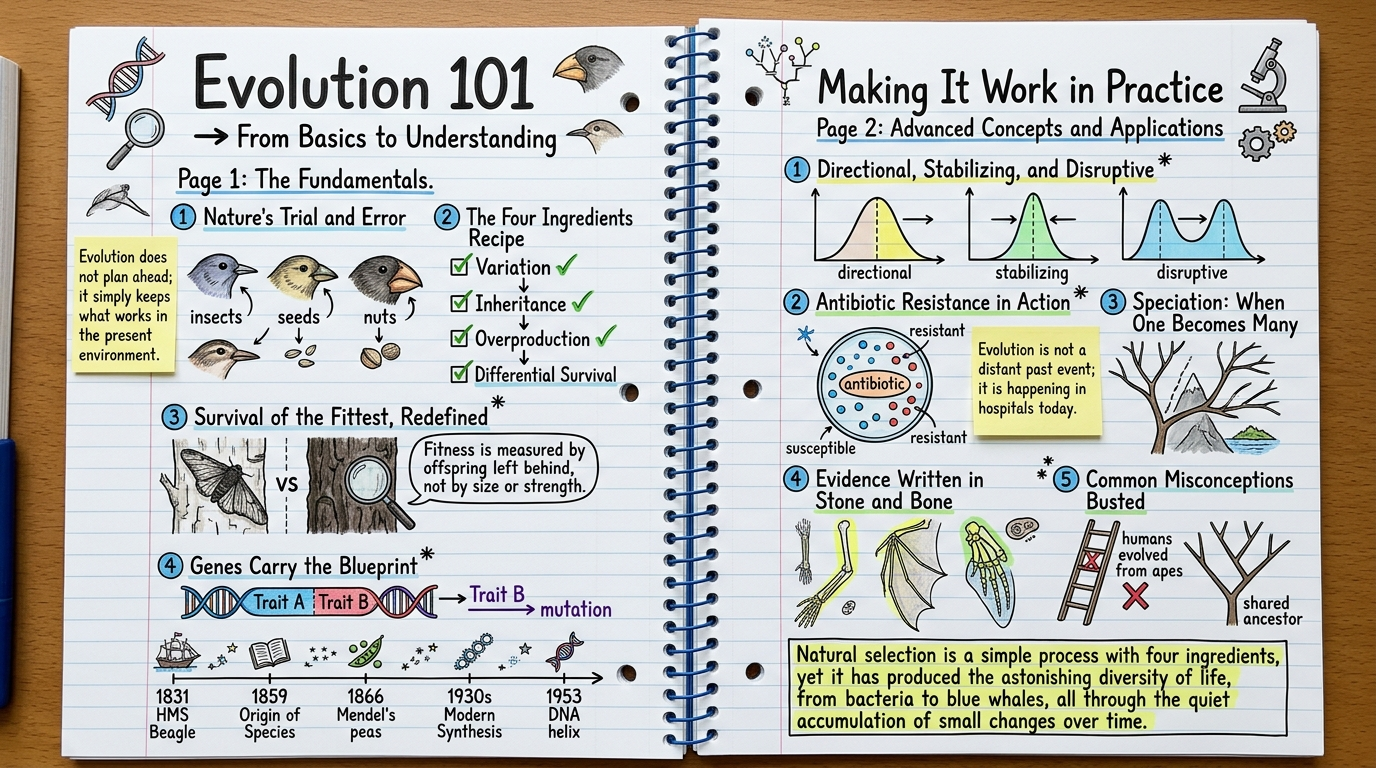
evolution by natural selection
The same content DoodleNotes wrote before drawing it.
Evolution 101 → From Basics to Understanding
- 1
Nature's Trial and Error
Evolution by natural selection is the process by which populations of living things change over generations. Individuals within a population vary in their traits, such as beak shape, fur thickness, or running speed. Those traits that help an organism survive and reproduce in its environment tend to be passed on more often than those that do not.
Sticky note: Evolution does not plan ahead; it simply keeps what works in the present environment.
- 2
The Four Ingredients Recipe
Natural selection works when four conditions are met: variation exists among individuals, some of that variation is inherited, more offspring are produced than can survive, and survival and reproduction differ depending on traits. Remove any one ingredient and the process stops. These conditions are what make selection a predictable mechanism rather than random chance.
- 3
Survival of the Fittest, Redefined
In biology, fitness does not mean being the strongest or fastest. It means having the greatest reproductive success in a specific environment. A small, well-camouflaged moth may be considered highly fit in a forest where birds hunt by sight, even though it is not physically impressive.
Sticky note: Fitness is measured by offspring left behind, not by size or strength.
- 4
Genes Carry the Blueprint
Traits are passed from parents to offspring through genes, which are segments of DNA that code for specific characteristics. Mutations create new gene variants, and these random changes are the raw material natural selection acts upon. Selection does not create variation; it sorts the variation that already exists.
Timeline: 1831 Darwin sets sail on the HMS Beagle · 1859 On the Origin of Species is published · 1866 Mendel's pea plant experiments are published · 1930s Modern Synthesis unites genetics and natural selection · 1953 DNA double helix structure is discovered
Making It Work in Practice
- 1
Directional, Stabilizing, and Disruptive
Selection can act in three main patterns. Directional selection favors one extreme of a trait, shifting the population's average. Stabilizing selection favors intermediate forms and reduces variation. Disruptive selection favors both extremes and can eventually split a population into two groups.
- 2
Antibiotic Resistance in Action
Bacteria reproduce extremely quickly, allowing natural selection to be observed in real time. When an antibiotic is used, most bacteria die, but a few carrying resistance genes survive and multiply. Within a few generations, the population becomes dominated by resistant strains, which is why completing a full course of medication matters.
Sticky note: Evolution is not a distant past event; it is happening in hospitals today.
- 3
Speciation: When One Becomes Many
When populations become geographically isolated, they can accumulate different mutations and face different selective pressures. Over long periods, these differences can grow so large that the groups can no longer interbreed, forming separate species. This process explains the incredible diversity of life on Earth.
- 4
Evidence Written in Stone and Bone
Scientists support evolution by natural selection with multiple lines of evidence, including fossils showing transitional forms, anatomical homologies such as the same bone structure in human arms and whale flippers, and genetic comparisons between species. Each independent line of evidence points to the same conclusion, making the theory extremely robust.
- 5
Common Misconceptions Busted
Evolution does not mean organisms intentionally change to meet their needs, and it does not progress toward a predetermined goal. Humans did not evolve from modern chimpanzees; we share a common ancestor with them. Individuals do not evolve during their lifetimes; populations evolve across generations.
Bottom insight: Natural selection is a simple process with four ingredients, yet it has produced the astonishing diversity of life, from bacteria to blue whales, all through the quiet accumulation of small changes over time.
For study only. Check anything you rely on against your textbook.
Studying something else?
Type a topic and get your own hand-drawn page like this one in about 40 seconds.
your turn