sound waves, longitudinal waves, human hearing, hearing aids, hearing damage, ATSI musical instruments
Made with DoodleNotes · Oct 29, 2026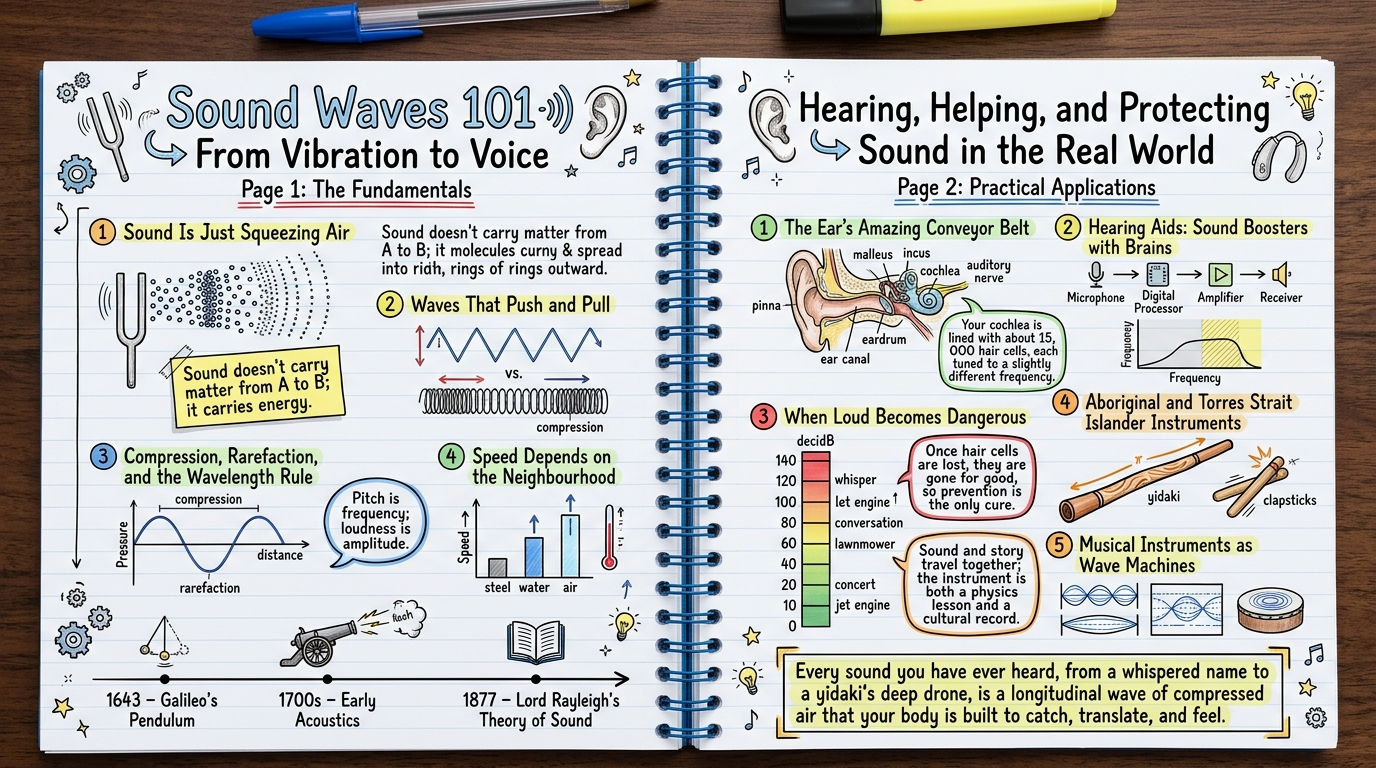
sound waves, longitudinal waves, human hearing, hearing aids, hearing damage, ATSI musical instruments
The same content DoodleNotes wrote before drawing it.
Sound Waves 101 → From Vibration to Voice
- 1
Sound Is Just Squeezing Air
Sound is a vibration that travels through a medium such as air, water, or solids. When an object vibrates, it pushes neighbouring particles together and then lets them spring apart, passing energy along without the particles themselves travelling far. Your ears detect these tiny pressure changes and turn them into the sounds you recognise.
Sticky note: Sound doesn't carry matter from A to B; it carries energy.
- 2
Waves That Push and Pull
Sound is a longitudinal wave, meaning the particles in the medium vibrate parallel to the direction the wave travels. This is different from a water wave or a guitar string wave, where motion is perpendicular to travel. Longitudinal waves create alternating regions of high and low pressure along their path.
- 3
Compression, Rarefaction, and the Wavelength Rule
One full cycle of a longitudinal wave includes one compression and one rarefaction. The distance between two consecutive compressions is the wavelength, and the number of cycles passing a point each second is the frequency. Frequency is measured in hertz (Hz), and higher frequencies are heard as higher pitches.
Sticky note: Pitch is frequency; loudness is amplitude.
- 4
Speed Depends on the Neighbourhood
Sound travels fastest through solids, slower through liquids, and slowest through gases, because particles in solids are packed closely and pass vibrations along quickly. In air at room temperature, sound moves at roughly 343 m/s. Temperature matters too, since warmer air lets particles move faster and carry sound more quickly.
Timeline: 1643 Galileo's Pendulum: Galileo's work on pendulums helps establish how vibrations produce regular, measurable tones. · 1700s Early Acoustics: Scientists begin measuring the speed of sound through air using cannon flashes and timed echoes. · 1877 Lord Rayleigh's Theory of Sound: His two-volume work formalises how waves travel through media.
Hearing, Helping, and Protecting → Sound in the Real World
- 1
The Ear's Amazing Conveyor Belt
The outer ear collects sound and funnels it down the ear canal to the eardrum, which vibrates in response. Three tiny bones in the middle ear, the malleus, incus, and stapes, amplify these vibrations and pass them to the cochlea. Inside the fluid-filled cochlea, hair cells convert vibrations into electrical signals sent to the brain.
Sticky note: Your cochlea is lined with about 15,000 hair cells, each tuned to a slightly different frequency.
- 2
Hearing Aids: Sound Boosters with Brains
Hearing aids pick up sound with a microphone, process it with a digital chip, and amplify the frequencies a person has trouble hearing before playing it through a small speaker. Modern devices can filter background noise and adjust to different environments. They work best when the cochlea's hair cells are partly working, since they boost sound rather than repair damaged hearing.
- 3
When Loud Becomes Dangerous
Hair cells in the cochlea can be bent or destroyed by sustained loud sound, and they do not regenerate in humans. Noise above about 85 decibels over long periods can cause permanent hearing loss, while very sudden loud sounds can damage hearing instantly. Protecting your ears early prevents damage that cannot be reversed.
Sticky note: Once hair cells are lost, they are gone for good, so prevention is the only cure.
- 4
Aboriginal and Torres Strait Islander Instruments
Many First Nations instruments are built to resonate with the natural world, such as the yidaki (didgeridoo), made from hollowed eucalyptus or termite-eaten wood, which produces a continuous drone through circular breathing. Clapsticks, or bilma, create sharp percussive waves when struck together, and their sound carries cultural stories and ceremony. These instruments demonstrate longitudinal sound physics through the vibration of air columns and wooden surfaces.
Sticky note: Sound and story travel together; the instrument is both a physics lesson and a cultural record.
- 5
Musical Instruments as Wave Machines
Instruments create standing waves by vibrating strings, air columns, or membranes, and the resulting pitch depends on length, tension, or size. A longer yidaki produces a lower fundamental tone, just as a longer guitar string does. Overtones blend with the fundamental to give each instrument its unique timbre.
Bottom insight: Every sound you have ever heard, from a whispered name to a yidaki's deep drone, is a longitudinal wave of compressed air that your body is built to catch, translate, and feel.
For study only. Check anything you rely on against your textbook.
Studying something else?
Type a topic and get your own hand-drawn page like this one in about 40 seconds.
your turn