Respiration
Made with DoodleNotes · Oct 28, 2026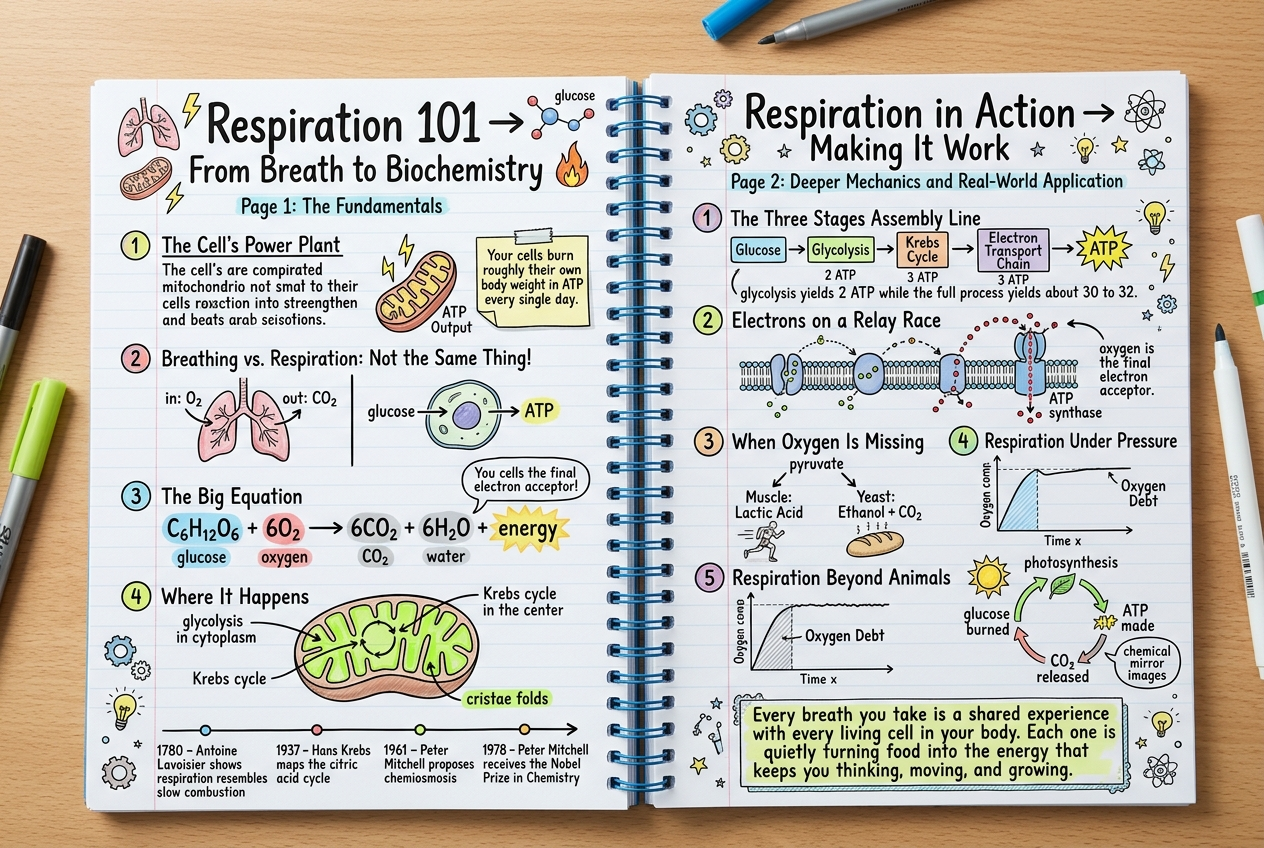
Respiration
The same content DoodleNotes wrote before drawing it.
Respiration 101 → From Breath to Biochemistry
- 1
The Cell's Power Plant
Respiration is the process cells use to break down glucose and release the energy stored inside it. This energy is captured in a molecule called ATP, which powers nearly everything a cell does, from muscle contraction to building new proteins. Without respiration, life as we know it would grind to a halt within minutes.
Sticky note: Your cells burn roughly their own body weight in ATP every single day.
- 2
Breathing vs. Respiration: Not the Same Thing!
Breathing moves air in and out of your lungs, bringing oxygen in and carrying carbon dioxide out. Respiration is the chemical reaction that happens inside your cells, using that oxygen to extract energy from food. Breathing is the delivery service; respiration is the factory that uses the delivery.
- 3
The Big Equation
Aerobic respiration combines glucose and oxygen to produce carbon dioxide, water, and energy. The overall reaction is C6H12O6 + 6O2 → 6CO2 + 6H2O + energy. Although the equation looks simple, it hides dozens of carefully sequenced chemical steps.
Sticky note: Burning glucose in a fire releases the same energy, but cells release it in small, controlled bites instead of one explosive flash.
- 4
Where It Happens
Most of respiration takes place in the mitochondria, often called the powerhouses of the cell. The early steps happen in the cytoplasm, while the final, energy-rich steps occur along folded inner membranes called cristae. Those folds increase surface area, letting the cell pack in far more energy-making machinery.
Timeline: 1780 Antoine Lavoisier shows that respiration resembles slow combustion, using oxygen · 1937 Hans Krebs maps the citric acid cycle, a central step in respiration · 1961 Peter Mitchell proposes chemiosmosis, explaining how ATP is made · 1978 Peter Mitchell receives the Nobel Prize in Chemistry for this work
Respiration in Action → Making It Work
- 1
The Three Stages Assembly Line
Respiration runs in three stages: glycolysis, the Krebs cycle, and the electron transport chain. Glycolysis splits glucose into two pyruvate molecules and makes a small amount of ATP without oxygen. The Krebs cycle and electron transport chain then extract far more energy, with the chain producing the vast majority of ATP.
Sticky note: Glycolysis yields only 2 ATP, but the full process can yield around 30 to 32 ATP per glucose.
- 2
Electrons on a Relay Race
Electrons carried by NADH and FADH2 are passed along a chain of protein complexes embedded in the inner mitochondrial membrane. As electrons move down the chain, they pump protons across the membrane, building up a gradient much like water behind a dam. Protons then rush back through ATP synthase, spinning it like a turbine to produce ATP.
Sticky note: Oxygen is the final electron acceptor. Without it, the chain jams and the whole process stalls.
- 3
When Oxygen Is Missing
Without enough oxygen, cells switch to anaerobic pathways. In muscle cells, pyruvate is converted to lactic acid, which lets glycolysis keep running to regenerate NAD+. Yeast uses a similar trick, converting pyruvate to ethanol and carbon dioxide, which is why bread rises and wine ferments.
- 4
Respiration Under Pressure
Your body adjusts respiration constantly. During exercise, breathing and heart rate increase to supply more oxygen and remove more carbon dioxide. Athletes train to improve their VO2 max, the maximum rate at which their bodies can use oxygen during intense effort.
- 5
Respiration Beyond Animals
Plants respire too, using the same basic machinery, and they do so day and night. Because photosynthesis and respiration are opposite reactions, they form a balance: plants produce glucose and oxygen by day and burn some of it for energy around the clock. Many bacteria also respire using molecules other than oxygen, such as nitrate or sulfate.
Sticky note: Respiration and photosynthesis are chemical mirror images of each other.
Bottom insight: Every breath you take is a shared experience with every living cell in your body. Each one is quietly turning food into the energy that keeps you thinking, moving, and growing.
For study only. Check anything you rely on against your textbook.
Studying something else?
Type a topic and get your own hand-drawn page like this one in about 40 seconds.
your turn