Blood typing, blood donation and Crime scene investigation
Made with DoodleNotes · Oct 27, 2026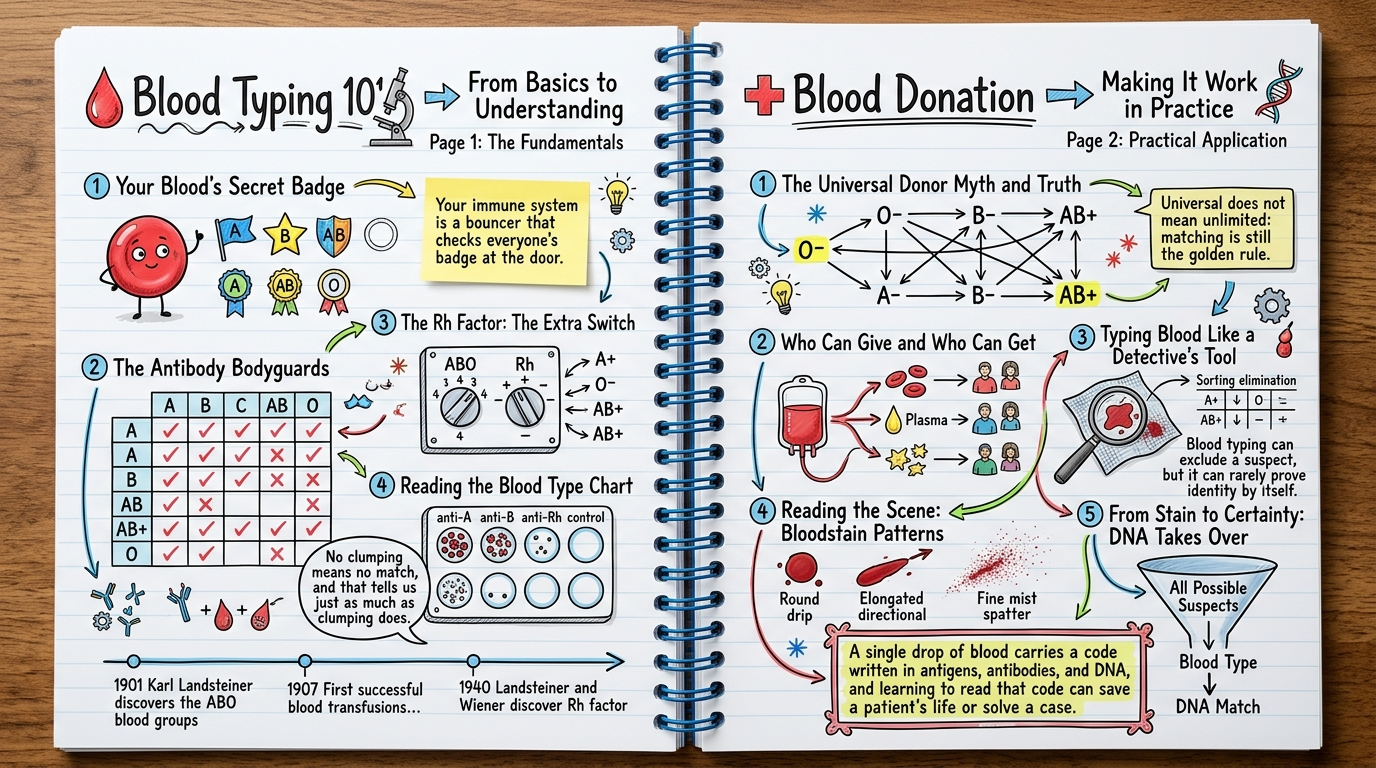
Blood typing, blood donation and Crime scene investigation
The same content DoodleNotes wrote before drawing it.
Blood Typing 101 → From Basics to Understanding
- 1
Your Blood's Secret Badge
Red blood cells carry molecules called antigens on their surface, and these act like tiny ID badges. The ABO system sorts people into four groups based on whether they have antigen A, antigen B, both, or neither. Your immune system learns to recognize your own badges as 'self' and attacks anything that displays an unfamiliar one.
Sticky note: Your immune system is a bouncer that checks everyone's badge at the door.
- 2
The Antibody Bodyguards
Your blood plasma contains antibodies that target antigens you do not have. A person with type A blood carries anti-B antibodies, while type B carries anti-A, and type O carries both. These antibodies are present before any exposure, which is why a mismatched transfusion can trigger a dangerous reaction within minutes.
- 3
The Rh Factor: The Extra Switch
Beyond the ABO system, a second protein called the Rh factor is either present (Rh positive) or absent (Rh negative) on red blood cells. Combined with the ABO group, this produces the eight common blood types such as A+, O-, or AB+. Unlike ABO antibodies, anti-Rh antibodies usually form only after exposure, such as during pregnancy or a transfusion.
- 4
Reading the Blood Type Chart
Blood typing works by mixing a sample with known anti-A and anti-B serums and watching for clumping, called agglutination. If the blood clumps with anti-A, it has A antigens, and so on. Clumping is the visible signal that reveals the hidden badge on each cell.
Sticky note: No clumping means no match, and that tells us just as much as clumping does.
Timeline: 1901 Karl Landsteiner discovers the ABO blood groups · 1907 First successful blood transfusions using blood typing · 1940 Landsteiner and Wiener discover the Rh factor
Blood Donation → Making It Work in Practice
- 1
The Universal Donor Myth and Truth
Type O negative is often called the universal red cell donor because its cells lack A, B, and Rh antigens, so they rarely trigger reactions. Type AB positive is the universal plasma recipient because it has no anti-A or anti-B antibodies to attack donor plasma. In practice, hospitals still match blood carefully, since rules vary by transfusion type.
Sticky note: Universal does not mean unlimited: matching is still the golden rule.
- 2
Who Can Give and Who Can Get
Donors must meet health criteria such as minimum weight, hemoglobin levels, and a recent health screening. Donated whole blood is separated into components like red cells, plasma, and platelets, so one donation can help several patients. Blood banks test every unit for infections and screen donors carefully to keep the supply safe.
- 3
Typing Blood Like a Detective's Tool
Blood typing is not only for transfusions; it is also a rapid screening tool. Forensic scientists type bloodstains found at crime scenes and compare them with suspects or victims to narrow down possibilities. Because ABO types are shared by many people, typing alone rarely identifies a person, but it can rule people in or out.
Sticky note: Blood typing can exclude a suspect, but it can rarely prove identity by itself.
- 4
Reading the Scene: Bloodstain Patterns
The shape, size, and distribution of bloodstains reveal how blood was released and how the scene may have unfolded. Spatter from a high-velocity impact looks like a fine mist, while drops falling straight down form round stains with sharp edges. Investigators use these clues to reconstruct events and test whether a story matches the physical evidence.
- 5
From Stain to Certainty: DNA Takes Over
When investigators need individual identification, they move beyond blood type to DNA profiling. Blood typing narrows the field quickly and cheaply, while DNA analysis provides the near-certain match needed for court. Modern labs often use both: blood typing as a first filter, DNA as the final proof.
Bottom insight: A single drop of blood carries a code written in antigens, antibodies, and DNA, and learning to read that code can save a patient's life or solve a case.
For study only. Check anything you rely on against your textbook.
Studying something else?
Type a topic and get your own hand-drawn page like this one in about 40 seconds.
your turn