CARTELERA DE Reproducción de invertebrados y reproducción en vertebrados y mecanismos de reproducción en vertebrados
Made with DoodleNotes · Oct 25, 2026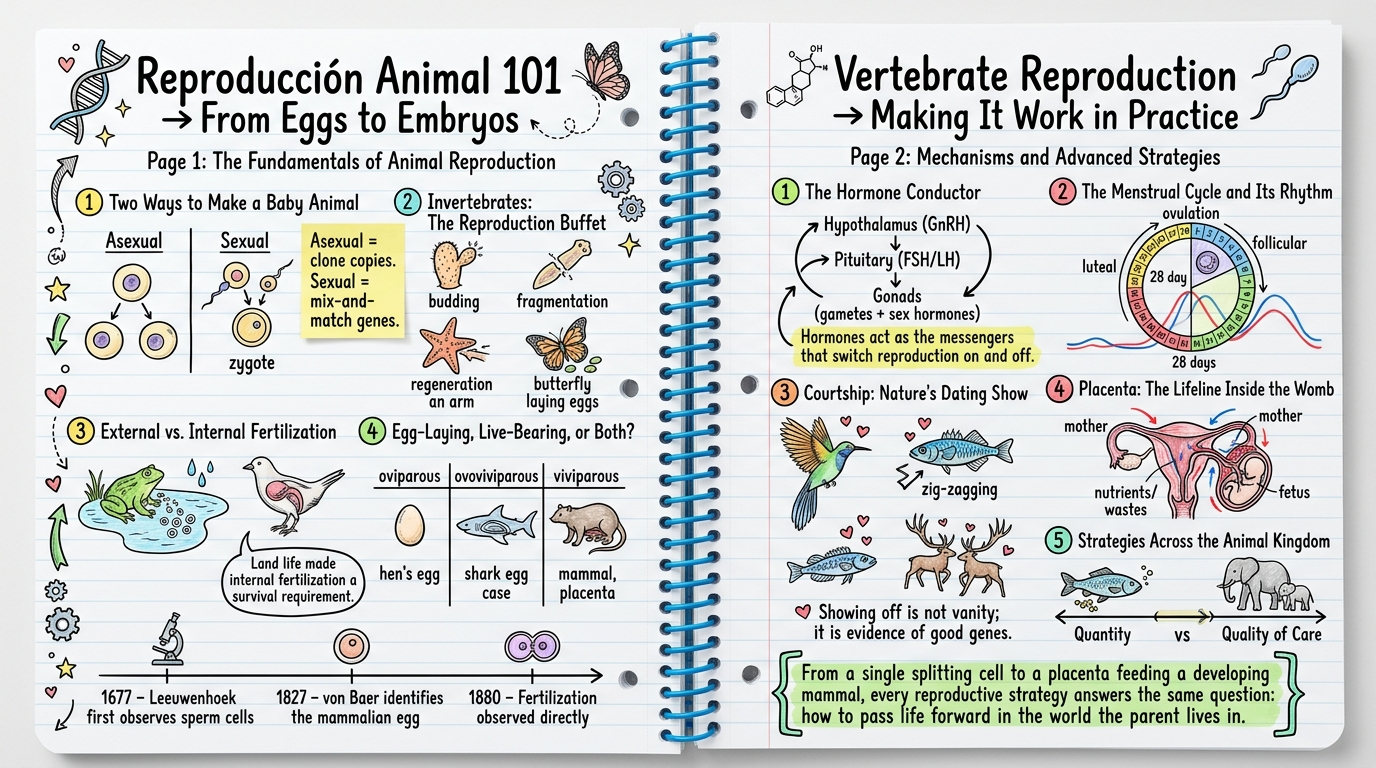
CARTELERA DE Reproducción de invertebrados y reproducción en vertebrados y mecanismos de reproducción en vertebrados
The same content DoodleNotes wrote before drawing it.
Reproducción Animal 101 → From Eggs to Embryos
- 1
Two Ways to Make a Baby Animal
Animals reproduce in two main ways: asexual reproduction, where a single parent produces offspring genetically identical to itself, and sexual reproduction, where two parents contribute gametes that combine to form a genetically unique zygote. Invertebrates use both strategies, while most vertebrates rely mainly on sexual reproduction. Each strategy trades speed for diversity in a different way.
Sticky note: Asexual = clone copies. Sexual = mix-and-match genes.
- 2
Invertebrates: The Reproduction Buffet
Invertebrates show remarkable variety. Sponges and hydras can bud off new individuals, planarians regenerate whole bodies from fragments, and starfish can regrow lost arms that develop into new starfish. Insects, mollusks, and worms usually reproduce sexually, often laying eggs in large numbers to offset high mortality.
- 3
External vs. Internal Fertilization
In external fertilization, eggs and sperm meet in water outside the body, as in most fish and frogs. Internal fertilization happens inside the female's body, which protects the gametes from drying out and predators. Internal fertilization is essential for animals living on land, where gametes would otherwise dehydrate quickly.
Sticky note: Land life made internal fertilization a survival requirement.
- 4
Egg-Laying, Live-Bearing, or Both?
Vertebrates reproduce in three main patterns. Oviparous animals lay eggs with yolk that feeds the embryo outside the mother, as in birds and most reptiles. Ovoviviparous animals keep eggs inside the body until they hatch, as in some sharks. Viviparous animals nourish developing young through a placenta, as in mammals.
Timeline: 1677 Leeuwenhoek first observes sperm cells under a microscope · 1827 von Baer identifies the mammalian egg, confirming egg-based reproduction · 1880 Fertilization in animals is observed directly, linking gametes to new life
Vertebrate Reproduction → Making It Work in Practice
- 1
The Hormone Conductor
Reproduction in vertebrates is coordinated by the hypothalamus, pituitary gland, and gonads through the HPG axis. The hypothalamus releases GnRH, which triggers the pituitary to secrete FSH and LH. These hormones stimulate the gonads to produce gametes and sex hormones such as estrogen, progesterone, and testosterone.
Sticky note: Hormones act as the messengers that switch reproduction on and off.
- 2
The Menstrual Cycle and Its Rhythm
In female mammals, hormones drive the menstrual or estrous cycle. Follicles mature in the ovary, one releases an egg at ovulation, and the uterine lining thickens to prepare for implantation. If fertilization does not occur, the lining is shed in menstruation, while in many other mammals the lining is reabsorbed instead.
- 3
Courtship: Nature's Dating Show
Many vertebrates perform elaborate courtship before mating. Birds of paradise dance and display colorful plumage, stickleback fish build nests and perform zigzag displays, and deer compete through antler contests. These behaviors help individuals signal health and fitness, increasing the chance of successful reproduction.
Sticky note: Showing off is not vanity; it is evidence of good genes.
- 4
Placenta: The Lifeline Inside the Womb
In placental mammals, the placenta grows from both embryonic and maternal tissues to exchange oxygen, nutrients, and wastes with the mother's blood without mixing it. Because the placenta filters what passes through, it protects the embryo from many substances but not all, which is why certain drugs and infections can still harm development.
- 5
Strategies Across the Animal Kingdom
Reproductive strategies reflect environment and survival odds. Species with high juvenile mortality, such as many fish, produce thousands of eggs with little parental care. Species like elephants and primates produce few offspring but invest heavily in each one through long gestation, nursing, and teaching. Both approaches are successful; they simply balance quantity and quality differently.
Bottom insight: From a single splitting cell to a placenta feeding a developing mammal, every reproductive strategy answers the same question: how to pass life forward in the world the parent lives in.
For study only. Check anything you rely on against your textbook.
Studying something else?
Type a topic and get your own hand-drawn page like this one in about 40 seconds.
your turn