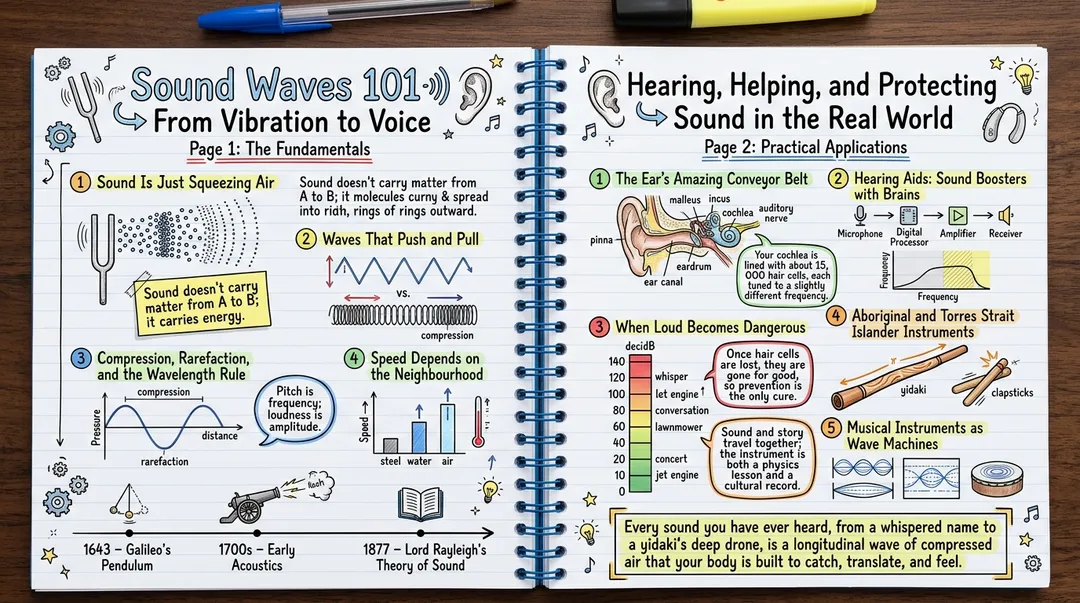
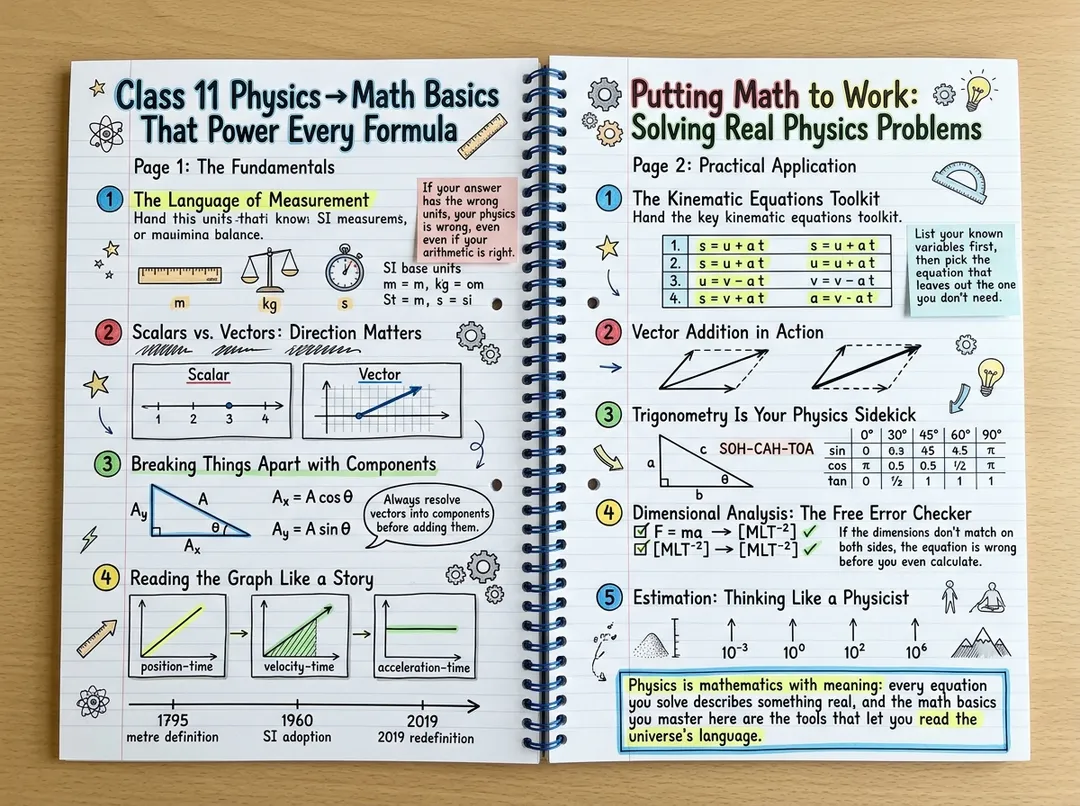
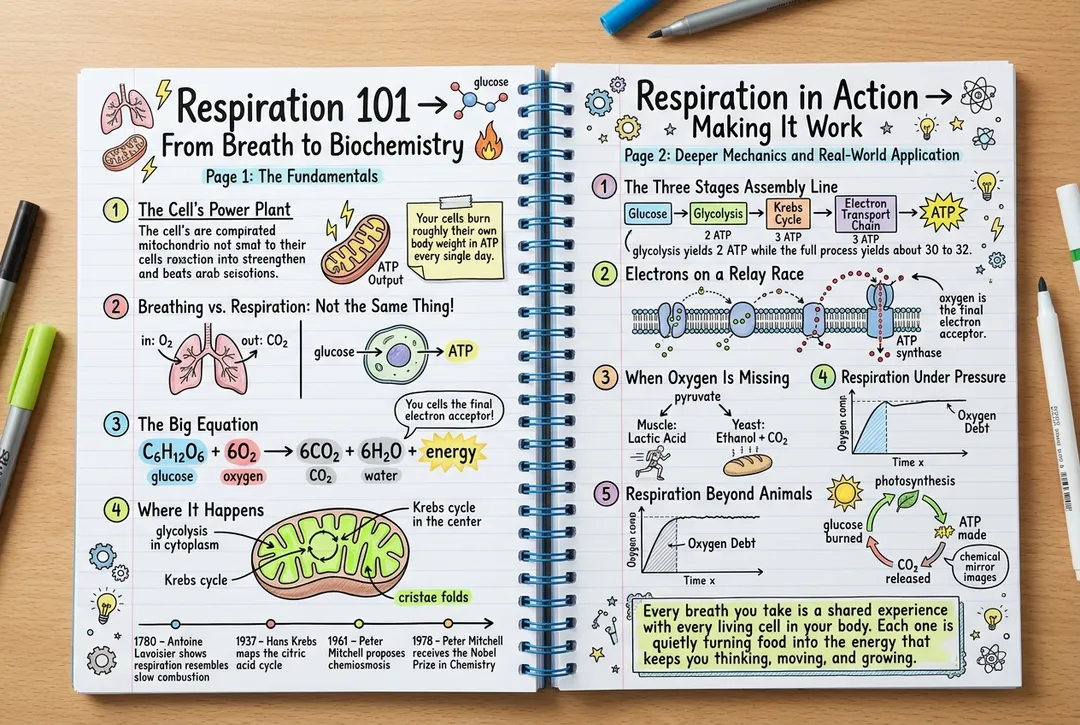
Chapter 1 exploration : enteing the world of secondary science
Made with DoodleNotes · Oct 27, 2026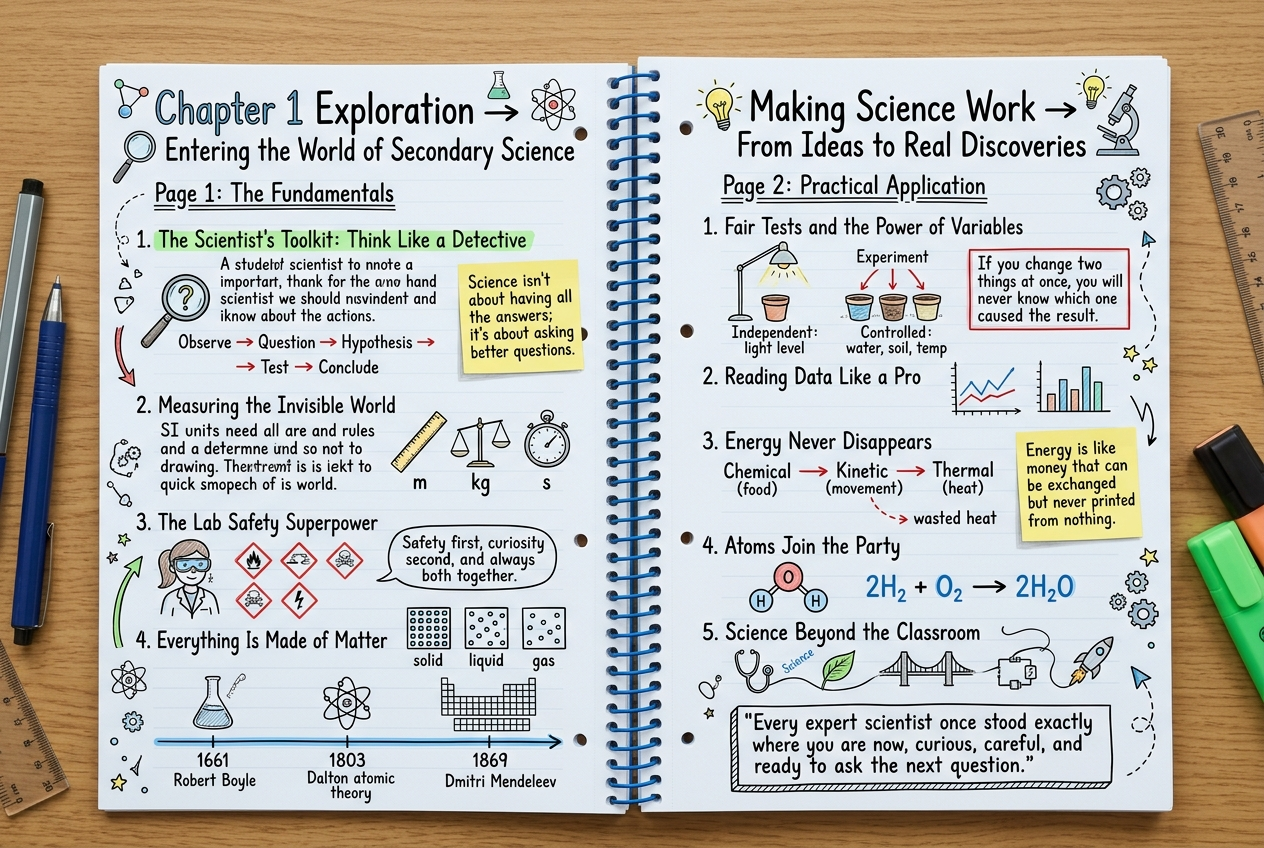
Chapter 1 exploration : enteing the world of secondary science
The same content DoodleNotes wrote before drawing it.
Chapter 1 Exploration → Entering the World of Secondary Science
- 1
The Scientist's Toolkit: Think Like a Detective
Science is a way of asking questions and finding answers through evidence. Scientists observe the world carefully, form testable ideas called hypotheses, and check them through experiments. Every great discovery started with someone who noticed something curious and asked 'why?'
Sticky note: Science isn't about having all the answers; it's about asking better questions.
- 2
Measuring the Invisible World
Scientists rely on units and measurements to describe the world in a shared language. Length is measured in metres, mass in kilograms, and time in seconds, following the SI system used worldwide. Accurate measurement makes it possible to compare results and repeat experiments reliably.
- 3
The Lab Safety Superpower
A good scientist always protects themselves and others before starting any experiment. Safety goggles, lab coats, and tied-back hair are basic protection, and hazard symbols warn you of chemical or physical dangers. Following safety rules is part of doing science properly, not an interruption to it.
Sticky note: Safety first, curiosity second, and always both together.
- 4
Everything Is Made of Matter
Matter is anything that has mass and takes up space, from the air you breathe to the desk you lean on. Matter exists as solids, liquids, or gases depending on how closely its particles are packed and how freely they move. This particle model explains almost every physical change you will study.
Timeline: 1661 Robert Boyle defines the modern idea of an element in The Sceptical Chymist · 1803 John Dalton proposes atomic theory, that matter is made of tiny indivisible atoms · 1869 Dmitri Mendeleev publishes the periodic table of elements
Making Science Work → From Ideas to Real Discoveries
- 1
Fair Tests and the Power of Variables
A fair test changes only one variable at a time while keeping everything else constant. The variable you change is the independent variable, and the one you measure is the dependent variable. Controlling the rest of the conditions ensures that any change you see is caused by what you tested.
Sticky note: If you change two things at once, you will never know which one caused the result.
- 2
Reading Data Like a Pro
Data becomes meaningful when it is organised into tables, graphs, and averages. Line graphs show trends over time, bar charts compare categories, and scatter plots reveal relationships between two variables. Always label your axes with units and include a clear title.
- 3
Energy Never Disappears
Energy can change from one form to another, such as chemical energy in food becoming kinetic energy when you run. The law of conservation of energy states that energy is never created or destroyed, only transferred or transformed. Some energy always spreads out as heat, which is why machines get warm.
Sticky note: Energy is like money that can be exchanged but never printed from nothing.
- 4
Atoms Join the Party
Atoms bond together to form molecules and compounds, such as water (H₂O) made from two hydrogen atoms and one oxygen atom. Chemical reactions rearrange these atoms, but the total number of each type of atom stays the same. This is why chemical equations must always be balanced.
- 5
Science Beyond the Classroom
Secondary science connects directly to medicine, environmental protection, engineering, and technology. Understanding these basics helps you evaluate news about climate change, vaccines, or new materials. Every step you take in this course builds the reasoning skills used by professional scientists.
Bottom insight: Every expert scientist once stood exactly where you are now, curious, careful, and ready to ask the next question.
For study only. Check anything you rely on against your textbook.
Studying something else?
Type a topic and get your own hand-drawn page like this one in about 40 seconds.
your turn