Chapter 1 exploration : enteing the world of secondary science
Made with DoodleNotes · Oct 27, 2026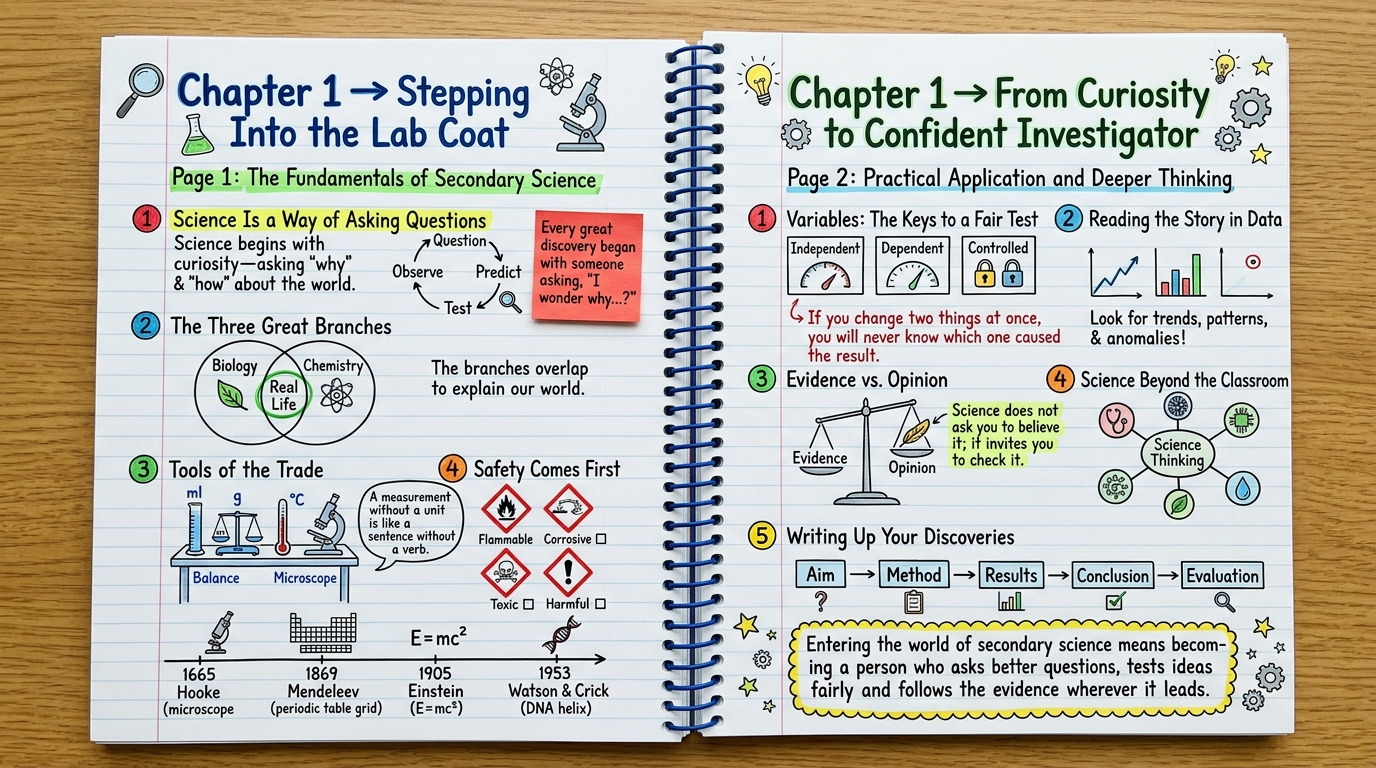
Chapter 1 exploration : enteing the world of secondary science
The same content DoodleNotes wrote before drawing it.
Chapter 1 → Stepping Into the Lab Coat
- 1
Science Is a Way of Asking Questions
Science is not just a list of facts to memorise; it is a process of curiosity. Scientists observe the world, ask 'why' and 'how', and then test their ideas. In secondary school, you begin to think and work like a scientist every time you make a prediction and check it.
Sticky note: Every great discovery began with someone asking, 'I wonder why...?'
- 2
The Three Great Branches
Secondary science is usually split into biology, chemistry and physics. Biology studies living things, chemistry studies substances and how they change, and physics studies energy, forces and motion. Although they look separate, they overlap constantly, such as when chemistry explains how your muscles use energy.
- 3
Tools of the Trade
Scientists rely on careful measurement and safe, accurate equipment. You will learn to use rulers, thermometers, balances and microscopes, and to record results in tables and graphs. Units such as metres, grams and seconds give your measurements meaning so others can understand and repeat your work.
Sticky note: A measurement without a unit is like a sentence without a verb.
- 4
Safety Comes First
Every experiment starts with a risk check. Goggles, lab coats, tied-back hair and clean benches protect you and your classmates. Knowing the hazard symbols on chemical bottles helps you act responsibly before anything goes wrong.
Timeline: 1665 Robert Hooke publishes Micrographia, revealing cells through a microscope · 1869 Mendeleev arranges the elements into the periodic table · 1905 Einstein explains energy and mass in his famous equation · 1953 Watson and Crick reveal the double helix structure of DNA
Chapter 1 → From Curiosity to Confident Investigator
- 1
Variables: The Keys to a Fair Test
A fair test changes only one thing at a time, called the independent variable. The thing you measure is the dependent variable, and everything else must be kept the same, these are the control variables. When you control variables well, your results truly show cause and effect.
Sticky note: If you change two things at once, you will never know which one caused the result.
- 2
Reading the Story in Data
Results are only useful when you can interpret them. A line graph can reveal a pattern, a bar chart can compare groups, and an anomaly, a result that does not fit, deserves investigation rather than deletion. Good scientists explain what the data shows and how confident they are in it.
- 3
Evidence vs. Opinion
A scientific claim must be backed by evidence that others can check. Opinions feel convincing, but evidence can be tested, repeated and challenged. Learning to ask 'What is the evidence for this?' will help you judge news stories, advertisements and even your own conclusions.
Sticky note: Science does not ask you to believe it; it invites you to check it.
- 4
Science Beyond the Classroom
The skills you build here support careers in medicine, engineering, environmental protection and technology, and they help you make informed decisions as a citizen. Every time you read a food label, check a weather forecast or troubleshoot a phone, you are using scientific thinking.
- 5
Writing Up Your Discoveries
A clear lab report tells the story of your investigation: the question, the method, the results and the conclusion. Writing in a logical order lets another scientist repeat your work exactly. Your report is both a record and an invitation for others to build on what you found.
Bottom insight: Entering the world of secondary science means becoming a person who asks better questions, tests ideas fairly and follows the evidence wherever it leads.
For study only. Check anything you rely on against your textbook.
Studying something else?
Type a topic and get your own hand-drawn page like this one in about 40 seconds.
your turn