Chapter 2 cell : the bulding block of life
Made with DoodleNotes · Oct 27, 2026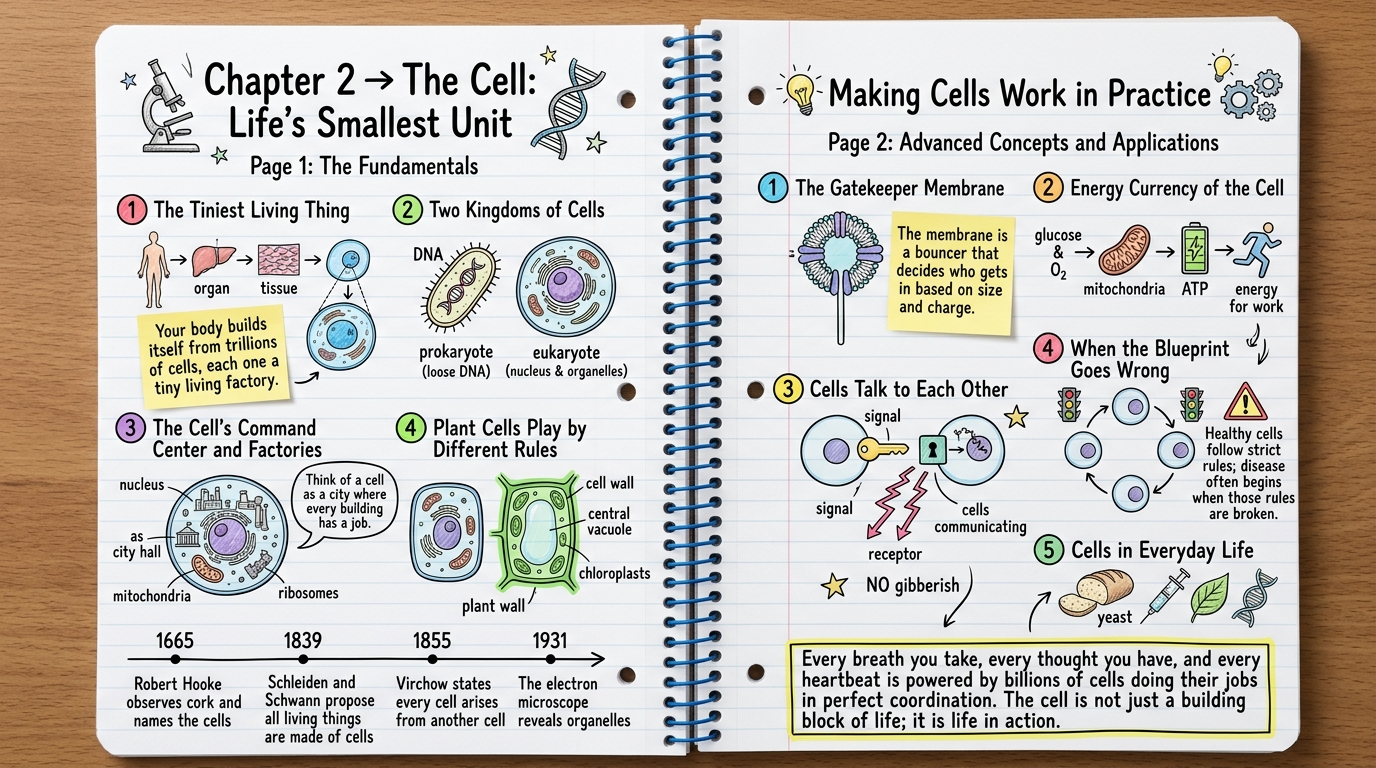
Chapter 2 cell : the bulding block of life
The same content DoodleNotes wrote before drawing it.
Chapter 2 → The Cell: Life's Smallest Unit
- 1
The Tiniest Living Thing
A cell is the smallest unit that can carry out all the processes we associate with life. Some organisms, like bacteria, are single cells, while your body contains roughly 37 trillion of them working together. Every cell is surrounded by a thin, flexible boundary called the cell membrane that controls what enters and leaves.
Sticky note: Your body builds itself from trillions of cells, each one a tiny living factory.
- 2
Two Kingdoms of Cells
Cells come in two main types: prokaryotic cells, which lack a nucleus and are found in bacteria, and eukaryotic cells, which have a membrane-bound nucleus and are found in plants, animals, fungi, and protists. Eukaryotic cells are generally larger and more complex, with many specialized compartments.
- 3
The Cell's Command Center and Factories
Organelles are the specialized structures inside a cell, each with a specific job. The nucleus stores DNA and directs activity, mitochondria release energy from food, and ribosomes build proteins. Together they act like departments in a busy city, each doing a critical task.
Sticky note: Think of a cell as a city where every building has a job and the whole city depends on teamwork.
- 4
Plant Cells Play by Different Rules
Plant cells share most organelles with animal cells but add three special features: a rigid cell wall for support, a large central vacuole for storage, and chloroplasts that capture sunlight to make food. These additions let plants stand upright and make their own energy.
Timeline: 1665 Robert Hooke observes cork under a microscope and names the 'cells' · 1839 Schleiden and Schwann propose that all living things are made of cells · 1855 Rudolf Virchow states that every cell arises from another existing cell · 1931 The electron microscope is developed, revealing organelles in detail
Making Cells Work in Practice
- 1
The Gatekeeper Membrane
The cell membrane is built from a phospholipid bilayer studded with proteins. Its selective permeability allows oxygen and water to pass easily while blocking large or charged molecules unless they are carried across by transport proteins. This control keeps the internal environment stable.
Sticky note: The membrane is a bouncer that decides who gets in based on size and charge.
- 2
Energy Currency of the Cell
Cells run on ATP, a molecule that stores energy in its chemical bonds. Mitochondria produce most of a cell's ATP through cellular respiration, while chloroplasts make sugars through photosynthesis. Breaking ATP releases energy to power everything from muscle contraction to protein building.
- 3
Cells Talk to Each Other
Cells communicate using chemical signals such as hormones and neurotransmitters. A signal molecule binds to a receptor on the target cell, triggering a chain of reactions inside it. This signaling coordinates growth, healing, and responses to the environment.
- 4
When the Blueprint Goes Wrong
Cells divide through the cell cycle, copying DNA and splitting in two. When regulation fails, cells can divide uncontrollably, forming cancer. Understanding normal cell processes helps scientists develop treatments that target these faulty signals.
Sticky note: Healthy cells follow strict rules; disease often begins when those rules are broken.
- 5
Cells in Everyday Life
Cell biology drives modern medicine, from vaccines and antibiotics to stem cell therapies and genetically modified crops. Even your daily bread depends on yeast cells fermenting sugars. Recognizing cells in everyday life connects textbook ideas to the world around you.
Bottom insight: Every breath you take, every thought you have, and every heartbeat is powered by billions of cells doing their jobs in perfect coordination. The cell is not just a building block of life; it is life in action.
For study only. Check anything you rely on against your textbook.
Studying something else?
Type a topic and get your own hand-drawn page like this one in about 40 seconds.
your turn