Diffusion
Made with DoodleNotes · Oct 26, 2026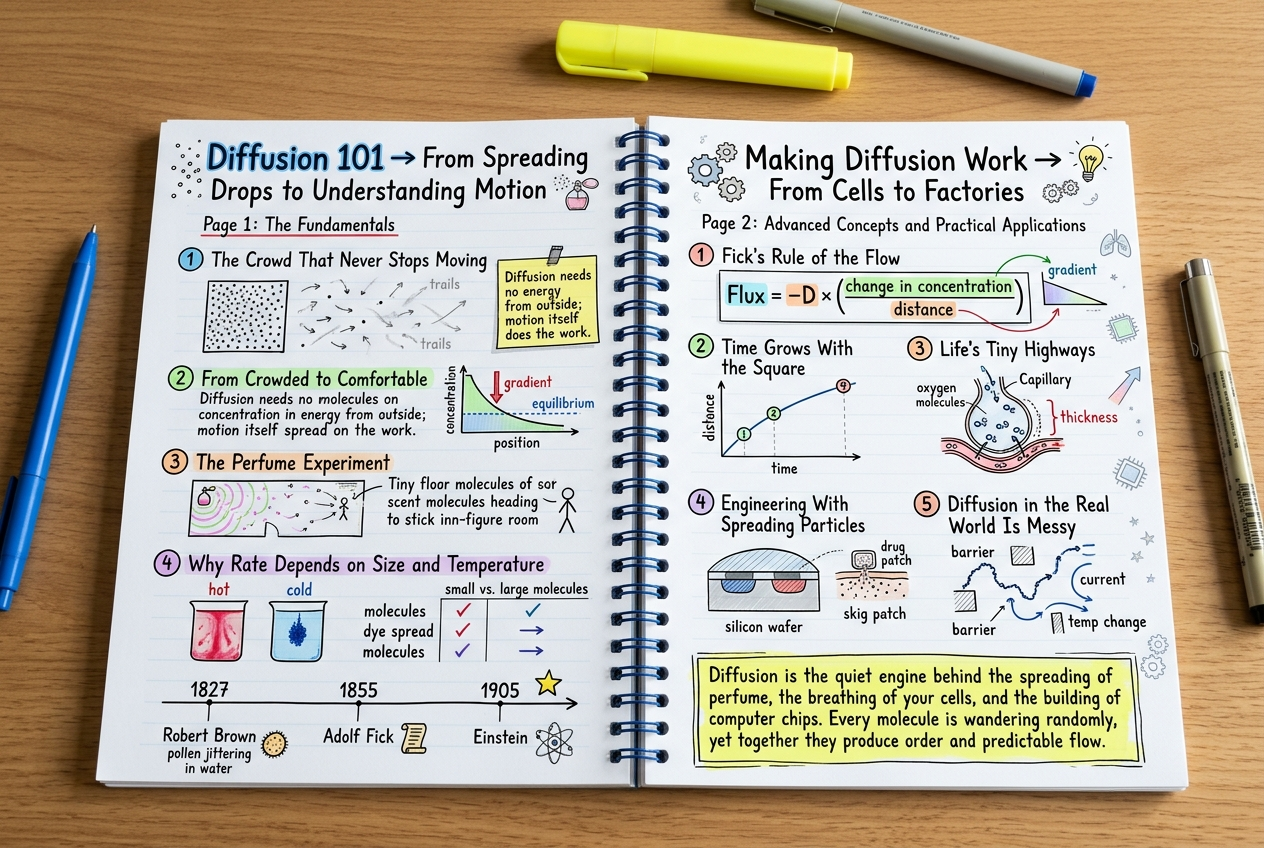
Diffusion
The same content DoodleNotes wrote before drawing it.
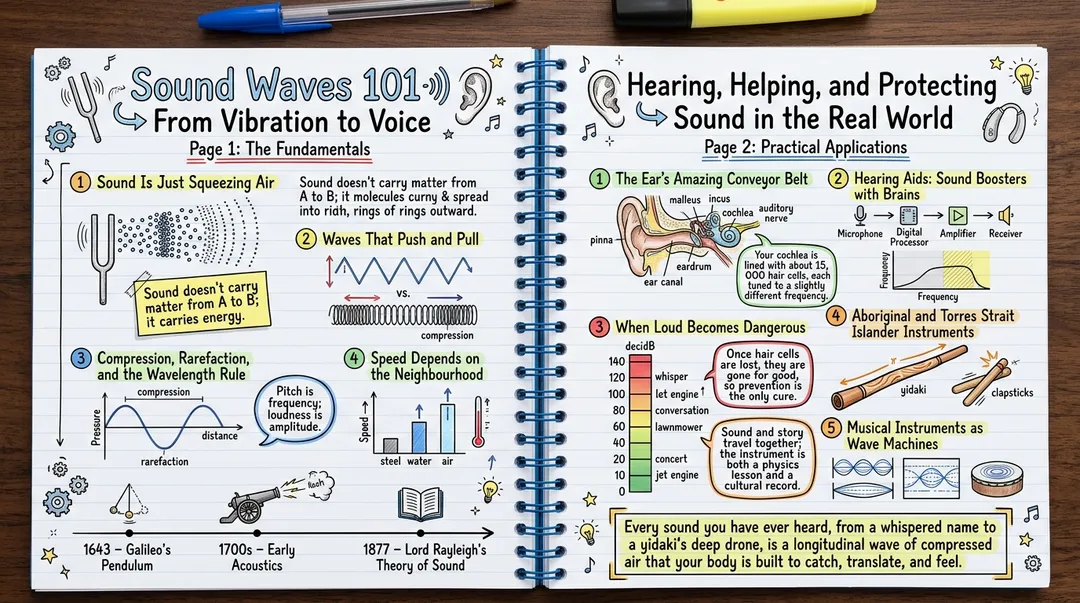
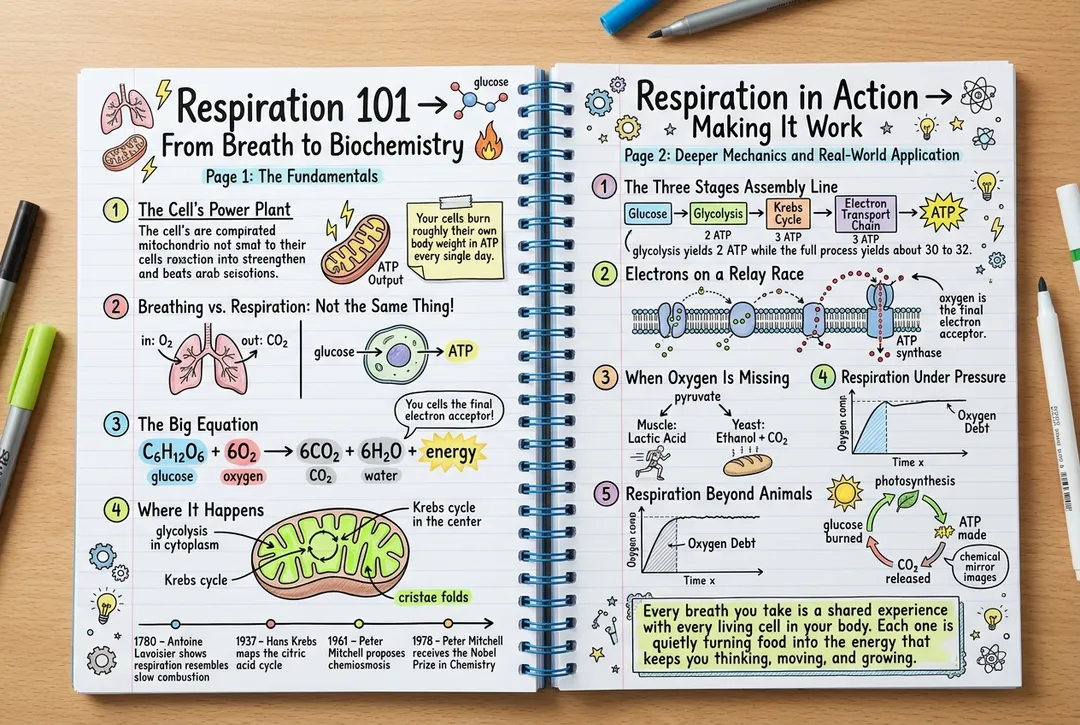
Diffusion 101 → From Spreading Drops to Understanding Motion
- 1
The Crowd That Never Stops Moving
Every particle in a gas or liquid is in constant, random motion, bumping into its neighbors billions of times per second. Diffusion is the net result of this chaotic motion: particles spread out from where they are crowded to where there is room. Nobody pushes them; they simply wander until the crowd evens out.
Sticky note: Diffusion needs no energy from outside; motion itself does the work.
- 2
From Crowded to Comfortable
Diffusion always moves particles down a concentration gradient, from high concentration to low concentration. The steeper the difference between the two regions, the faster the spreading happens. Once concentrations are equal, particles keep moving but there is no longer any net flow.
- 3
The Perfume Experiment
Open a bottle of perfume in one corner of a room and within minutes people across the room can smell it. No air currents are needed for this to happen, because the scent molecules are diffusing through the air on their own. This everyday event is the clearest example of diffusion you will ever experience.
- 4
Why Rate Depends on Size and Temperature
Smaller particles and hotter temperatures make diffusion faster because small, energetic particles move more quickly and travel further between collisions. Larger molecules move sluggishly and spread more slowly. This is why a drop of food coloring spreads faster in warm water than in cold water.
Timeline: 1827 Robert Brown observes pollen grains jittering in water, the first clue to particle motion · 1855 Adolf Fick publishes his laws describing diffusion mathematically · 1905 Einstein explains Brownian motion, confirming that atoms really exist
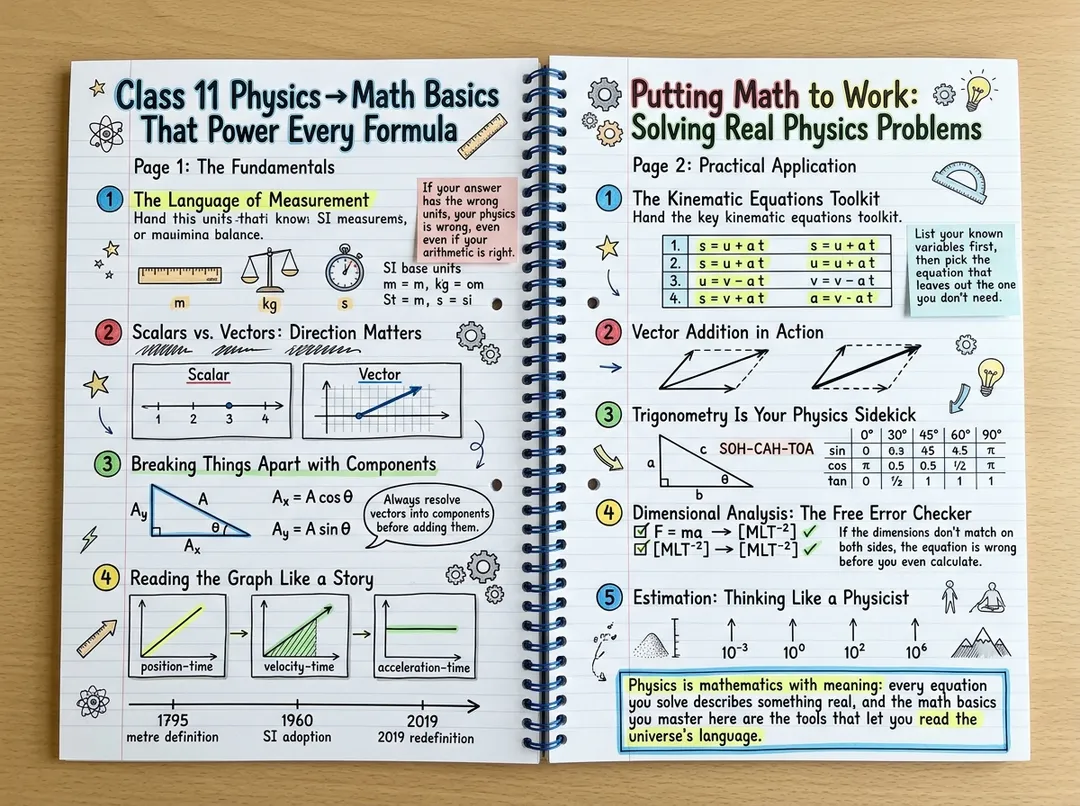
Making Diffusion Work → From Cells to Factories
- 1
Fick's Rule of the Flow
Fick's First Law states that the flux of particles is proportional to the concentration gradient and a constant called the diffusion coefficient. Written simply, flux equals minus D times the change in concentration over distance. The minus sign reminds us that flow goes from high to low concentration.
Sticky note: Flux = −D × (change in concentration ÷ distance)
- 2
Time Grows With the Square
The average distance a diffusing particle travels grows with the square root of time, not with time itself. This means doubling the distance takes four times as long. That is why diffusion is excellent over tiny distances but painfully slow across a room, let alone across a body.
- 3
Life's Tiny Highways
Cells rely on diffusion to move oxygen into their interiors and carbon dioxide out, since their membranes and cytoplasm have no pumps for these gases. In your lungs, oxygen diffuses across extremely thin alveolar walls into your blood, which is why those walls are only one cell thick. Diffusion is a biological necessity, not just a physics demonstration.
- 4
Engineering With Spreading Particles
Engineers use diffusion to make computer chips by baking dopant atoms into silicon wafers, creating the precise regions that form transistors. Diffusion also drives drug delivery through skin patches and governs how pollutants disperse in rivers and air. Controlling the spread is central to a huge range of technologies.
- 5
Diffusion in the Real World Is Messy
Real environments are rarely uniform, so diffusion can be sped up or slowed by barriers, currents, and changing temperatures. Scientists model these complications with equations that adjust the diffusion coefficient across space and time. Understanding these models helps predict everything from groundwater contamination to how medicines reach tumors.
Bottom insight: Diffusion is the quiet engine behind the spreading of perfume, the breathing of your cells, and the building of computer chips. Every molecule is wandering randomly, yet together they produce order and predictable flow.
For study only. Check anything you rely on against your textbook.
Studying something else?
Type a topic and get your own hand-drawn page like this one in about 40 seconds.
your turn