Dissolving, Solutions and solubility, paper chromatography for grade 7
Made with DoodleNotes · Oct 26, 2026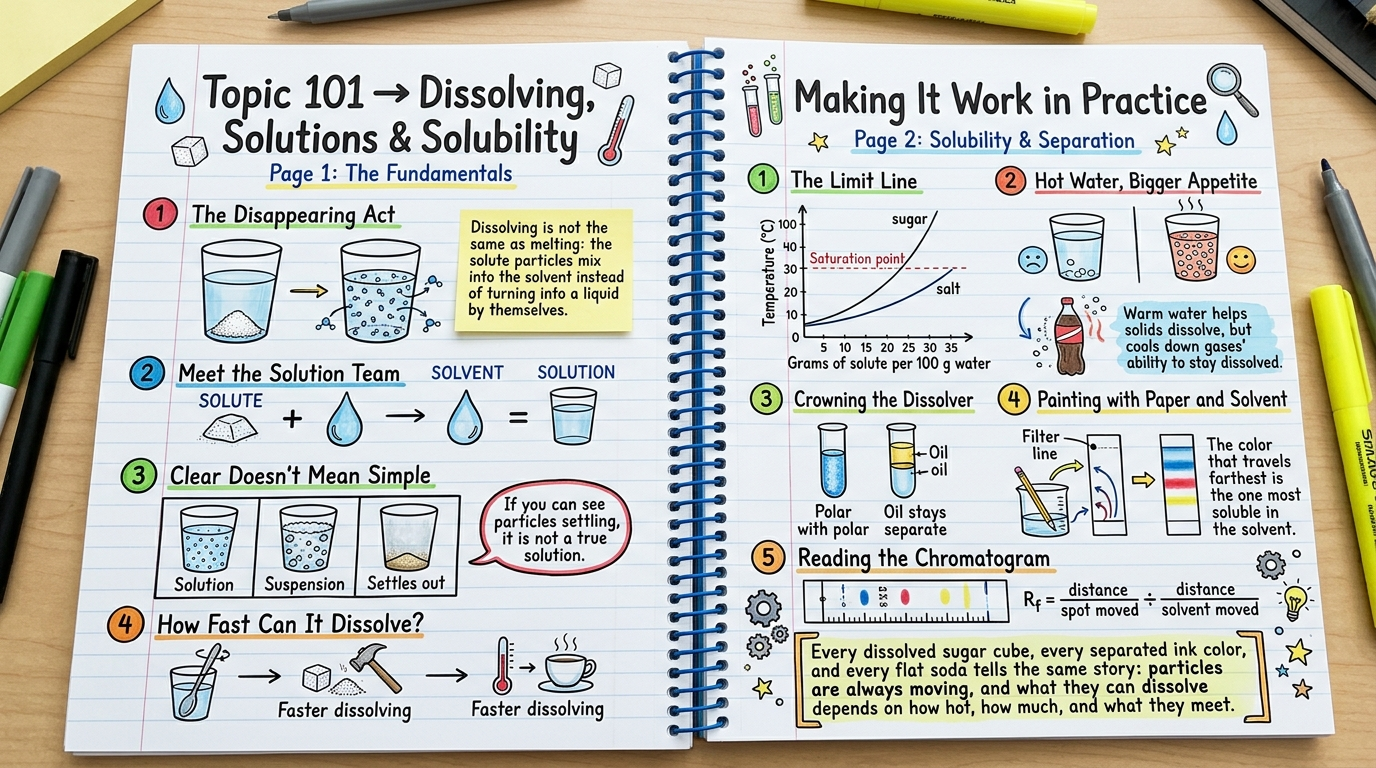
Dissolving, Solutions and solubility, paper chromatography for grade 7
The same content DoodleNotes wrote before drawing it.
Topic 101 → Dissolving, Solutions & Solubility
- 1
The Disappearing Act
When a solid like sugar or salt is mixed into water, it seems to vanish. In reality, its particles spread out evenly between the water molecules, so the solid is still there but too small and spread out to see. This process is called dissolving, and the substance that disappears is the solute.
Sticky note: Dissolving is not the same as melting: the solute particles mix into the solvent instead of turning into a liquid by themselves.
- 2
Meet the Solution Team
Every solution has two main parts. The solute is the substance that gets dissolved, and the solvent is the substance that does the dissolving. In salt water, salt is the solute and water is the solvent. Together they form a solution, which is always a uniform mixture throughout.
- 3
Clear Doesn't Mean Simple
Solutions can look completely clear, yet they are made of different particles mixed together. Because the particles are so small, light passes through them without scattering. Solutions do not separate over time, which sets them apart from suspensions like muddy water, where particles settle to the bottom.
Sticky note: If you can see particles settling, it is not a true solution.
- 4
How Fast Can It Dissolve?
Dissolving speed depends on a few factors. Stirring spreads the solute particles faster, crushing a solid increases its surface area so more particles meet the solvent at once, and warmer solvents let particles move more quickly. Knowing these factors helps you dissolve things faster in the kitchen or the lab.
Making It Work in Practice
- 1
The Limit Line
Solvents can only hold so much solute. Solubility is the maximum amount of solute that dissolves in a given amount of solvent at a set temperature. Once that limit is reached, extra solute stays undissolved, and the solution is called saturated.
Sticky note: A solution holding all the solute it can is called saturated. Add more solute and it simply sits at the bottom.
- 2
Hot Water, Bigger Appetite
For most solids, raising the temperature increases solubility because particles move faster and make more room for solute. This is why it is easier to dissolve a large amount of sugar in hot tea than in iced tea. Gases behave differently: warmer water holds less dissolved gas, which is why soda goes flat when it gets warm.
Sticky note: Warm water helps solids dissolve, but cools down gases' ability to stay dissolved.
- 3
Crowning the Dissolver
Solubility also depends on the type of solvent and solute. Water is called the universal solvent because it dissolves so many substances, especially those with charged or polar parts. Oil does not mix with water because its molecules are non-polar, so oil and water form two separate layers.
- 4
Painting with Paper and Solvent
Paper chromatography uses a solvent to separate the parts of a mixture, such as the colors in black ink. A strip of filter paper is dipped in a solvent, which climbs up the paper by capillary action. Each dye dissolves to a different degree and travels a different distance, revealing the hidden colors.
Sticky note: The color that travels farthest is the one most soluble in the solvent.
- 5
Reading the Chromatogram
To interpret a chromatogram, measure the distance each spot traveled from the starting line and compare it with the solvent front. This ratio, called the Rf value, helps identify substances because it stays consistent under the same conditions. Scientists use this method to check food dyes, detect drugs, and investigate crime scenes.
Bottom insight: Every dissolved sugar cube, every separated ink color, and every flat soda tells the same story: particles are always moving, and what they can dissolve depends on how hot, how much, and what they meet.
For study only. Check anything you rely on against your textbook.
Studying something else?
Type a topic and get your own hand-drawn page like this one in about 40 seconds.
your turn