Dissolving, Solutions and solubility, paper chromatography for grade 7
Made with DoodleNotes · Oct 26, 2026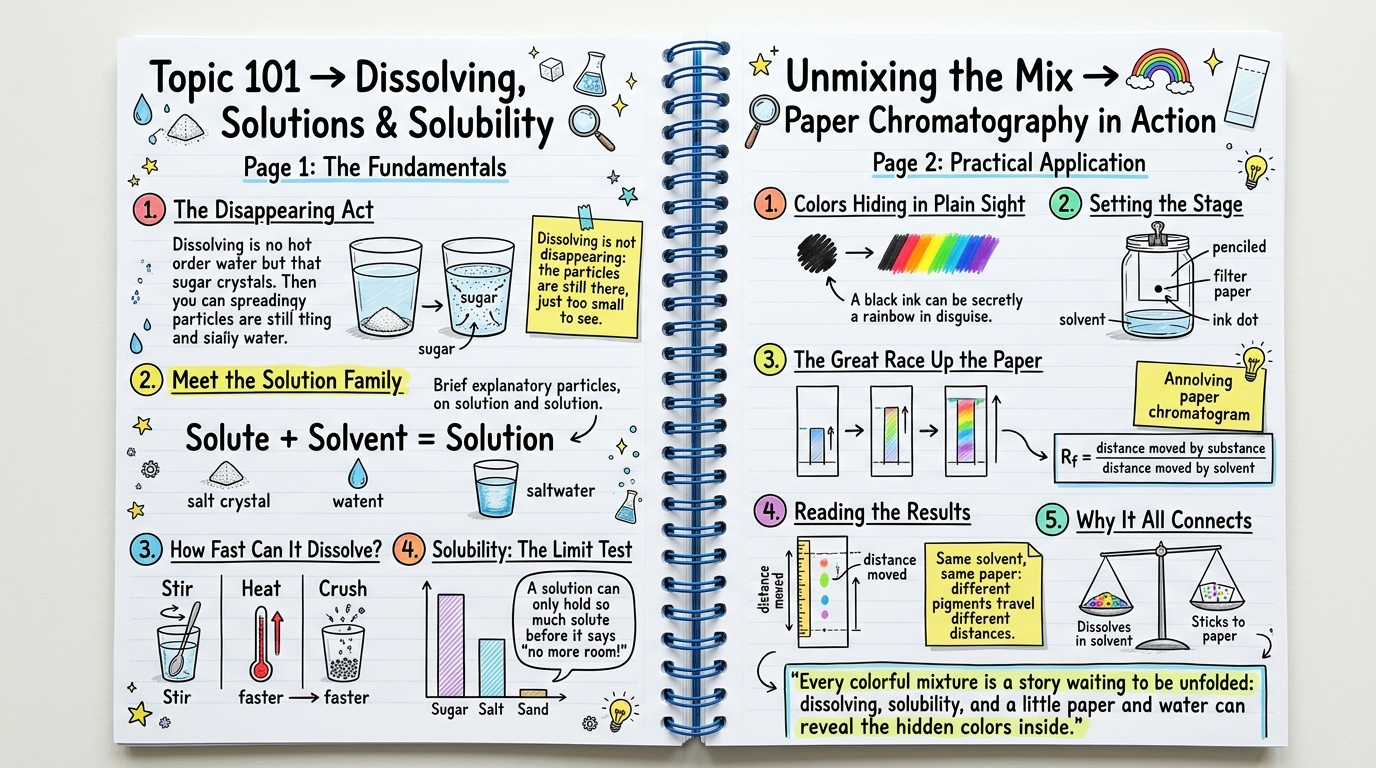
Dissolving, Solutions and solubility, paper chromatography for grade 7
The same content DoodleNotes wrote before drawing it.
Topic 101 → Dissolving, Solutions & Solubility
- 1
The Disappearing Act
When a solid like sugar is stirred into water, it seems to vanish. In reality, the sugar breaks into tiny particles that spread evenly throughout the water. This process is called dissolving, and the result is a solution where you can no longer see the separate parts.
Sticky note: Dissolving is not disappearing: the particles are still there, just too small to see.
- 2
Meet the Solution Family
Every solution has two main members: the solute, which is the substance that dissolves (like salt), and the solvent, which does the dissolving (like water). Together they form a solution. Water is called the universal solvent because it dissolves more substances than any other common liquid.
- 3
How Fast Can It Dissolve?
Several factors control how quickly a solute dissolves. Stirring, heating the solvent, and crushing the solute into smaller pieces all speed things up because they expose more surface area or give particles more energy to move. Cold water usually slows dissolving down.
- 4
Solubility: The Limit Test
Solubility measures how much solute can dissolve in a given amount of solvent at a set temperature. Once no more solute can dissolve, the solution is saturated and extra solid simply sinks to the bottom. Some substances, like sugar, are highly soluble, while others, like sand, are nearly insoluble.
Sticky note: A solution can only hold so much solute before it says 'no more room!'
Unmixing the Mix → Paper Chromatography in Action
- 1
Colors Hiding in Plain Sight
Many inks and dyes that look like a single color are actually mixtures of several dissolved pigments. Chromatography is a technique that separates these hidden colors. Paper chromatography uses paper, a solvent, and the natural tendency of different substances to travel at different speeds.
Sticky note: A black ink can be secretly a rainbow in disguise.
- 2
Setting the Stage
To run paper chromatography, draw a pencil line near the bottom of filter paper and place a small dot of ink on it. Pencil is used because its graphite will not dissolve or move. Then hang the paper so its bottom tip just touches the solvent in a jar, making sure the ink dot stays above the liquid.
- 3
The Great Race Up the Paper
As the solvent climbs up the paper by capillary action, it carries the dissolved ink with it. Pigments that are more soluble and less attracted to the paper travel farther, while less soluble ones lag behind. Over time, the ink splits into distinct colored bands, each stopping at a different height.
- 4
Reading the Results
When the solvent front nears the top, remove the paper and mark how far the solvent traveled and how far each color moved. Dividing each color's distance by the solvent distance gives the Rf value, a fingerprint number that helps identify substances. Matching Rf values can reveal which dyes were used.
Sticky note: Same solvent, same paper: different pigments travel different distances.
- 5
Why It All Connects
Chromatography works because of solubility. Each pigment dissolves to a different degree in the moving solvent and sticks to the paper to a different degree. The balance between dissolving and sticking decides how far each color travels, linking the ideas of solutions and solubility to a real laboratory skill.
Bottom insight: Every colorful mixture is a story waiting to be unfolded: dissolving, solubility, and a little paper and water can reveal the hidden colors inside.
For study only. Check anything you rely on against your textbook.
Studying something else?
Type a topic and get your own hand-drawn page like this one in about 40 seconds.
your turn