Financial Engineering
Made with DoodleNotes · Oct 28, 2026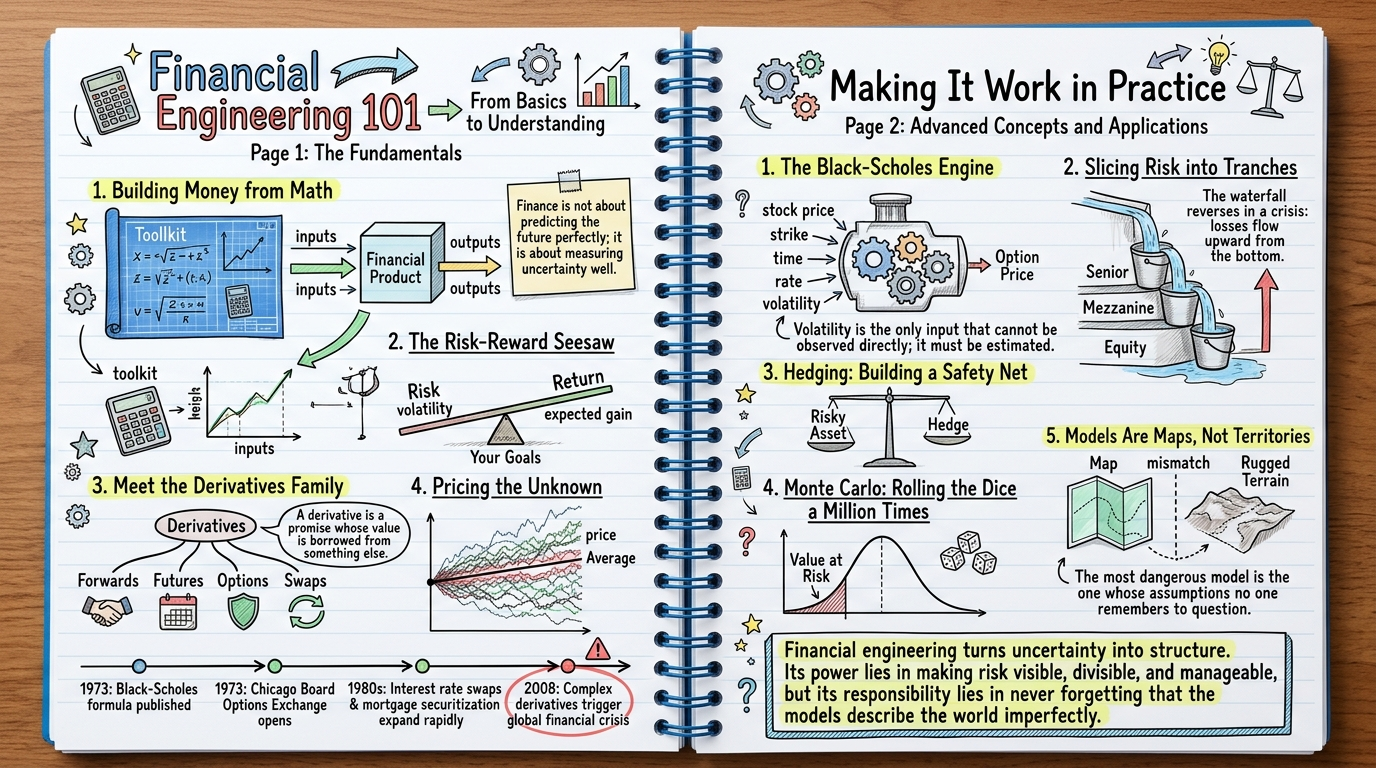
Financial Engineering
The same content DoodleNotes wrote before drawing it.
Financial Engineering 101 → From Basics to Understanding
- 1
Building Money from Math
Financial engineering uses mathematics, statistics, and computer science to design, price, and manage financial products. Instead of simply buying and selling assets, engineers build new instruments tailored to specific risks or goals. Think of it as the architecture of finance: it designs the blueprint before anything gets built.
Sticky note: Finance is not about predicting the future perfectly; it is about measuring uncertainty well.
- 2
The Risk-Reward Seesaw
Every financial decision balances risk against potential return. Higher expected returns almost always come with higher uncertainty about outcomes. Financial engineers quantify this trade-off so investors can choose the balance that fits their goals.
- 3
Meet the Derivatives Family
Derivatives are contracts whose value comes from an underlying asset such as a stock, bond, currency, or commodity. The main family includes forwards, futures, options, and swaps. Each one lets people lock in prices, speculate, or protect against losses.
Sticky note: A derivative is a promise whose value is borrowed from something else.
- 4
Pricing the Unknown
Financial engineers estimate what a product is worth before its payoff is known. They use models that simulate thousands of possible future price paths and average the results. This process turns uncertainty into a fair price.
Timeline: 1973 Black-Scholes option pricing formula published · 1973 Chicago Board Options Exchange opens · 1980s Interest rate swaps and mortgage securitization expand rapidly · 2008 Complex derivatives trigger global financial crisis
Making It Work in Practice
- 1
The Black-Scholes Engine
The Black-Scholes model calculates an option's fair price using the stock price, strike price, time to expiration, interest rate, and volatility. Its key insight is that a perfectly hedged option position earns the risk-free rate, which allows a single price to be derived. Although its assumptions are simplified, it remains the language traders use.
Sticky note: Volatility is the only input that cannot be observed directly; it must be estimated.
- 2
Slicing Risk into Tranches
Securitization pools many loans, such as mortgages, and divides the cash flows into tranches with different risk levels. Senior tranches get paid first and carry lower risk, while junior tranches absorb early losses and offer higher yields. This structure lets investors choose their risk appetite.
Sticky note: The waterfall reverses in a crisis: losses flow upward from the bottom.
- 3
Hedging: Building a Safety Net
Hedging uses offsetting positions so that losses in one investment are balanced by gains in another. A airline might buy fuel futures to lock in costs, while an exporter might use currency forwards to protect revenue. The goal is stability, not profit from the hedge itself.
- 4
Monte Carlo: Rolling the Dice a Million Times
Monte Carlo simulation generates thousands or millions of random scenarios to estimate outcomes that have no simple formula. Engineers use it to price exotic options, measure portfolio risk, and stress-test banks. The accuracy improves as the number of simulations grows.
- 5
Models Are Maps, Not Territories
Every model rests on assumptions, such as normal price movements or constant volatility, that real markets sometimes violate. Responsible financial engineers test models against extreme scenarios and keep human judgment in the loop. Understanding a model's limits is as important as understanding its output.
Sticky note: The most dangerous model is the one whose assumptions no one remembers to question.
Bottom insight: Financial engineering turns uncertainty into structure. Its power lies in making risk visible, divisible, and manageable, but its responsibility lies in never forgetting that the models describe the world imperfectly.
For study only. Check anything you rely on against your textbook.
Studying something else?
Type a topic and get your own hand-drawn page like this one in about 40 seconds.
your turn