forces of gravity- friction for 8th graders
Made with DoodleNotes · Oct 26, 2026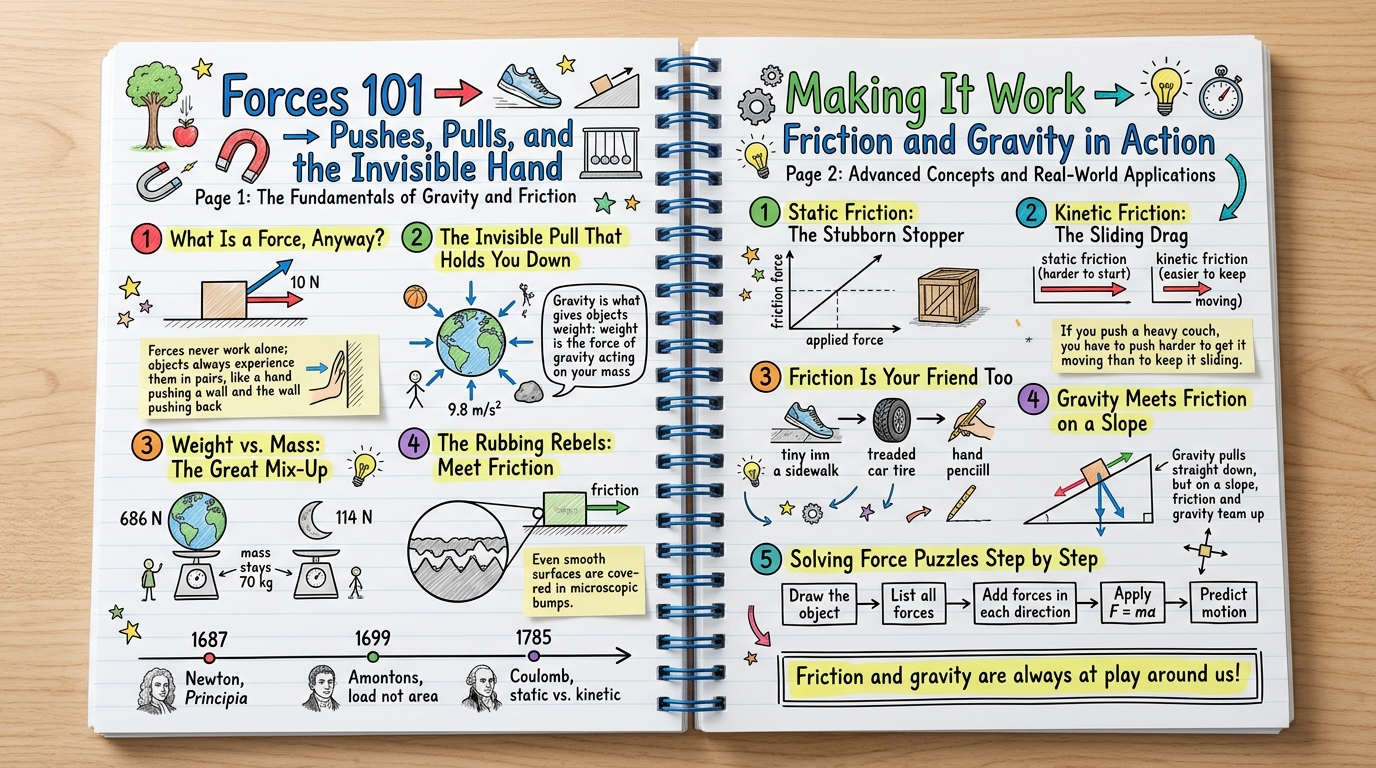
forces of gravity- friction for 8th graders
The same content DoodleNotes wrote before drawing it.
Forces 101 → Pushes, Pulls, and the Invisible Hand
- 1
What Is a Force, Anyway?
A force is a push or a pull that can change how an object moves. Forces can make things start moving, stop moving, speed up, slow down, or change direction. Every force has a size (how strong it is) and a direction (where it points), which is why scientists measure forces in newtons (N).
Sticky note: Forces never work alone; objects always experience them in pairs, like a hand pushing a wall and the wall pushing back.
- 2
The Invisible Pull That Holds You Down
Gravity is a force of attraction between any two objects that have mass. Earth's gravity pulls everything toward its center, which is why dropped objects fall and why you stay on the ground. The more mass an object has, the stronger its gravitational pull.
Sticky note: Gravity is what gives objects weight: weight is the force of gravity acting on your mass.
- 3
Weight vs. Mass: The Great Mix-Up
Mass measures how much matter is in an object, and it stays the same no matter where you are. Weight measures the gravitational force on that mass, so it changes depending on the gravity around you. On the Moon, your mass stays the same, but your weight is only about one-sixth of what it is on Earth.
- 4
The Rubbing Rebels: Meet Friction
Friction is a force that opposes motion when two surfaces touch or slide against each other. It always acts in the direction opposite to motion, which is why a sliding book eventually stops. Friction comes from tiny bumps and ridges on surfaces that catch on each other at the microscopic level.
Sticky note: Even surfaces that look perfectly smooth are covered in microscopic bumps that create friction.
Timeline: 1687 Isaac Newton publishes the law of universal gravitation in Principia · 1699 Guillaume Amontons shows friction depends on load, not contact area · 1785 Charles-Augustin de Coulomb distinguishes static and kinetic friction
Making It Work → Friction and Gravity in Action
- 1
Static Friction: The Stubborn Stopper
Static friction keeps an object from moving when a force is applied to it. It grows to match the applied force up to a maximum value, which is why a heavy box may not budge until you push hard enough. Once the force exceeds this maximum, the object starts sliding.
- 2
Kinetic Friction: The Sliding Drag
Kinetic friction acts on objects that are already sliding past each other. It is usually weaker than static friction, which is why it takes more effort to start a box moving than to keep it moving. The size of kinetic friction depends on how hard the surfaces press together and the materials they're made of.
Sticky note: The effort you feel to start pushing a heavy couch is static friction fighting you before the couch ever moves.
- 3
Friction Is Your Friend Too
Without friction, you could not walk, grip a pencil, or stop a bicycle. Friction between your shoes and the ground pushes you forward when you walk, and tire friction on the road lets cars brake and turn. Engineers design shoe soles, tire treads, and brake pads to control friction for safety.
- 4
Gravity Meets Friction on a Slope
When an object sits on a ramp, gravity pulls it downward, and that pull can be split into two parts: one pushing into the ramp and one pulling along it. Friction opposes the downhill part, so a steeper ramp makes the object more likely to slide. This balance is why some ramps are safe for wheelchairs while others are too steep.
Sticky note: Gravity pulls straight down, but on a slope, friction and gravity team up to decide whether things stay put or slide.
- 5
Solving Force Puzzles Step by Step
To analyze any force problem, first draw a free-body diagram showing every force acting on the object. Then add the forces in each direction to find the net force, and use Newton's second law (F = ma) to predict the motion. This method works for everything from a sliding hockey puck to a rocket launching.
Bottom insight: Gravity and friction are the forces that quietly shape nearly everything you do, from the way you walk to how a car stops, and understanding them means you can predict how the world will move.
For study only. Check anything you rely on against your textbook.
Studying something else?
Type a topic and get your own hand-drawn page like this one in about 40 seconds.
your turn