Genética mendeliana psicologia UNED
Made with DoodleNotes · Oct 27, 2026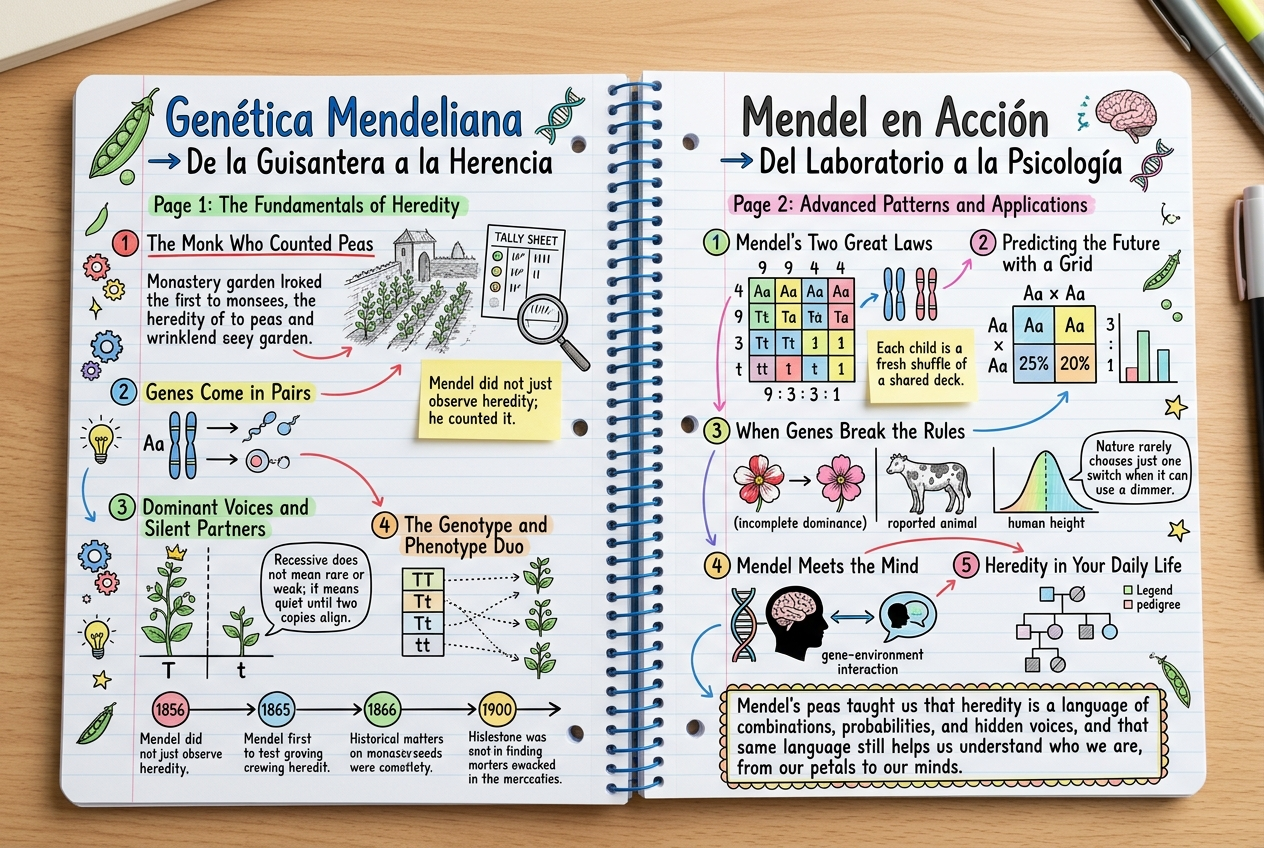
Genética mendeliana psicologia UNED
The same content DoodleNotes wrote before drawing it.
Genética Mendeliana → De la Guisantera a la Herencia
- 1
The Monk Who Counted Peas
Gregor Mendel, an Augustinian friar working in a monastery garden in Brno, cultivated thousands of pea plants and carefully tracked how traits like seed shape and flower color passed from parents to offspring. Instead of blending traits, he noticed that characteristics appeared in clear, countable ratios. His meticulous method, combining controlled crosses with numerical analysis, laid the foundation of modern genetics.
Sticky note: Mendel did not just observe heredity; he counted it.
- 2
Genes Come in Pairs
Each individual carries two copies of every hereditary factor, one inherited from each parent. These copies are called alleles, and they may be identical or different. Mendel's key insight was that these factors do not mix permanently; they segregate during the formation of gametes, so each offspring receives one allele from each parent.
- 3
Dominant Voices and Silent Partners
When two different alleles meet, one may fully express its trait while the other remains hidden. The expressed version is dominant, and the hidden one is recessive. A plant carrying one tall allele and one short allele will still grow tall, because the tall allele dominates. Recessive traits only appear when an individual carries two copies of the recessive allele.
Sticky note: Recessive does not mean rare or weak; it means quiet until two copies align.
- 4
The Genotype and Phenotype Duo
Genotype refers to the genetic makeup of an organism, the actual combination of alleles it carries. Phenotype is the observable expression of those genes, such as flower color or eye color. Two individuals with different genotypes can look identical, which is why understanding the hidden code matters so much.
Timeline: 1856 Mendel begins his pea experiments in the Brno monastery garden · 1865 Mendel presents his findings to the Natural History Society of Brno · 1866 Mendel publishes Experiments on Plant Hybridization · 1900 Hugo de Vries, Carl Correns, and Erich von Tschermak rediscover Mendel's laws
Mendel en Acción → Del Laboratorio a la Psicología
- 1
Mendel's Two Great Laws
The Law of Segregation states that each parent passes only one allele of each gene to offspring, chosen at random. The Law of Independent Assortment states that genes for different traits are inherited independently of one another, as long as they sit on different chromosomes. Together, these laws explain why siblings can differ so dramatically.
Sticky note: Each child is a fresh shuffle of a shared deck.
- 2
Predicting the Future with a Grid
The Punnett square is a tool that maps all possible allele combinations from two parents. By placing one parent's alleles along the top and the other's along the side, students can calculate the probability of each genotype and phenotype in offspring. It transforms inheritance into a predictable, testable calculation.
- 3
When Genes Break the Rules
Not all inheritance follows simple dominance. In incomplete dominance, heterozygotes show a blended phenotype, such as pink snapdragons from red and white parents. In codominance, both alleles are fully expressed, as in AB blood type. Polygenic traits, like human height, involve many genes working together, producing a continuous range of outcomes.
Sticky note: Nature rarely chooses just one switch when it can use a dimmer.
- 4
Mendel Meets the Mind
In psicología, Mendelian thinking helps researchers separate genetic contributions from environmental ones when studying behavior, intelligence, and mental health. Twin and adoption studies apply these principles to estimate heritability, while acknowledging that genes influence traits probabilistically rather than deterministically. Understanding this distinction helps avoid simplistic claims about destiny.
- 5
Heredity in Your Daily Life
Students of UNED can apply Mendelian reasoning to interpret research articles, evaluate claims about genetic determinism in popular media, and understand genetic counseling for inherited conditions. Recognizing patterns of dominance and recessiveness also clarifies why some hereditary diseases appear in families across generations while skipping others.
Bottom insight: Mendel's peas taught us that heredity is a language of combinations, probabilities, and hidden voices, and that same language still helps us understand who we are, from our petals to our minds.
For study only. Check anything you rely on against your textbook.
Studying something else?
Type a topic and get your own hand-drawn page like this one in about 40 seconds.
your turn