histort of discovery of DNA
Made with DoodleNotes · Oct 25, 2026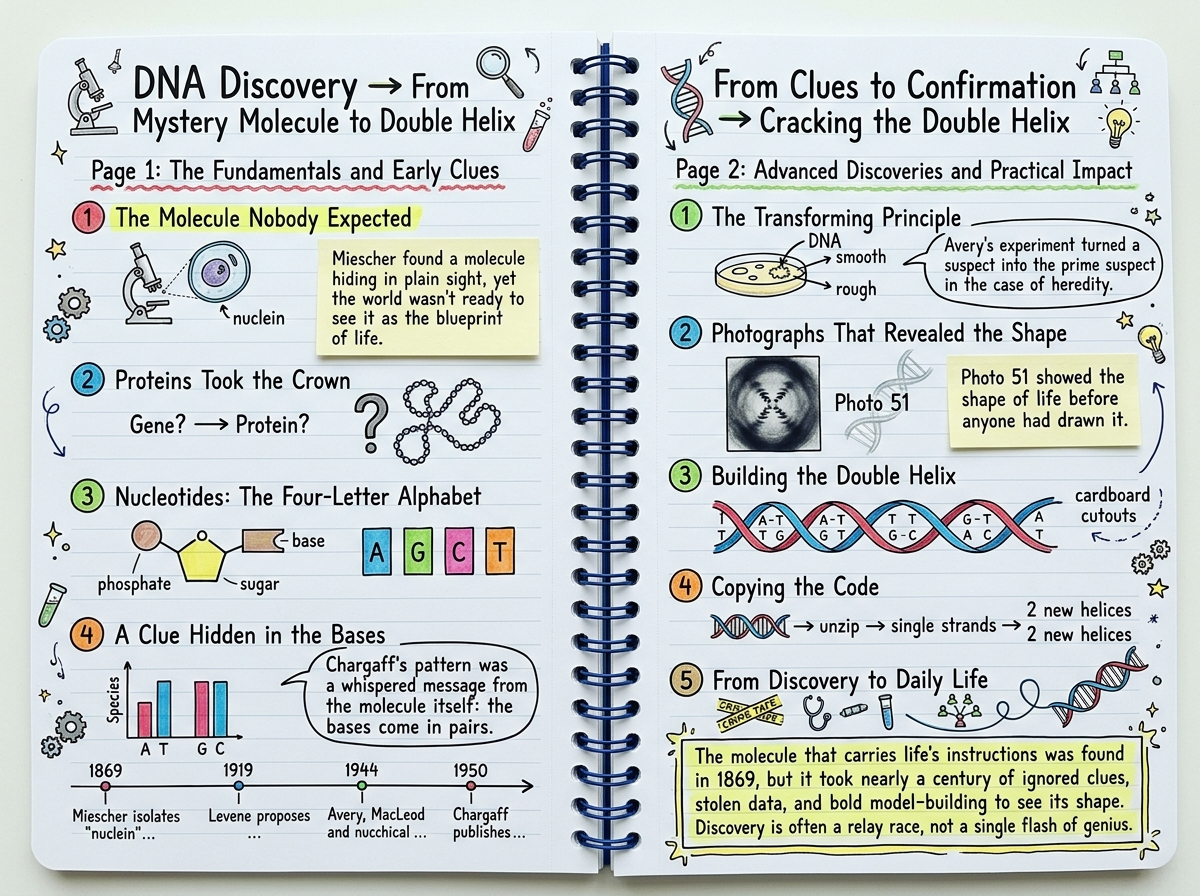
histort of discovery of DNA
The same content DoodleNotes wrote before drawing it.
DNA Discovery → From Mystery Molecule to Double Helix
- 1
The Molecule Nobody Expected
In 1869, Swiss chemist Friedrich Miescher isolated a substance from the nuclei of white blood cells in pus-soaked bandages, which he called 'nuclein.' It was rich in phosphorus and unlike the proteins scientists thought carried heredity. For decades, most researchers assumed proteins, with their 20 amino acid building blocks, must hold the secrets of life.
Sticky note: Miescher found a molecule hiding in plain sight, yet the world wasn't ready to see it as the blueprint of life.
- 2
Proteins Took the Crown
Early geneticists studying inheritance in peas and fruit flies saw traits passed through generations, but nobody knew the physical carrier. Since proteins are chemically diverse and complex, many believed they must encode heredity. This 'protein hypothesis' dominated biology well into the 1940s.
- 3
Nucleotides: The Four-Letter Alphabet
By the early 1900s, Phoebus Levene identified the components of nucleic acids: a sugar, a phosphate group, and four nitrogenous bases (adenine, guanine, cytosine, and thymine). He proposed a repeating tetranucleotide structure, which seemed too simple to store complex information. This misleading idea delayed the search for DNA's true role.
- 4
A Clue Hidden in the Bases
In the 1940s and 1950s, Erwin Chargaff measured base ratios across many DNA samples. He found that adenine always matched thymine, and guanine always matched cytosine, in consistent proportions. These equal ratios, later called Chargaff's rules, hinted that the bases pair in a specific way.
Sticky note: Chargaff's pattern was a whispered message from the molecule itself: the bases come in pairs.
Timeline: 1869 Miescher isolates 'nuclein' from cell nuclei · 1919 Levene proposes the tetranucleotide model · 1944 Avery, MacLeod & McCarty show DNA carries genetic information · 1950 Chargaff publishes base-pairing rules
From Clues to Confirmation → Cracking the Double Helix
- 1
The Transforming Principle
In 1944, Oswald Avery, Colin MacLeod, and Maclyn McCarty showed that purified DNA, not protein, could transform harmless bacteria into deadly ones. Their experiment shifted the scientific spotlight decisively toward DNA. Many researchers still resisted, but the evidence was becoming hard to ignore.
Sticky note: Avery's experiment turned a suspect into the prime suspect in the case of heredity.
- 2
Photographs That Revealed the Shape
Rosalind Franklin, working at King's College London, used X-ray diffraction to capture Photo 51 in 1952, a striking X-shaped pattern that signaled a helical structure. Her precise measurements suggested the molecule was regular and had its phosphate backbone on the outside. Her data, shared without her knowledge, became central to the final model.
Sticky note: Photo 51 showed the shape of life before anyone had drawn it.
- 3
Building the Double Helix
In 1953, James Watson and Francis Crick used cardboard cutouts and metal plates to build a physical model that fit Chargaff's rules and Franklin's measurements. Two strands twist around a central axis, with adenine pairing with thymine and guanine pairing with cytosine. Their paper in Nature famously understated the discovery, noting the pairing 'suggests a possible copying mechanism.'
- 4
Copying the Code
The base-pairing structure explained how DNA could be copied: each strand serves as a template for building a new partner. During replication, the two strands unzip, and each is used to rebuild its complement. This elegant mechanism revealed how genetic information passes faithfully from one cell to the next.
- 5
From Discovery to Daily Life
Today, DNA knowledge powers forensic identification, medical diagnosis, and genetic engineering, from CRISPR gene editing to ancestry testing. Understanding the helix turned biology into an information science. Every new advance builds on a story that began with a chemist puzzling over a substance in bandages.
Bottom insight: The molecule that carries life's instructions was found in 1869, but it took nearly a century of ignored clues, stolen data, and bold model-building to see its shape. Discovery is often a relay race, not a single flash of genius.
For study only. Check anything you rely on against your textbook.
Studying something else?
Type a topic and get your own hand-drawn page like this one in about 40 seconds.
your turn