How to use doodle notes for history notes
Made with DoodleNotes · Oct 21, 2026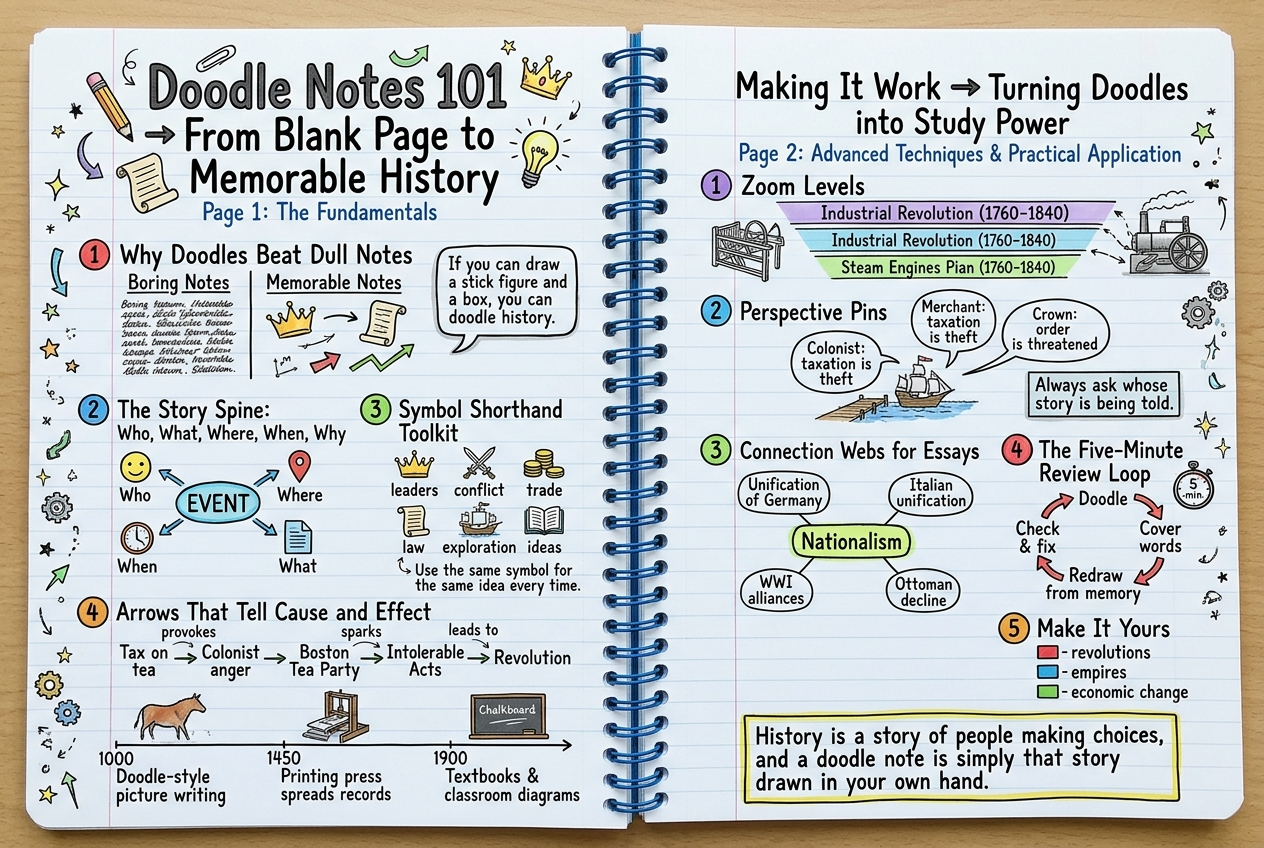
How to use doodle notes for history notes
The same content DoodleNotes wrote before drawing it.
Doodle Notes 101 → From Blank Page to Memorable History
- 1
Why Doodles Beat Dull Notes
Doodle notes combine words, simple drawings, and arrows to capture history as a visual story. Your brain remembers pictures and connections far better than long paragraphs of text. In history, where dates, people, and causes can blur together, a single doodle can anchor an entire event in your memory.
Sticky note: If you can draw a stick figure and a box, you can doodle history.
- 2
The Story Spine: Who, What, Where, When, Why
Every historical event can be broken into five core questions. Build each doodle note around these anchors so no key detail gets lost. Placing each answer in its own corner of the page creates a natural map of the event.
- 3
Symbol Shorthand Toolkit
Create a personal set of symbols you reuse across every history topic, such as a crown for leaders, a sword for wars, a coin for economics, and a scroll for laws. Consistent symbols let you scan a page and instantly recognize categories. Over time your symbol library becomes a visual language of its own.
Sticky note: Use the same symbol for the same idea every time, and your notes start to read themselves.
- 4
Arrows That Tell Cause and Effect
History is a chain of causes and consequences, so arrows are your most powerful tool. Draw arrows from cause to effect and label them with a short phrase explaining the link. Two-way arrows can show events that influenced each other.
Timeline: 1000 Doodle-style picture writing and early records appear in ancient civilizations · 1450 Printing press spreads written records and illustrated texts across Europe · 1900 Textbooks and classroom diagrams become standard tools for teaching history
Making It Work → Turning Doodles into Study Power
- 1
Zoom Levels: Big Picture to Tiny Detail
Organize your page in layers, starting with a bold era label across the top, then major events in the middle, and small details in the margins. This zoom structure lets you review at different depths depending on whether you are preparing for a quiz or an essay. It also trains you to see how small events fit into larger movements.
- 2
Perspective Pins: Who Saw It How?
History is shaped by viewpoints, and doodles can capture them. Draw a small speech bubble or thought cloud for each perspective and sketch the person's face or symbol nearby. Comparing bubbles side by side reveals bias, conflict, and missing voices.
Sticky note: The same event can be a victory for one group and a tragedy for another. Always ask whose story is being told.
- 3
Connection Webs for Essays
When writing essays, draw a web connecting related events, people, and themes across different units. Lines between notes show patterns like repeated causes or recurring leaders. A web turns isolated facts into arguments you can defend.
- 4
The Five-Minute Review Loop
Doodle notes are most powerful when revisited. Spend five minutes reviewing a page by covering the words and redrawing the symbols and arrows from memory, then checking your accuracy. Active recall through drawing strengthens retention much more than rereading.
Sticky note: Redrawing from memory is the test. If you can rebuild the page, you know the history.
- 5
Make It Yours
Your doodle style does not need to be polished or artistic. Use the same colors for each era, develop a signature border, and keep a symbol key on the inside cover of your notebook. Personal style makes your notes feel like your own story rather than a copy of someone else's.
Bottom insight: History is a story of people making choices, and a doodle note is simply that story drawn in your own hand, so every page you draw becomes a map you can walk through again and again.
For study only. Check anything you rely on against your textbook.
Studying something else?
Type a topic and get your own hand-drawn page like this one in about 40 seconds.
your turn