i-Ready Classroom Mathematics 2024, Grade 8, Lesson 13, Session 1
Made with DoodleNotes · Oct 22, 2026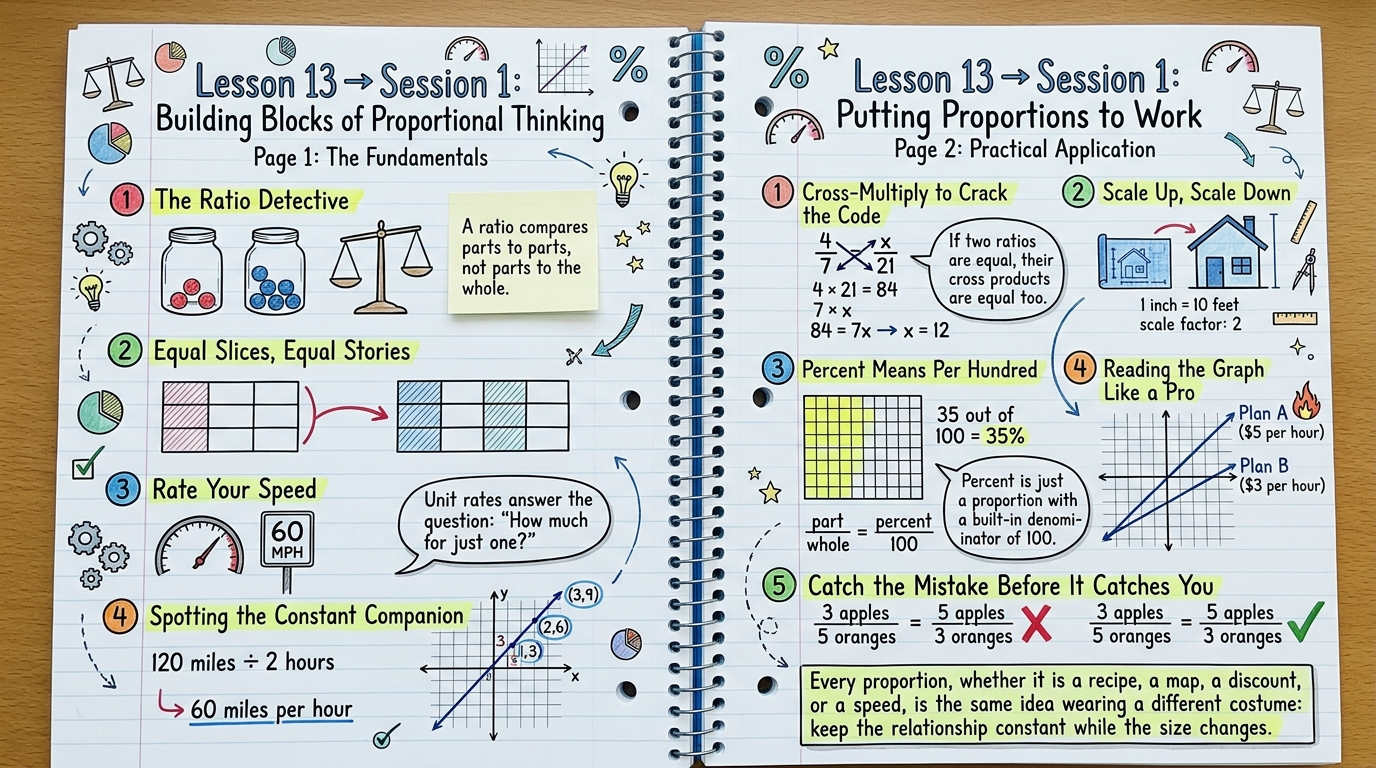
i-Ready Classroom Mathematics 2024, Grade 8, Lesson 13, Session 1
The same content DoodleNotes wrote before drawing it.
Lesson 13 → Session 1: Building Blocks of Proportional Thinking
- 1
The Ratio Detective
A ratio compares two quantities by division, such as 3 red marbles to 5 blue marbles, written 3:5 or 3/5. Ratios tell us how much of one thing there is compared to another, not just how much there is in total. Think of a ratio as a recipe: it keeps the balance the same no matter how big the batch becomes.
Sticky note: A ratio compares parts to parts, not parts to the whole.
- 2
Equal Slices, Equal Stories
Equivalent ratios are different-looking ratios that describe the same relationship, like 2:3 and 6:9. You find them by multiplying or dividing both terms by the same nonzero number. This works because scaling both parts together never changes how they relate to each other.
- 3
Rate Your Speed
A rate is a special kind of ratio that compares two quantities with different units, such as 120 miles in 2 hours. A unit rate simplifies this to one unit of the second quantity, like 60 miles per 1 hour. Unit rates make it easy to compare options quickly, like which car gets better gas mileage.
Sticky note: Unit rates answer the question: 'How much for just one?'
- 4
Spotting the Constant Companion
A proportional relationship is one where the ratio between two quantities stays the same as they change. When you graph a proportional relationship, the points form a straight line through the origin. The steady ratio is called the constant of proportionality.
Lesson 13 → Session 1: Putting Proportions to Work
- 1
Cross-Multiply to Crack the Code
To solve a proportion like 4/7 = x/21, cross-multiply to get 4 × 21 = 7 × x, giving 84 = 7x and x = 12. This method works because equal ratios have equal cross products. It lets you find a missing value whenever you know three of the four numbers.
Sticky note: If two ratios are equal, their cross products are equal too.
- 2
Scale Up, Scale Down
Scale factors help you enlarge or shrink a recipe, map, or model while keeping its proportions intact. Multiply every quantity by the same scale factor to scale up, or by a fraction less than one to scale down. Architects and mapmakers rely on this idea every day.
- 3
Percent Means Per Hundred
A percent is a ratio that compares a number to 100, so 35% means 35 out of every 100. Percent problems are proportions in disguise, since you can set up part/whole = percent/100. This connection makes discounts, tips, and tax calculations much easier to handle.
Sticky note: Percent is just a proportion with a built-in denominator of 100.
- 4
Reading the Graph Like a Pro
On a proportional graph, the slope tells you the unit rate, and the steeper the line, the faster the rate of change. You can read any point on the line as an equivalent ratio to the others. Comparing two graphs side by side lets you decide which rate is better at a glance.
- 5
Catch the Mistake Before It Catches You
A common error is comparing a part to a part when the problem asks for part to whole, or mixing up which quantity goes on top. Always check that units match on both sides of the proportion before you cross-multiply. Writing the labels next to each number keeps your setup honest.
Bottom insight: Every proportion, whether it is a recipe, a map, a discount, or a speed, is the same idea wearing a different costume: keep the relationship constant while the size changes.
For study only. Check anything you rely on against your textbook.
Studying something else?
Type a topic and get your own hand-drawn page like this one in about 40 seconds.
your turn