iReady Classroom Mathematics, Grade 8, Lesson 13, Session 1
Made with DoodleNotes · Oct 22, 2026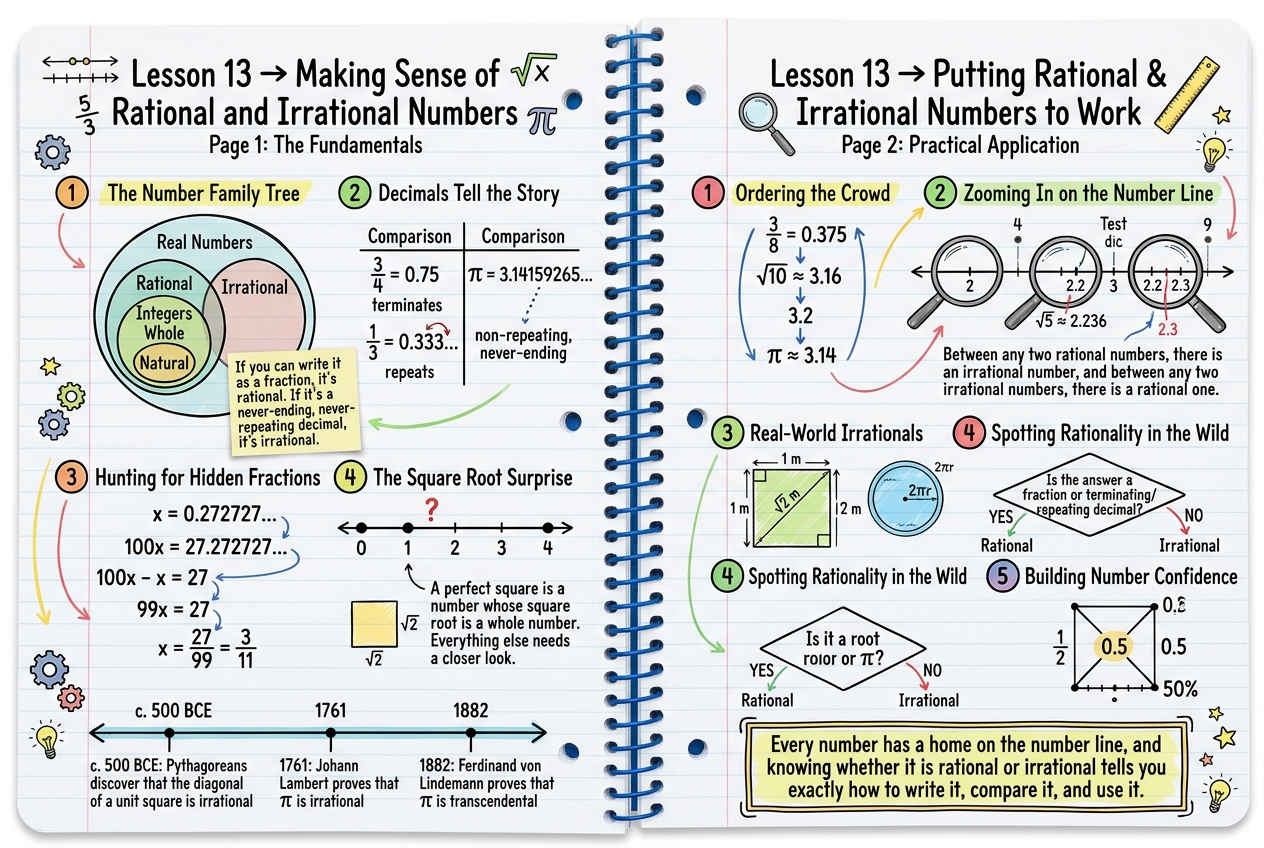
iReady Classroom Mathematics, Grade 8, Lesson 13, Session 1
The same content DoodleNotes wrote before drawing it.
Lesson 13 → Making Sense of Rational Numbers and Irrational Numbers
- 1
The Number Family Tree
Every real number belongs to a family. Natural numbers count things, whole numbers add zero, and integers add negatives. Rational numbers are any numbers that can be written as a fraction of two integers, and this family includes terminating and repeating decimals. Together, rational and irrational numbers make up the entire real number line.
Sticky note: If you can write it as a fraction, it's rational. If it's a never-ending, never-repeating decimal, it's irrational.
- 2
Decimals Tell the Story
The decimal form of a number reveals whether it is rational. Terminating decimals like 0.75 stop after a finite number of digits, and repeating decimals like 0.333... show a pattern that continues forever. Both types can be converted into fractions. Irrational numbers, such as pi or the square root of 2, have decimal expansions that neither terminate nor repeat.
- 3
Hunting for Hidden Fractions
To change a repeating decimal into a fraction, we use algebra as a tool. Let x equal the repeating decimal, multiply x by a power of 10 that shifts one full repeating block to the left of the decimal point, then subtract the original equation. The repeating parts cancel out, leaving a simple equation you can solve for x.
- 4
The Square Root Surprise
Some square roots produce clean whole numbers, like √49 = 7. Others, like √2, cannot be written as a fraction and are irrational. Perfect squares are the key clue: if a number is not a perfect square, its square root is typically irrational. Estimating between two perfect squares helps you locate these numbers on the number line.
Sticky note: A perfect square is a number whose square root is a whole number. Everything else needs a closer look.
Timeline: c. 500 BCE Pythagoreans discover that the diagonal of a unit square is irrational · 1761 Johann Lambert proves that π is irrational · 1882 Ferdinand von Lindemann proves that π is transcendental
Lesson 13 → Putting Rational and Irrational Numbers to Work
- 1
Ordering the Crowd
To compare rational and irrational numbers, convert them to decimals or estimate their values. Once every number is in decimal form, arranging them from least to greatest becomes straightforward. Estimation with perfect squares gives a quick sense of where an irrational number lands.
- 2
Zooming In on the Number Line
Irrational numbers fill the gaps between rational numbers, so there is always another number hiding between any two of them. To place √5 precisely, find the perfect squares on either side (4 and 9), then refine your estimate by testing decimals such as 2.2 and 2.3. Repeating this process narrows the position to any level of accuracy you need.
Sticky note: Between any two rational numbers, there is an irrational number, and between any two irrational numbers, there is a rational one.
- 3
Real-World Irrationals
Irrational numbers appear in measurements all around us. The diagonal of a square garden, the circumference of a circular pool, and the length of a ramp are often irrational. Recognizing when a result is irrational tells you to keep an exact form such as √2 or π, or to round carefully when a decimal approximation is needed.
- 4
Spotting Rationality in the Wild
When solving problems, check whether a result simplifies to a fraction or a whole number. If it does, the answer is rational. If an answer keeps a root sign or contains π, it is irrational and should be left in exact form unless the problem asks for a decimal approximation.
- 5
Building Number Confidence
Mastering rational and irrational numbers means moving fluidly between fractions, decimals, roots, and the number line. Each representation reveals a different side of the same value. Practice switching among them until the connections feel natural.
Bottom insight: Every number has a home on the number line, and knowing whether it is rational or irrational tells you exactly how to write it, compare it, and use it.
For study only. Check anything you rely on against your textbook.
Studying something else?
Type a topic and get your own hand-drawn page like this one in about 40 seconds.
your turn