Kemi anteckningar
Made with DoodleNotes · Oct 24, 2026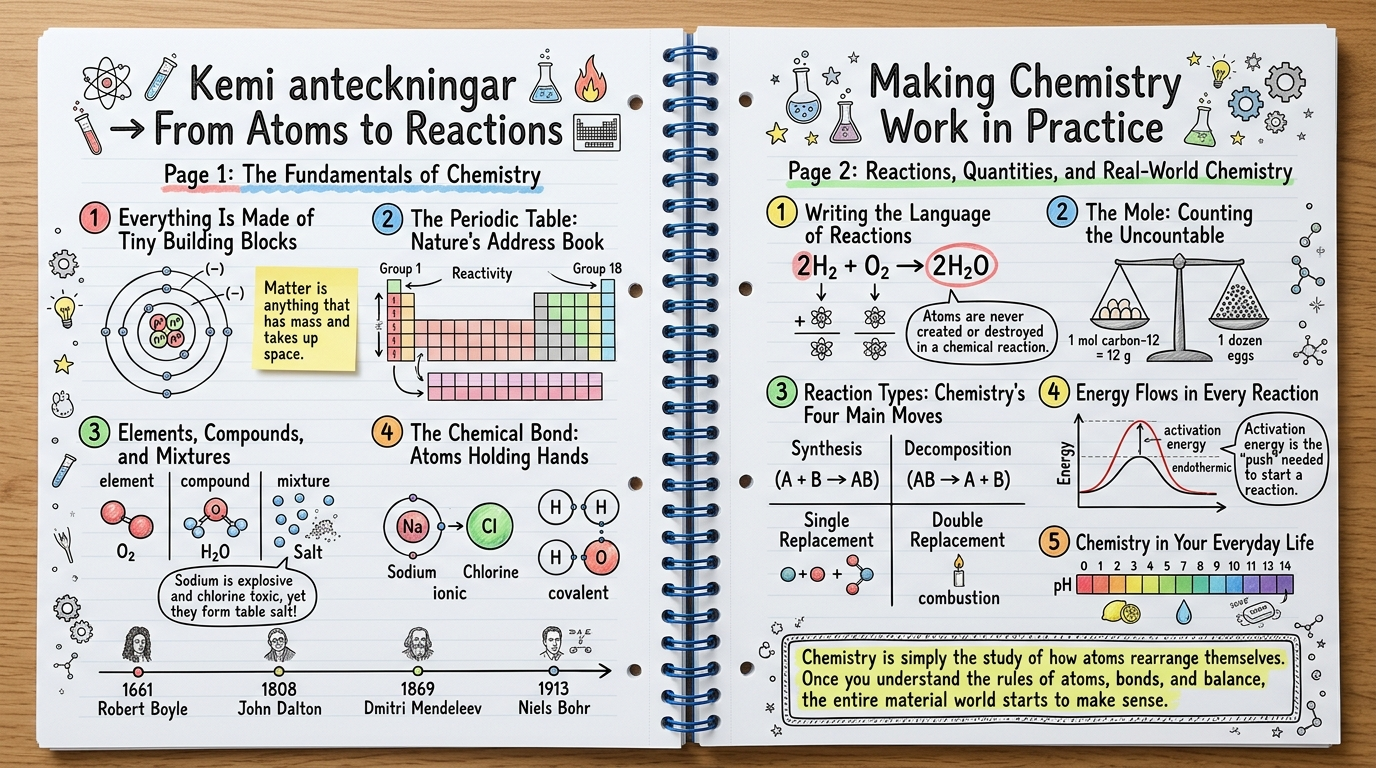
Kemi anteckningar
The same content DoodleNotes wrote before drawing it.
Kemi anteckningar → From Atoms to Reactions
- 1
Everything Is Made of Tiny Building Blocks
Chemistry is the science of matter and the changes it undergoes. All matter, from the air you breathe to the phone in your hand, is made of atoms. Atoms are the smallest units that keep the properties of an element, and they combine in countless ways to form everything around us.
Sticky note: Matter is anything that has mass and takes up space.
- 2
The Periodic Table: Nature's Address Book
The periodic table organizes all known elements by atomic number, arranging them into rows called periods and columns called groups. Elements in the same group share similar chemical behavior because they have the same number of outer electrons. Once you learn to read the table, you can predict how an element will act.
- 3
Elements, Compounds, and Mixtures
An element contains only one type of atom, like pure oxygen (O₂) or gold (Au). A compound forms when two or more elements bond chemically in fixed proportions, such as water (H₂O). A mixture combines substances physically without bonding, so salt dissolved in water can be separated back out.
Sticky note: Compounds have properties completely different from their elements: sodium is explosive and chlorine is toxic, yet together they form table salt.
- 4
The Chemical Bond: Atoms Holding Hands
Atoms bond because they want a stable outer electron configuration, often eight electrons in their outermost shell. Ionic bonds transfer electrons from one atom to another, while covalent bonds share electrons between atoms. Understanding bonds explains why substances melt, dissolve, or conduct electricity.
Timeline: 1661 Robert Boyle defines the element as a substance that cannot be broken down further · 1808 John Dalton proposes atomic theory · 1869 Dmitri Mendeleev publishes the first widely recognized periodic table · 1913 Niels Bohr introduces electron shell model
Making Chemistry Work in Practice
- 1
Writing the Language of Reactions
A chemical equation shows reactants transforming into products using formulas and coefficients. Every equation must be balanced, meaning the number of each type of atom is equal on both sides, because atoms are conserved in chemical reactions. Learning to balance equations is the foundation of all quantitative chemistry.
Sticky note: Atoms are never created or destroyed in a chemical reaction. They are simply rearranged.
- 2
The Mole: Counting the Uncountable
A mole is a counting unit equal to 6.022 × 10²³ particles, just as a dozen equals 12 items. Because atoms are so tiny, chemists use moles to connect the invisible world of atoms to grams we can weigh on a scale. Molar mass, the mass of one mole of a substance, is the bridge between the two.
- 3
Reaction Types: Chemistry's Four Main Moves
Most reactions fall into a few patterns: synthesis (A + B → AB), decomposition (AB → A + B), single replacement, and double replacement. Recognizing the pattern helps you predict the products before you even balance the equation. Combustion, a rapid reaction with oxygen that releases heat and light, is a common special case.
- 4
Energy Flows in Every Reaction
Reactions either release energy (exothermic) or absorb it (endothermic). Breaking bonds requires energy, while forming bonds releases it, and the net difference determines whether a reaction heats or cools its surroundings. Energy diagrams make this easy to see, with the activation energy acting as the hill reactants must climb.
Sticky note: Activation energy is the 'push' needed to start a reaction, even when the overall process releases energy.
- 5
Chemistry in Your Everyday Life
Chemistry surrounds you in cooking, medicine, cleaning products, and the batteries that power your devices. Acids and bases appear in your stomach, your soap, and your lemonade, measured on the pH scale from 0 to 14. Every time you apply what you have learned here, you are doing chemistry.
Bottom insight: Chemistry is simply the study of how atoms rearrange themselves. Once you understand the rules of atoms, bonds, and balance, the entire material world starts to make sense.
For study only. Check anything you rely on against your textbook.
Studying something else?
Type a topic and get your own hand-drawn page like this one in about 40 seconds.
your turn