limitaions of mbo
Made with DoodleNotes · Oct 26, 2026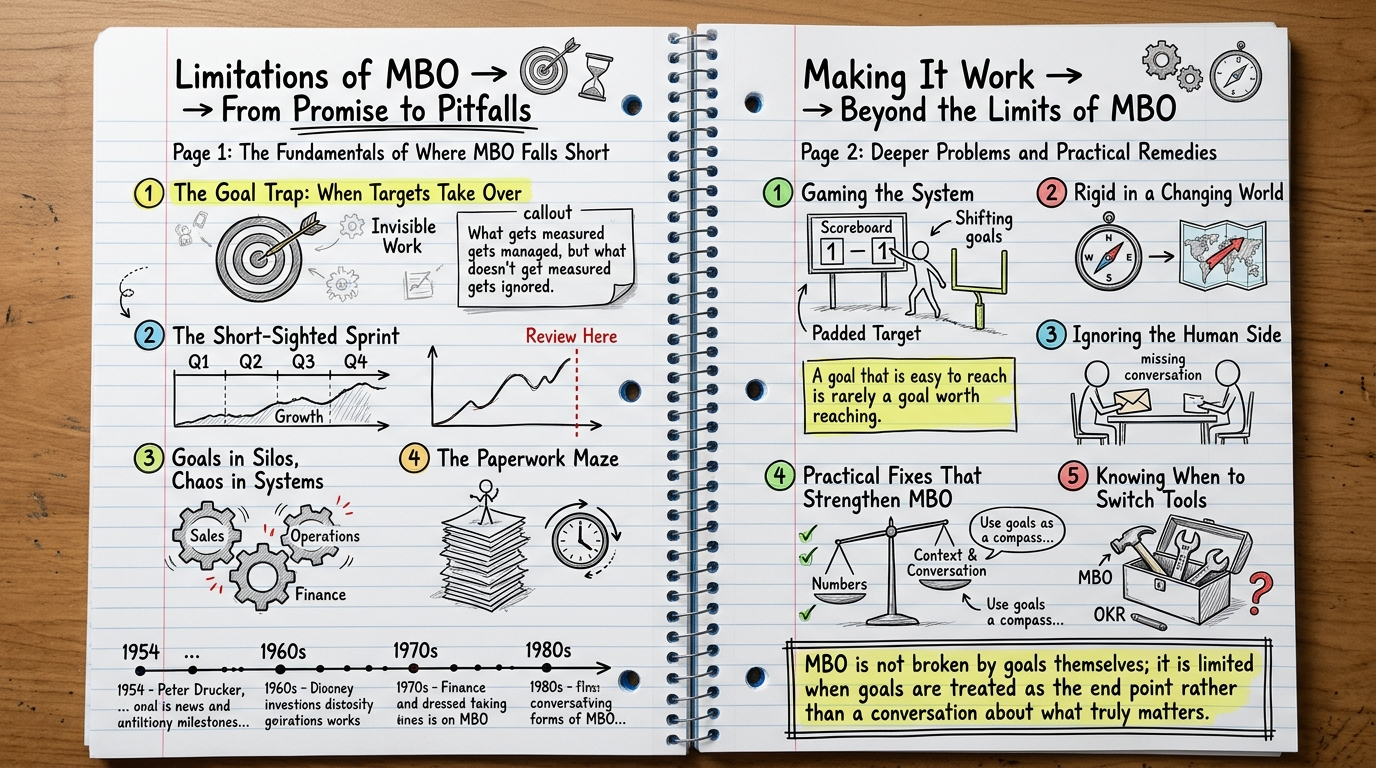
limitaions of mbo
The same content DoodleNotes wrote before drawing it.
Limitations of MBO → From Promise to Pitfalls
- 1
The Goal Trap: When Targets Take Over
Management by Objectives (MBO) ties rewards to measurable goals, but people quickly learn to chase the number rather than the purpose behind it. Employees may focus on hitting targets that are easy to measure while ignoring important work that is hard to quantify, such as mentoring or long-term innovation.
Sticky note: What gets measured gets managed, but what doesn't get measured gets ignored.
- 2
The Short-Sighted Sprint
MBO usually runs on annual or quarterly cycles, which pushes teams toward quick wins. Long-term projects that pay off over several years can look like failures on a yearly scorecard, so people avoid them even when they matter most.
- 3
Goals in Silos, Chaos in Systems
When each department sets its own objectives, those goals can conflict or even work against each other. Sales may push for big promises while operations struggles to deliver them, leaving the organization pulling in several directions at once.
- 4
The Paperwork Maze
Setting, tracking, and reviewing objectives takes significant time and effort. In many organizations, the process becomes a bureaucratic ritual of forms and meetings that consumes energy better spent on actual work.
Timeline: 1954 Peter Drucker introduces MBO in 'The Practice of Management' · 1960s MBO spreads widely across corporations in the US and Europe · 1970s Critics begin pointing out goal displacement and short-term thinking · 1980s Total Quality Management and other approaches challenge MBO's emphasis on individual targets
Making It Work → Beyond the Limits of MBO
- 1
Gaming the System
When rewards depend on hitting numbers, people may set easy targets, inflate their results, or manipulate data. The objective stops being a tool for improvement and becomes a score to beat, which erodes trust between managers and employees.
Sticky note: A goal that is easy to reach is rarely a goal worth reaching.
- 2
Rigid in a Changing World
Objectives are often set months in advance, but markets, technologies, and customer needs can shift quickly. Teams that stick rigidly to outdated targets may keep working hard on the wrong priorities.
- 3
Ignoring the Human Side
MBO assumes that clear targets automatically motivate people, but motivation also depends on autonomy, purpose, and a sense of fairness. When objectives are imposed rather than co-created, employees may feel controlled instead of inspired.
- 4
Practical Fixes That Strengthen MBO
Organizations can reduce these limits by pairing objectives with key results that include qualitative judgment, reviewing goals more frequently, and involving teams in setting targets. Balancing numbers with narrative feedback keeps the focus on genuine progress.
Sticky note: Use goals as a compass for direction, not a whip for pressure.
- 5
Knowing When to Switch Tools
MBO works best in stable, measurable environments with clear outputs. In creative, complex, or fast-changing fields, complementary approaches such as OKRs, balanced scorecards, or agile reviews may serve better.
Bottom insight: MBO is not broken by goals themselves; it is limited when goals are treated as the end point rather than a conversation about what truly matters.
For study only. Check anything you rely on against your textbook.
Studying something else?
Type a topic and get your own hand-drawn page like this one in about 40 seconds.
your turn