Moon phases
Made with DoodleNotes · Oct 21, 2026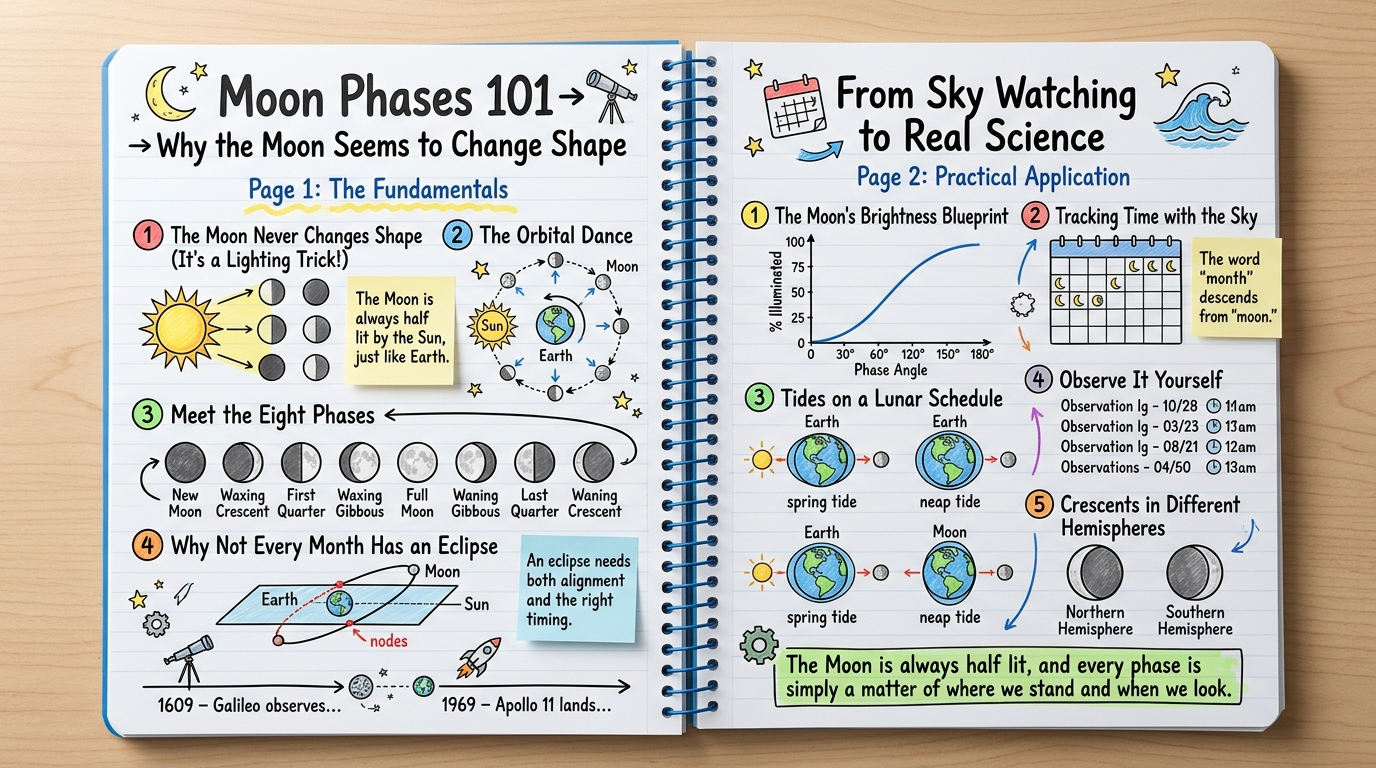
Moon phases
The same content DoodleNotes wrote before drawing it.
Moon Phases 101 → Why the Moon Seems to Change Shape
- 1
The Moon Never Changes Shape (It's a Lighting Trick!)
The Moon is always a sphere, but we only see the part of it that the Sun is lighting up. As the Moon orbits Earth, our view of its sunlit side changes, creating the shapes we call phases. The Moon's full cycle of phases takes about 29.5 days.
Sticky note: The Moon is always half lit by the Sun, just like Earth. We only see the lit part from where we stand.
- 2
The Orbital Dance
The Moon circles Earth roughly once a month while Earth circles the Sun. Because of this motion, the angle between the Sun, Earth, and Moon constantly shifts. That changing angle determines how much of the Moon's bright side faces us.
- 3
Meet the Eight Phases
The cycle moves through eight recognizable stages: New Moon, Waxing Crescent, First Quarter, Waxing Gibbous, Full Moon, Waning Gibbous, Last Quarter, and Waning Crescent. Waxing means the lit portion is growing, while waning means it is shrinking. Each phase lasts several days.
- 4
Why Not Every Month Has an Eclipse
The Moon's orbit is tilted about 5 degrees compared to Earth's orbit around the Sun. Most months, the Moon passes above or below the Sun-Earth line, so no eclipse happens. Eclipses only occur when the alignment is nearly perfect.
Sticky note: An eclipse needs both alignment and the right timing, which is why they are rarer than full moons.
Timeline: 1609 Galileo observes the Moon through a telescope and sees its craters and light-dark boundary · 1969 Apollo 11 astronauts land on the Moon, giving humans a close-up view of its surface lighting
From Sky Watching to Real Science
- 1
The Moon's Brightness Blueprint
The fraction of the Moon that is illuminated can be calculated from the angle between the Sun and Moon as seen from Earth, called the phase angle. A Full Moon has a phase angle near zero, while a New Moon has one near 180 degrees. Astronomers use this relationship to predict brightness for observation planning.
- 2
Tracking Time with the Sky
Ancient cultures used the Moon as a natural calendar, counting months between consecutive New Moons. The word month itself comes from the Moon. Lunar calendars, like the one used for many religious festivals, still follow this rhythm today.
Sticky note: The word 'month' descends from 'moon,' a reminder of how closely our timekeeping is tied to the sky.
- 3
Tides on a Lunar Schedule
The Moon's gravity pulls on Earth's oceans and creates tides. Spring tides, with the highest highs and lowest lows, occur during New and Full Moons when the Sun and Moon line up. Neap tides, with weaker tidal range, happen at the Quarter Moons when they are at right angles.
- 4
Observe It Yourself
You can track moon phases with nothing but your eyes and a notebook. Sketch the Moon each night at the same time and note its shape and position in the sky. Over a month, your sketches will reveal the full cycle and the Moon's gradual shift across the sky.
- 5
Crescents in Different Hemispheres
Observers in the Northern and Southern Hemispheres see the Moon's lit side on opposite sides. In the north, a waxing Moon appears lit on the right, while in the south it appears lit on the left. The phases themselves are identical everywhere, but the orientation flips.
Bottom insight: The Moon is always half lit, and every phase is simply a matter of where we stand and when we look. Once you see that, the sky becomes a living clock.
For study only. Check anything you rely on against your textbook.
Studying something else?
Type a topic and get your own hand-drawn page like this one in about 40 seconds.
your turn