টপোলজি
Made with DoodleNotes · Oct 21, 2026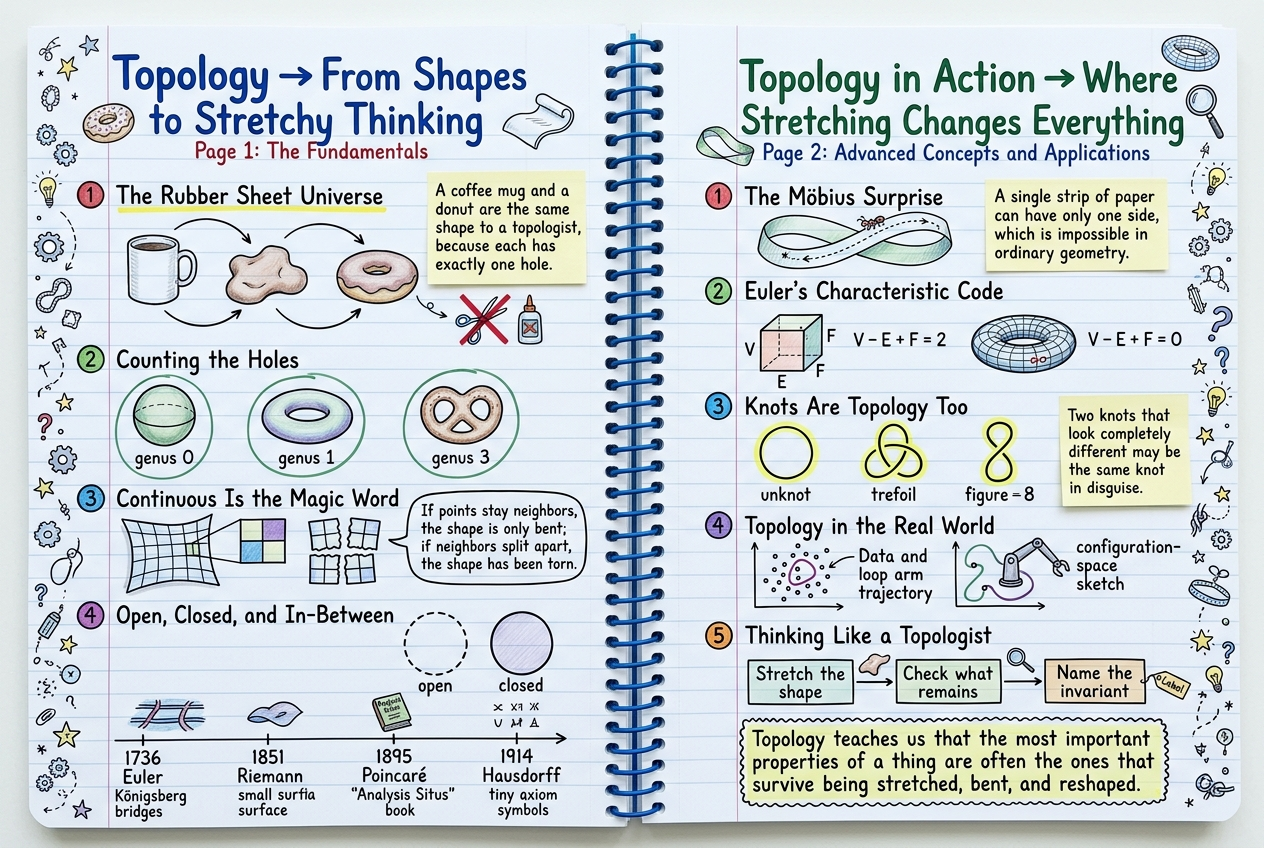
টপোলজি
The same content DoodleNotes wrote before drawing it.
Topology → From Shapes to Stretchy Thinking
- 1
The Rubber Sheet Universe
Topology is the branch of mathematics that studies shapes by what stays the same when you stretch, bend, or twist them without tearing or gluing. Imagine a figure made of rubber: you can reshape it freely, but you cannot cut it or join separate parts. What survives this process is the true essence of the shape. Topology asks: what properties are truly fundamental?
Sticky note: A coffee mug and a donut are the same shape to a topologist, because each has exactly one hole.
- 2
Counting the Holes
One of the simplest topological invariants is the number of holes, formally called the genus. A sphere has genus zero, a donut has genus one, and a pretzel has genus three. Holes cannot be removed by stretching, so this count is a property that survives every continuous transformation. It is the first clue that topology measures structure rather than size or angle.
- 3
Continuous Is the Magic Word
A continuous deformation means points that are close together stay close together after the change. You may stretch a region enormously, but you cannot tear it apart or teleport a point across the space. This single rule of nearness is what defines a topological transformation, and it is the foundation on which every other idea in the subject is built.
Sticky note: If points stay neighbors, the shape is only bent; if neighbors split apart, the shape has been torn.
- 4
Open, Closed, and In-Between
Topology builds its vocabulary from open sets, collections of points surrounding each of their members with some breathing room. A closed set includes its boundary, while an open set does not. These definitions let mathematicians describe space without any measuring tape, relying only on which points are near which others.
Timeline: 1736 Euler solves the Seven Bridges of Königsberg problem, birth of graph topology · 1851 Riemann explores surfaces and connectivity in complex analysis · 1895 Poincaré publishes Analysis Situs, launching algebraic topology · 1914 Hausdorff defines topological spaces with modern axioms
Topology in Action → Where Stretching Changes Everything
- 1
The Möbius Surprise
A Möbius strip is a surface with only one side and one edge, created by giving a strip of paper a half twist before joining its ends. Walking along the surface, you return to your starting point upside down, having covered both faces without crossing an edge. This shows how topology reveals hidden structure that everyday intuition misses entirely.
Sticky note: A single strip of paper can have only one side, which is impossible in ordinary geometry.
- 2
Euler's Characteristic Code
For polyhedra, the quantity vertices minus edges plus faces always equals a fixed number tied to genus: two for a sphere, zero for a torus. This Euler characteristic is an invariant that connects counting with shape. It lets you verify that a surface is topologically a sphere even if it looks wildly irregular.
- 3
Knots Are Topology Too
A mathematical knot is a loop embedded in three-dimensional space that cannot be unknotted by continuous motion without passing through itself. Knot theory, a branch of topology, classifies these loops and uses invariants to tell whether two tangled-looking knots are actually the same. It has practical roles in DNA research, where molecules form knotted structures that affect how they function.
Sticky note: Two knots that look completely different may be the same knot in disguise, revealed only through topological invariants.
- 4
Topology in the Real World
Topological ideas now power data analysis, where persistent homology finds meaningful loops and clusters in large datasets. Robotics uses configuration spaces to plan motion around obstacles, and physicists classify exotic states of matter by their topological properties. These applications show that abstract shapes can guide very concrete decisions.
- 5
Thinking Like a Topologist
Practicing topology means asking what survives change. When you meet a new space, try to find its holes, its connectivity, and the features that stay fixed under stretching. This habit of looking past size and angle to structure is powerful far beyond mathematics, sharpening how you analyze networks, systems, and patterns.
Bottom insight: Topology teaches us that the most important properties of a thing are often the ones that survive being stretched, bent, and reshaped.
For study only. Check anything you rely on against your textbook.
Studying something else?
Type a topic and get your own hand-drawn page like this one in about 40 seconds.
your turn