উচ্চ মাধ্যমিক বইয়ের টপোলজি
Made with DoodleNotes · Oct 21, 2026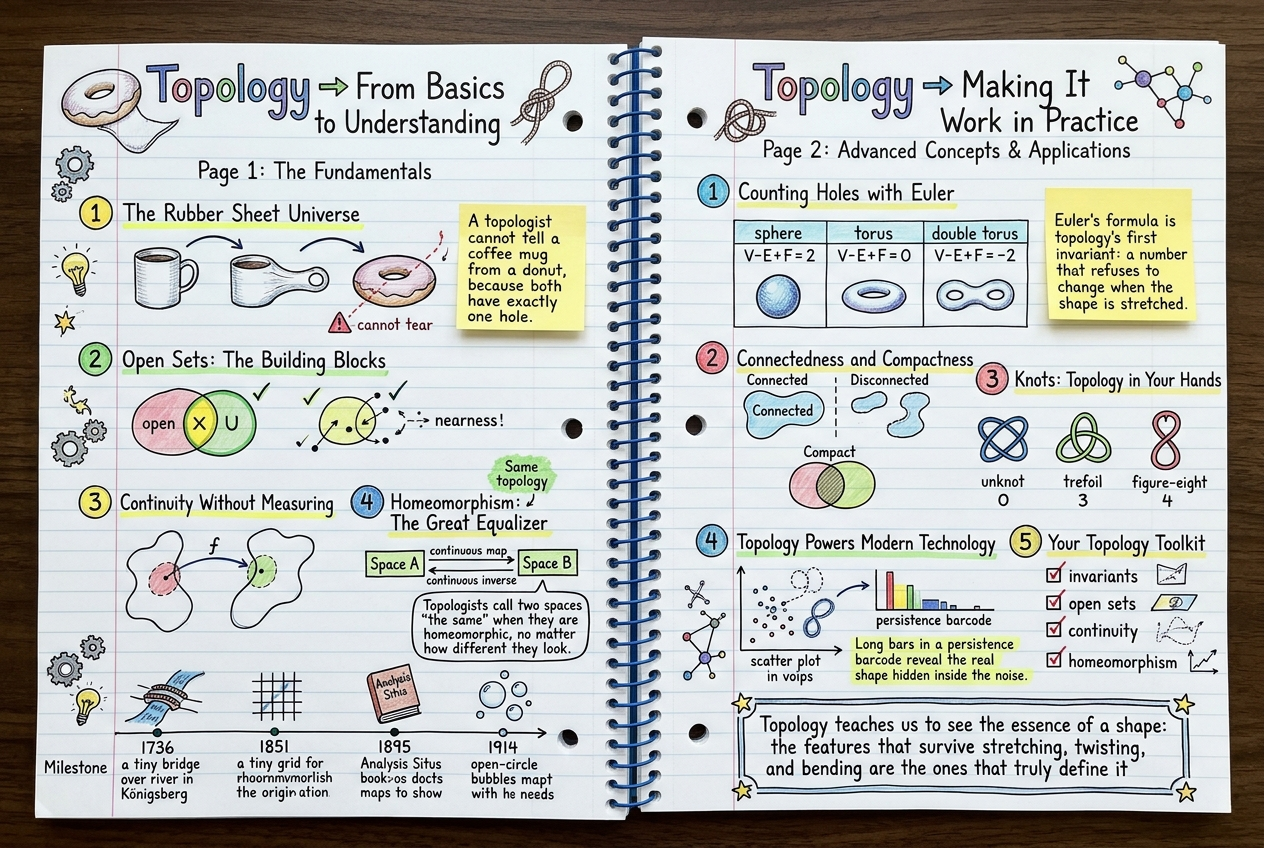
উচ্চ মাধ্যমিক বইয়ের টপোলজি
The same content DoodleNotes wrote before drawing it.
Topology → From Basics to Understanding
- 1
The Rubber Sheet Universe
Topology studies the properties of shapes that remain unchanged when they are stretched, bent, or twisted, but not torn or glued. Think of a space as a flexible rubber sheet: a coffee mug and a donut are topologically the same because one can be smoothly deformed into the other. The study focuses on connectedness, continuity, and the number of holes rather than exact distances or angles.
Sticky note: A topologist cannot tell a coffee mug from a donut, because both have exactly one hole.
- 2
Open Sets: The Building Blocks
A topological space is defined by a collection of open sets that satisfy three simple rules: the empty set and the whole space are open, any union of open sets is open, and any finite intersection of open sets is open. These rules replace the idea of distance with a notion of nearness. Open sets tell us which points are 'neighbors' of each other.
- 3
Continuity Without Measuring
A function between topological spaces is continuous if the preimage of every open set is open. This definition avoids epsilon-delta arguments and captures the intuition that nearby inputs produce nearby outputs. It lets us compare spaces that have no ruler or metric attached to them at all.
- 4
Homeomorphism: The Great Equalizer
Two spaces are called homeomorphic if there is a continuous bijection between them whose inverse is also continuous. Homeomorphic spaces are considered identical in topology, since they share every topological property. Showing two spaces are NOT homeomorphic usually requires finding an invariant, such as the number of holes or connectedness, that differs.
Sticky note: Topologists call two spaces 'the same' when they are homeomorphic, no matter how different they look.
Timeline: 1736 Euler solves the Königsberg bridge problem, an early seed of topology · 1851 Riemann introduces topological ideas in complex function theory · 1895 Poincaré publishes Analysis Situs, founding algebraic topology · 1914 Hausdorff axiomatizes topological spaces with open sets
Topology → Making It Work in Practice
- 1
Counting Holes with Euler
For polyhedra, Euler's characteristic V − E + F equals 2 for any sphere-like surface. This number is a topological invariant, meaning it stays the same under any continuous deformation. A torus gives 0, and a surface with g holes gives 2 − 2g, so the characteristic instantly reveals the shape's hole count.
Sticky note: Euler's formula is topology's first invariant: a number that refuses to change when the shape is stretched.
- 2
Connectedness and Compactness
A space is connected if it cannot be split into two disjoint nonempty open sets, and compact if every open cover has a finite subcover. Compactness generalizes the idea of a closed and bounded region, and it guarantees that continuous functions attain maximum and minimum values. These two properties are among the most important tools for proving results in analysis.
- 3
Knots: Topology in Your Hands
A mathematical knot is a closed loop embedded in three-dimensional space, and two knots are equivalent if one can be deformed into the other without cutting. The trefoil, figure-eight, and unknot are distinct knot types, and invariants like the Jones polynomial distinguish them. Knot theory now helps chemists understand DNA folding and physicists study quantum field theories.
- 4
Topology Powers Modern Technology
Persistent homology, a tool from algebraic topology, extracts shape features from noisy data such as point clouds, sensor readings, or neural activity. It is used to detect patterns in medical imaging, analyze the structure of networks, and study the geometry of high-dimensional datasets. The field has become a bridge between pure mathematics and data science.
Sticky note: Long bars in a persistence barcode reveal the real shape hidden inside the noise.
- 5
Your Topology Toolkit
To work with topology, start by asking what stays the same when a shape is deformed, then look for invariants like connectedness, compactness, or Euler characteristic. Practice identifying open sets and checking continuity through preimages. With these habits, you can approach proofs and real problems by focusing on structure instead of measurement.
Bottom insight: Topology teaches us to see the essence of a shape: the features that survive stretching, twisting, and bending are the ones that truly define it.
For study only. Check anything you rely on against your textbook.
Studying something else?
Type a topic and get your own hand-drawn page like this one in about 40 seconds.
your turn