Quantitative Finance
Made with DoodleNotes · Oct 28, 2026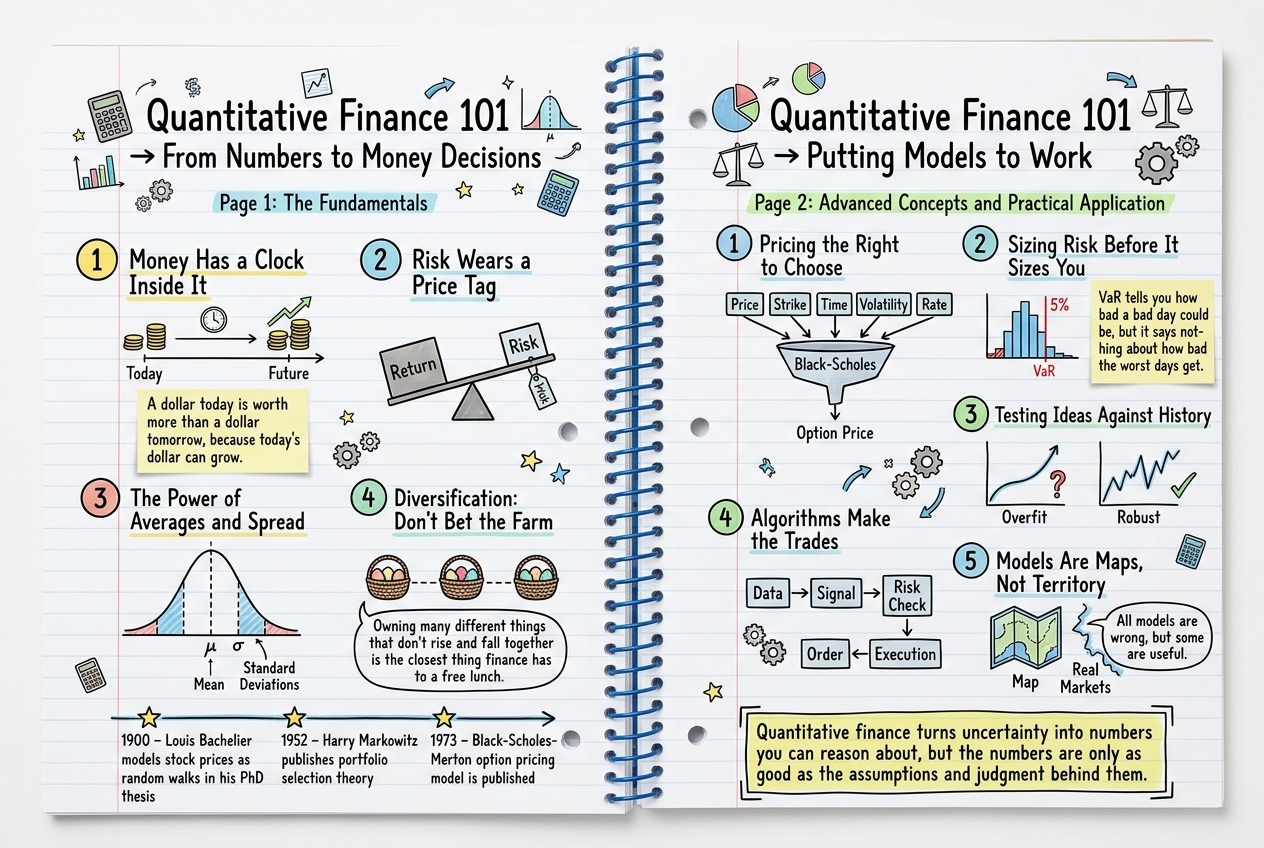
Quantitative Finance
The same content DoodleNotes wrote before drawing it.
Quantitative Finance 101 → From Numbers to Money Decisions
- 1
Money Has a Clock Inside It
Quantitative finance starts with the idea that a dollar today is worth more than a dollar tomorrow. Investors could earn interest by putting money to work, so waiting to receive cash carries a cost. This concept, called the time value of money, is the foundation for pricing almost every financial asset.
Sticky note: A dollar today is worth more than a dollar tomorrow, because today's dollar can grow.
- 2
Risk Wears a Price Tag
Every investment carries uncertainty, and quantitative finance measures that uncertainty with numbers. Volatility, the typical size of price swings, is the most common yardstick. Investors expect higher returns as compensation for taking on more risk.
- 3
The Power of Averages and Spread
Returns are often modeled as random variables, described by their mean (average outcome) and variance (how spread out outcomes are). A bell curve shows how most outcomes cluster near the average, with rare extremes in the tails. These two numbers let analysts compare very different investments on equal footing.
- 4
Diversification: Don't Bet the Farm
Combining assets that do not move in lockstep can reduce overall portfolio risk without necessarily lowering expected return. This is the core idea behind modern portfolio theory, developed by Harry Markowitz. The benefit comes from correlation, which measures how closely two assets move together.
Sticky note: Owning many different things that don't rise and fall together is the closest thing finance has to a free lunch.
Timeline: 1900 Louis Bachelier models stock prices as random walks in his PhD thesis · 1952 Harry Markowitz publishes portfolio selection theory · 1973 Black-Scholes-Merton option pricing model is published
Quantitative Finance 101 → Putting Models to Work
- 1
Pricing the Right to Choose
An option gives its holder the right, but not the obligation, to buy or sell an asset at a set price. The Black-Scholes model calculates a fair price for this right using the asset's price, volatility, time to expiry, and interest rates. It turned option pricing from guesswork into a calculable formula.
- 2
Sizing Risk Before It Sizes You
Value at Risk (VaR) estimates the maximum loss a portfolio is unlikely to exceed over a given period at a chosen confidence level. For example, a 95% one-day VaR of $1 million means losses should exceed that amount only about 5% of days. Banks and regulators rely on it to set capital requirements.
Sticky note: VaR tells you how bad a bad day could be, but it says nothing about how bad the worst days get.
- 3
Testing Ideas Against History
A trading strategy is only useful if it works on data it was not built from. Backtesting runs a strategy on historical prices to see how it would have performed, while out-of-sample testing reserves recent data to check it. Overfitting, where a model memorizes noise instead of signal, is the most common trap.
- 4
Algorithms Make the Trades
Quantitative strategies often translate signals into orders automatically, aiming to execute trades quickly and at low cost. Transaction costs, slippage, and market impact can erase a strategy's profits if ignored. Good quant work accounts for these frictions from the start.
- 5
Models Are Maps, Not Territory
Every model simplifies reality and rests on assumptions, such as normally distributed returns, that can fail during crises. Quantitative finance works best when paired with judgment about what a model cannot capture. Knowing a model's limits is as important as knowing its formulas.
Sticky note: All models are wrong, but some are useful.
Bottom insight: Quantitative finance turns uncertainty into numbers you can reason about, but the numbers are only as good as the assumptions and judgment behind them.
For study only. Check anything you rely on against your textbook.
Studying something else?
Type a topic and get your own hand-drawn page like this one in about 40 seconds.
your turn