Structural organization of the body, including tissue types, organ systems, jobs that organ systems do, and elements needed for life.
Made with DoodleNotes · Oct 27, 2026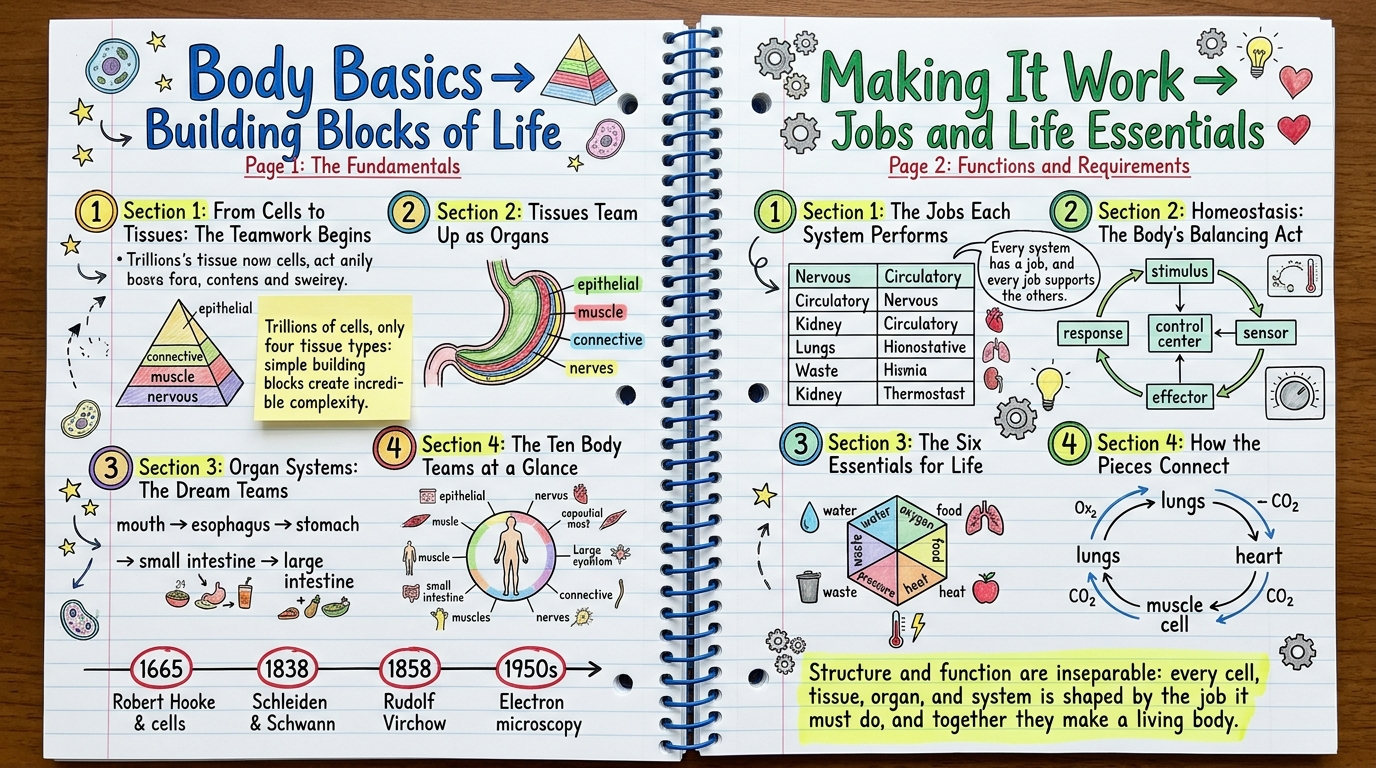
Structural organization of the body, including tissue types, organ systems, jobs that organ systems do, and elements needed for life.
The same content DoodleNotes wrote before drawing it.
Body Basics → Building Blocks of Life
- 1
From Cells to Tissues: The Teamwork Begins
Your body is built from trillions of cells, but cells rarely work alone. Cells with a shared structure and job group together to form tissues. The body has four main tissue types: epithelial (covering and protection), connective (support and connection), muscle (movement), and nervous (communication).
Sticky note: Trillions of cells, only four tissue types: simple building blocks create incredible complexity.
- 2
Tissues Team Up as Organs
When two or more tissue types work together on a specific job, they form an organ. Your stomach, for example, uses muscle tissue to churn food, epithelial tissue to line and protect its walls, and nervous tissue to coordinate timing. Organs are the specialized workshops of the body.
- 3
Organ Systems: The Dream Teams
Organs that cooperate toward a shared goal form an organ system. The digestive system, for instance, includes the mouth, esophagus, stomach, intestines, and liver. Each organ contributes a piece to one big mission: turning food into usable energy and nutrients.
- 4
The Ten Body Teams at a Glance
Humans have around eleven major organ systems, including the integumentary, skeletal, muscular, nervous, endocrine, cardiovascular, lymphatic, respiratory, digestive, urinary, and reproductive systems. Each one has a distinct role, yet all of them depend on each other to keep the body running.
Timeline: 1665 Robert Hooke observes cells in cork and coins the term 'cell' · 1838 Schleiden and Schwann propose that all living things are made of cells · 1858 Rudolf Virchow states that every cell arises from a pre-existing cell · 1950s Electron microscopy reveals the detailed structures inside cells and tissues
Making It Work → Jobs and Life Essentials
- 1
The Jobs Each System Performs
Every organ system exists to perform essential jobs. The cardiovascular system transports oxygen and nutrients, the respiratory system exchanges gases, the urinary system filters waste, and the endocrine system sends chemical messengers. Together these jobs maintain the body's internal stability.
Sticky note: Every system has a job, and every job supports the others.
- 2
Homeostasis: The Body's Balancing Act
Systems constantly work to keep conditions stable, a process called homeostasis. Body temperature, blood sugar, and pH are kept within narrow ranges. When something drifts, feedback loops respond to bring it back, much like a thermostat turning on the heat.
- 3
The Six Essentials for Life
Life requires a set of basic elements and conditions: water, oxygen, nutrients (carbohydrates, proteins, fats, vitamins, minerals), a suitable temperature, and waste removal. Without any one of these, the organ systems cannot sustain the cells they serve.
Sticky note: Organ systems exist to keep cells supplied with what they need to live.
- 4
How the Pieces Connect
Consider a single breath: lungs take in oxygen, the cardiovascular system carries it to muscle cells, and cells release carbon dioxide that the lungs exhale. This chain shows how tissues, organs, and systems interlock to support every living cell.
Bottom insight: Structure and function are inseparable: every cell, tissue, organ, and system is shaped by the job it must do, and together they make a living body.
For study only. Check anything you rely on against your textbook.
Studying something else?
Type a topic and get your own hand-drawn page like this one in about 40 seconds.
your turn