The War in Kosovo
Made with DoodleNotes · Oct 24, 2026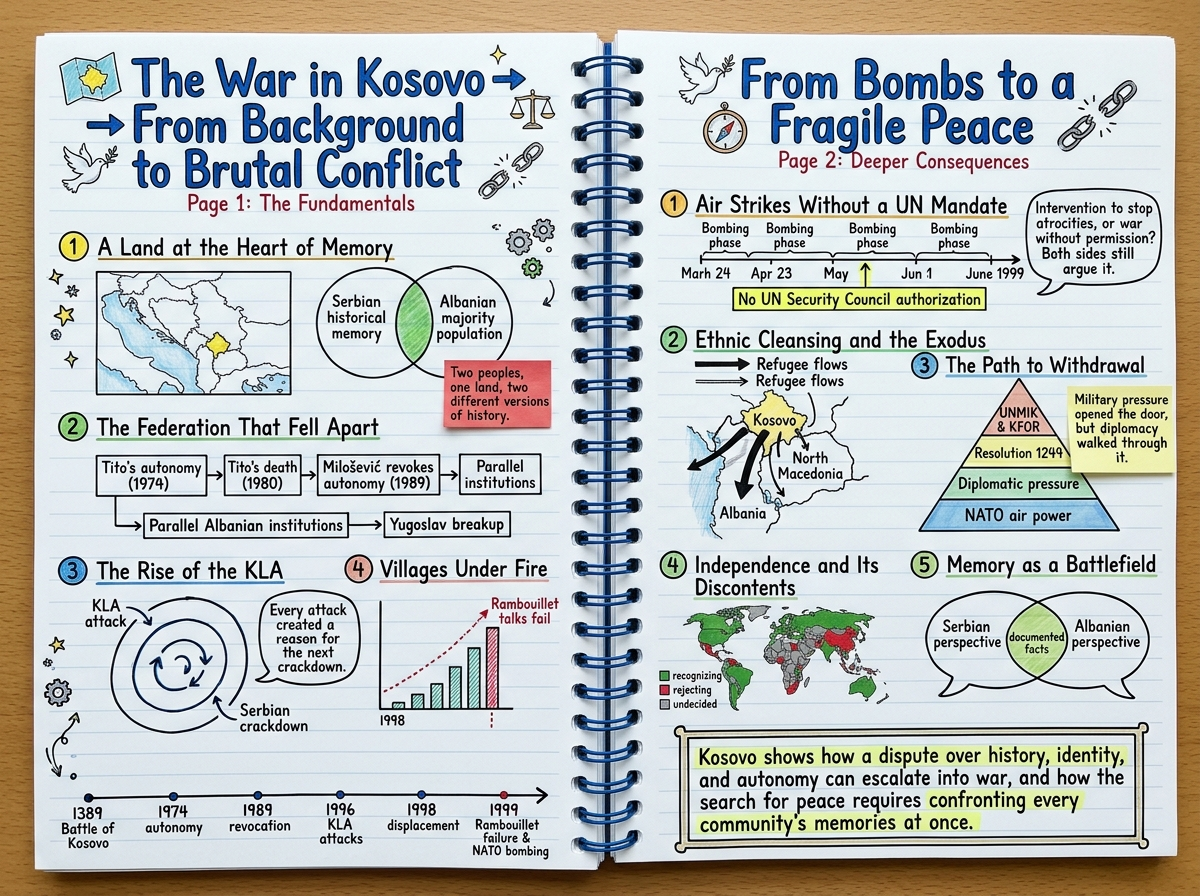
The War in Kosovo
The same content DoodleNotes wrote before drawing it.
The War in Kosovo → From Background to Brutal Conflict
- 1
A Land at the Heart of Memory
Kosovo is a region in the Balkans whose identity is deeply tied to medieval history, especially the 1389 Battle of Kosovo, which Serbs remember as a foundational national myth. By the late 20th century, the region had a population that was overwhelmingly ethnic Albanian, while Serbia regarded it as the historic heartland of the Serbian nation. This clash between demographic reality and historical memory became the core tension of the conflict.
Sticky note: Two peoples, one land, two different versions of history.
- 2
The Federation That Fell Apart
Under Tito's Yugoslavia, Kosovo held the status of an autonomous province within Serbia, with significant self-governance. After Tito's death in 1980 and the rise of Slobodan Milošević, that autonomy was steadily stripped away in 1989 and beyond. Albanians responded by building parallel institutions, schools, and a shadow state, while the wider federation was disintegrating along republic lines.
- 3
The Rise of the KLA
Frustrated by years of nonviolent resistance that had failed to win concessions, a militant group called the Kosovo Liberation Army (KLA) began armed attacks on Serbian police and officials in the mid-1990s. The KLA was funded partly through diaspora donations and criminal networks, and its attacks provoked increasingly harsh counterinsurgency operations by Serbian security forces. Each cycle of violence fed the next.
Sticky note: Every attack created a reason for the next crackdown.
- 4
Villages Under Fire
By 1998, fighting had displaced tens of thousands of civilians, many of them ethnic Albanians fleeing villages during Serbian offensives. The international community grew alarmed as reports of massacres, including the Drenica region operations, circulated widely. Diplomatic efforts such as the Rambouillet talks in early 1999 failed to produce a settlement acceptable to both sides.
Timeline: 1389 Battle of Kosovo, central to Serbian national memory · 1974 Kosovo gains autonomy within Yugoslavia · 1989 Milošević revokes Kosovo's autonomy · 1996 KLA begins armed attacks on Serbian targets · 1998 Serbian offensives displace tens of thousands · 1999 Rambouillet talks fail; NATO bombing begins
From Bombs to a Fragile Peace
- 1
Air Strikes Without a UN Mandate
In March 1999, NATO launched an air campaign against Yugoslavia without authorization from the UN Security Council, arguing that a humanitarian catastrophe was unfolding. The bombing lasted about 78 days and targeted military, infrastructure, and some civilian sites. The legality and morality of the intervention remain intensely debated among scholars and policymakers.
Sticky note: Intervention to stop atrocities, or war without permission? Both sides still argue it.
- 2
Ethnic Cleansing and the Exodus
As NATO bombed, Serbian forces expelled hundreds of thousands of ethnic Albanians from Kosovo, with many forced across borders into Albania and North Macedonia. Massacres such as those at Račak and Đakovica were documented, and mass graves were later discovered. The scale of displacement became one of the defining humanitarian crises in Europe since World War II.
- 3
The Path to Withdrawal
Under sustained air pressure and diplomatic isolation, Milošević agreed in June 1999 to withdraw Serbian forces. UN Security Council Resolution 1244 placed Kosovo under interim UN administration while formally keeping it within Yugoslavia. KFOR, a NATO-led peacekeeping force, deployed to maintain security, and the UN mission took on civil governance.
Sticky note: Military pressure opened the door, but diplomacy walked through it.
- 4
Independence and Its Discontents
In February 2008, Kosovo declared independence from Serbia, a move recognized by a majority of UN member states but rejected by Serbia, Russia, and several others. The unresolved status shapes ongoing negotiations, EU-facilitated dialogue, and regional politics. Questions about minority rights, missing persons, and reconciliation remain central to building lasting peace.
- 5
Memory as a Battlefield
Competing narratives about who was the aggressor and who was the victim continue to shape politics, education, and identity in the region. Understanding Kosovo requires holding together the real suffering of both Albanian and Serbian communities, as well as the wider geopolitical forces that shaped the conflict.
Bottom insight: Kosovo shows how a dispute over history, identity, and autonomy can escalate into war, and how the search for peace requires confronting every community's memories at once.
For study only. Check anything you rely on against your textbook.
Studying something else?
Type a topic and get your own hand-drawn page like this one in about 40 seconds.
your turn